Category: News

  • Moroccan Lady Cause of Thomas Partey’s Revert To Islam?  

    Moroccan Lady Cause of Thomas Partey’s Revert To Islam?  

    Adnan Adams Mohammed

    Ghana and Arsenal midfielder, Thomas Teye Partey has reportedly converted to Islam after months of studying the religion at his base in England.

    The 28-year-old is yet to confirm his switch in religions, but reports widespread on social media have stated he is now a Muslim.  

    Being a Christian since infancy, it surprises what had caused his decision. Although there hasn’t been an official statement released to the public about the footballer’s sudden decision to change his religion to Islam,

    “..but information gathered also disclosed Partey is dating a Moroccan lady, who could be behind his decision to convert”, Sportsbrief has reported.

    Also, others are speculating that, Partey’s move from the Spanish League to the Premier League might have influenced his decision to switch his religion.

    England is well known to have a huge number of Islamic believers and since he will be playing for Arsenal, Thomas might have found it appropriate to change his religion.

    As a reminder, Thomas Partey has signed a 5 year deal of £52,000,000 contract with the Arsenal F.C. The deal includes an annual average salary of £10,400,000.

    See the post below:

  • Lack of quorum in Parliament hangs two loan agreement depending approval

    Lack of quorum in Parliament hangs two loan agreement depending approval

    Lack of quorum in Parliament for the second time in seven days has resulted in delay for approval of two major loan agreements within two weeks.

    In the first instance, the House failed to approve a €38 million loan agreement meant for the construction of three 40-bed capacity district hospitals due to lack of quorum on Thursday, March 10, 2022.

    The failure to approve the agreement between the government of Ghana and the Deutsche Bank of Frankfurt came after the National Democratic Congress (NDC) MP for Tamale Central, Mr Ibrahim Murtala Muhammed, raised an objection on lack of quorum.

    He had made an application to the First Deputy Speaker of Parliament, Mr Joseph Osei-Owusu, who was presiding, that the House did not have a quorum and therefore proceedings should be adjourned.

    At today’s sitting, which was presided over by the Second Deputy Speaker, Mr Andrew Asiamah Amoako, the House also failed to approve a €20 million agreement between the government of Ghana and the German Development Bank Group, Frankfurt.

    Objective of loan

    The amount is to finance the Green Credit Line under the Reform and Investment Partnership between the government of Ghana and the Federal Republic of Germany.

    The loan, which seeks to expand Ghana’s access to renewable energy, among others, is part of the G20 Compact with Africa and will be repaid in 32 years at an interest rate of 12 percent with a grant element of 53.2 percent.

    The overall objective of the project is to achieve the national target of reducing greenhouse gas emissions by 15 percent by 2030 and achieving a renewable energy (RE) share of 10 percent of the total energy mix (excluding hydroelectric power plants).

    The project will also contribute to the development of a sustainable green finance market as one of the preconditions for promoting RE and energy efficiency market in Ghana.

    Why no approval?

    The inability of the House to endorse the agreement came after the Minority raised an objection on the lack of quorum due to the limited number of members in the House.

    The objection came soon after the Chairman of the Finance Committee, Mr Kwaku Kwarteng, had presented the committee’s report on the facility and moved the motion for the House to approve the agreement.

    The Minority Chief Whip, Mr Mohammed-Mubarak Muntaka, raised objection on the lack of quorum and suggested that the Speaker caused the bell to be rung for 10 minutes to draw members from both sides of the House into the Chamber.

    “If quorums are raised, you cannot negotiate them out,” he said, and after a while suggested that the loan approval be deferred for both sides of the House to mobilize their members on Friday.

    “Believe me that any attempt to carry on would create problems for all of us. I agree that this is a grant that is coming to us as a country at almost free of charge,” the MP for Asawase stated.

    Let’s compromise

    Reacting, the Majority Chief Whip, Mr Frank Annoh-Dompreh, informed the House that prior to the commencement of business in the House today, the leadership engaged in extensive consultation for the motion on the agreement to be moved and passed.

    While he however agreed that the bell be rung, he urged the House to look at the agreement from the perspective that it would improve Ghana’s renewable energy mix aspirations.

    “We are masters of our own rules, and I only want to plead with my colleagues that a motion has been moved; let’s wait for it to be second and then we can debate it.

    “It is very important that we deal with this matter as it cannot be shelved. I am not contesting the issues raised; you are right and I am just pleading that we let go and get this thing passed,” he said.

    He added that the agreement was time-dependent and it was important that the House got it passed.

    “Please, do not forget that there are very important fiscal variables in this agreement and partners who are waiting on this agreement to be passed as it is almost like a grant.”

    He was of the view that the overdependence on the national grid by public institutions such as educational institutions could be weaned off with the implementation of the project, with the national grid focused on supporting industries.

    He, therefore, urged the House to support the loan approval.

    Later, Mr Annoh-Dompreh conceded that while it was quite regrettable for an objection to be raised on the lack of quorum, “I would accede to the request by the colleague Muntaka that you do not put a question on the motion and we take it tomorrow.”

  • ‘It’s a matter of being fiscally disciplined and not E-Levy versus IMF’ – finance expert to gov’t

    ‘It’s a matter of being fiscally disciplined and not E-Levy versus IMF’ – finance expert to gov’t

    Adnan Adams Mohammed

    A finance expert has rubbish the government obsession and justification for the implementation of the Electronic Transaction Levy (E-Levy) to save the economy.

    The experts says, it is a matter of the government being disciplined with it’s expenditure. Although, some economists and financial analysts have advised the government to go to the International Monetary Fund (IMF) for a bailout to restore credibility to the economy and debt sustainability, the government have proofed adamant.

    In a latest twist, www.newsguideafrica.com has picked that, government is expected to hold a crunch cabinet meeting to find solutions to the raging economic challenges. Among other things, the meeting is expected to take place at the Peduase Lodge, from Thursday, March 17, to Sunday, March 20, 2022, is to discuss whether the government force E-Levy on the citizens or seek bailout from IMF. But, the finance expert disagree with the government posturing.

    “It’s not between IMF and e-Levy ohhhh”, former executive director at Standard Chartered Bank, Alex Mould has insisted in a quick response to a teaser of the crunch meeting on Gabby Okyere Darko’s Twitter account. “It is between being disciplined and doing the right thing versus rampant spending on foolish political manifesto promises that only result in state capture.”

    The crunch meeting will be chaired by President Akufo-Addo, together with all NPP MPs, ministers, government appointees, and the governing New Patriotic Party (NPP) leadership.

    According to JoyNews’ sources, the meeting will discuss whether government should continue to push through with the E-levy Bill or resort to the International Monetary Fund (IMF), in the face of the current fiscal hurdles.

    Confirming the retreat on Joy FM’s Midday News on Thursday, the source further said the meeting will discuss other pertinent issues relating to the country’s development.

    In a tweet on Thursday, a leading member of the ruling New Patriotic Party, Gabby Otchere-Darko also indicated that given the current deadlock on the controversial E-Levy Bill, there’s the need for a ‘national debate’ on the way forward.

    “2022 began without the usual $3 billion injections of Eurobond cash. Govt’s post-COVID recovery GhanaCARES programme hinged partly on an E-levy which Parliament may not even OK.

    “There should be a national debate: do we want IMF or E-Levy or both or none? Tough decisions confront Ghana”, he tweeted.

    Meanwhile, an Economist and former Board Chairman of the Ghana Revenue Authority (GRA), Professor Stephen Adei has refuted claims that Ghana’s economy is on the verge of collapse.

    Speaking in an interview on JoyNews’ Upfront, he said the economy is not collapsing but “we are in difficult times.”

    According to him, the country’s economy is stronger “than the word broke.”

    His comment comes after an economist with the University of Ghana Business School (UGBS), Prof. Godfred Alufar Bokpin, warned of possible collapse of Ghana’s economy.

    Speaking on the Super Morning Show, Prof. Bokpin reiterated that as the country’s debt stock hits high distress levels, the current debt situation could get worse by the end of September if proper interventions are not implemented.

    Ghana’s current public debt stock stands at a staggering ¢341.8 billion with a corresponding debt to GDP ratio of more than 77% as of September ending 2021.

    This means if the country should share this amount across the country’s 30.8 million population, everyone will owe approximately ¢11,000.

    In terms of interest payments on our borrowings, Ghana has spent on average 147 billion Ghana cedis, which is 47 billion Ghana cedis more than our projected revenue plus grants for 2022.

    In the first quarter of 2022, government has indicated that it will borrow a total of ¢24.5 billion from the domestic market of which ¢20.7 billion will be used to service existing debt in the local market, leaving government with just ¢3.8 billion to finance other expenses.

    Commenting on the country’s debt stock, Prof Adei proposed that the country’s expenditure be reduced.

    “If you are exceeding your income, then you must accept to live below your income, which is the easy way, otherwise if you are earning ¢3,000 and you are in debt of ¢10,000 you cannot day to day spend ¢3,000.

    For you to get out of the rag you will have to cut your expenditure to ¢2,000 because you must service your debt. So we are in that situation as a country,” he said.

    He explained that although cutting expenditure might be difficult for the government, especially nearing an election period, that is the right way to go.  

    “… And they [government] must thank God that this crisis has come now and not 2023, because if they don’t go for the hard one now, which normally will take about 18 months to go over this type of hunch, then they have a good chance by the middle of 2023 to see some good results in 2024.

    If not, things would get worse and they want to prevent being thrown out of government, they would be thrown out anyway,” he said.

  • UEFA Champions League: Villarreal humiliate Juventus to reach UCL quarters

    UEFA Champions League: Villarreal humiliate Juventus to reach UCL quarters

    Villarreal reached the quarterfinals of the Champions League on Wednesday after humiliating Juventus 3-0 in Turin to go through 4-1 on aggregate.

    Penalties from Gerard Moreno and Arnaut Danjuma and Pau Torres’s tap-in in the final quarter of an hour were enough for Unai Emery’s well-organised side to see off the Italians at the Allianz Stadium and make Friday’s last-eight draw.

    Villarreal stunned Juve with three sucker punches after spending most of the match on the back foot, content to hold off the hosts’ attacks which got less potent as the match wore on.

    An embarrassing defeat was just Juve’s second since the end of November and punctures a dogged run of form which has put them back into the league title race at home.

    They were loudly booed off by the home crowd who watched their team shrink from a promising start and bounce off a yellow wall before being bundled out of the competition.

    Italy are now without a single representative in this season’s Champions League as it moves into its latter stages.

  • Use $550mn crude oil sales windfall to cushion consumers – Energy expert to gov’t

    Use $550mn crude oil sales windfall to cushion consumers – Energy expert to gov’t

    An energy expert has projected that Ghana will earn an additional $550million from crude oil sales.

    This is aside the government’s expected $1billion revenue from Ghana’s crude oil sales.

    According to him, this unexpected windfall could go a long way to help government cushion consumers from sharp price hikes that have characterized the cost of fuel at the pumps in the past months.

    “It will be prudent of government to cease worrying about revenue losses as it plans to reduce levies on petroleum products and instead look at the extra revenue it will make from oil sales, royalties and taxes from oil companies”, Former Ghana National Petroleum Corporation boss, Alex Mould urged during a TV program yesterday.

    “Because our benchmark price was about $61 or something like that and the average price that is projected by all the research companies in the world is showing that our crude oil price is going to be no less than $85 for the full year.

    “For the first quarter we’re going to look at something above $100, the second quarter it will drop to about $90, and for the rest of the year it will be in the $80s. So the average for the year is going to be about $85 to $90.

    “So if you look at the windfall, and we should understand that government will be getting windfall, because government has only budgeted for $61 and so my calculation based on that shows us that based on 59 million barrels of crude oil, Ghana gets about 20% of the total crude oil and it is split between royalties and also something we call the CAPI. And CAPI is basically the Carried and Participatory Interest and then we have taxes,” he said.

    “We’re looking at an increase in royalties from this $20 increase for about $68million with regards to our equity contribution we are looking at about $250million and with regards to taxes, this is from the windfall that will come, we’ll derive to be partners because of the Tullows, the ENIs we’re looking at about $235million.

    “So in all we’re looking at windfall of almost $550million coming the way of government. And this is something government should look at critically if government wants to use part of that to subsidise the price for the consumer,” he added.

  • Fuel price spikes restricting ‘freedom of movement’ – Kwesi Pratt

    Fuel price spikes restricting ‘freedom of movement’ – Kwesi Pratt

    The Managing Editor of the Insight Newspaper, Kwesi Pratt Jnr, has asserted that some significant sections of Ghanaians have begun reducing their daily movements due to the high cost of fuel in the country.

    Although there are global challenges impacting the prices of petroleum products and commodities, Mr Pratt wants the government to fast-track intervention processes that will cushion customers against the hardships induced by the unexpected increase in fuel prices.

    He blamed the current development on what he describes as the “continuous propaganda” by the government and its officials.

    “I can tell you that people have begun to restrict their mobility because of the high fuel prices. We are here because of our continuous propaganda.

    “It is true that we are experiencing some global challenges but the government can meet the Ghanaian consumer half way by stabilising the cedi and reducing or removing some of the taxes on the petroleum products. This will reduce the price here,” he said.

    In an interview on Accra-based Metropolitan Television, the media professional added that the hikes in fuel prices have already impacted negatively on the cost of living of consumers and households.

    Fuel prices at the various pumps are expected to hit ¢11 per litre from Wednesday, March 16 nationwide.

    The Bulk Oil Distributors has blamed the situation on the volatility on the market as well as the rising cost of crude on the international market.

    JoyNews/AdomNews · Fuel prices to hit ¢11 per litre from Wednesday, March 16

    According to the Chief Executive, Senyo Hosi, the cedi which is depreciating among other major trading currencies is also a factor for the rise in the price of the commodities.

    “This is not really with crude but with products on a metric tonne basis. You’re actually breaking the pair and likely breaking 11 as well, subject to which product and how the OMCs want to add some margins on their current prices.

    “What you see from the OMCs publication is quite reflective of what the market situation is and I think a big chunk of it has to do with some of the onset increase around our current cedi issues,” he said.

    Meanwhile, the Institute for Energy Security (IES) says the situation has contributed to the inflationary pressures hitting businesses in the country.

    According to the IES, if government fails to intervene, the price of petrol and diesel will soon move to at the very least ¢10.00 per litre.

    Citing examples like Egypt, Kenya, Togo and South Africa, the IES said these countries have found ways to manage the key determinants of domestic fuel prices through government subsidies on fuels, so citizens and businesses are not badly hit.

    Fuel prices gone up 27% since January 1, 2022

    A monitoring report from IES Research Analysts showed that fuel prices at the pumps have already incurred a net increase of ¢1.8 per liter (27%t) for both petrol and diesel, since the start of the year, and for five consecutive Pricing-windows.

    Referenced to March 2021, the report also revealed that the price of both petrol and diesel have surged by roughly ¢3.33 per litre, suggesting a 65% increment.

    While petrol cost per litre in Ghana has surged by about some 65% between March 2021 and March 2022, Kenya, South Africa, and Egypt have recorded price jumps of approximately 14%, 34%, and 26% respectively, within same period.

    The IES said the differences in prices across the listed countries are due to the interventions of respective governments to the rising international oil prices, and the extent to which local currencies are managed against the US dollar.

    Since the beginning of the year, prices of petrol and diesel have gone up by more than ¢3 per litre.

  • Russia in Ukraine: what you need to understand

    Russia in Ukraine: what you need to understand

    By Andani Umf

    I see so many people reflexively proffer vituperative condemnation of Putin and Russia on this momentous occasion of Russian military incursion into Ukraine. On one hand I understand the urge but on another I see the ignorance and the huge unsaid assumptions behind this posture. 

    A little bit of history.

    In international politics, we have what we call polarity or in layman’s terms international power and politics. In short, a multipolar world is where we have multiple fairly matched global and regional powers. At the end of the second world war, the world was generally accepted to be a multipolar (some will say bipolar) world where the USA and USSR (now Russia) were equitably matched. This allowed for the eastern block led by the USSR and the western block led by the  USA. Vying and posturing for influence and new members to be added to their block between the USA and USSRA was what we ended up calling the Cold War. The USSR formed the Warsaw Pact while the Americans formed NATO. Suffice to say that the USA won that cold war and the USSR collapsed. 

    But before this collapse and after the collapse, there have been multiple treaties and agreements between the United States and Russia regarding expanding too close to each other’s borders and causing a significant security threat. These overtures got into full swing after the world nearly saw a nuclear war after America threatened to bomb Cuba because Russia stationed nuclear weapons in Cuba. So the understanding between the USA and Russia has been that they will not militarily expand too close to each other and destroy the other’s security blanket. 

    Unfortunately, most analysts in the 1990s believed that Russia was no longer a credible global power and was merely a regional power like China. So the world was now a unipolar world with America the sole hegimon. And it appears the Americans believed the same given their posturing with NATO expansion. They did have a great deal of reasons to believe so. After the Soviet Union collapsed, small states emerged from it and left the successor state to the union, Russia, barely a threat to the western alliance! It wasn’t helped by successive weak and corrupt leadership in Moscow. 

    Things started  to change after Vladimir Putin, a KGB (Russia’s version of the CIA) agent took over the country. Now, agreements between the USA and Russia stipulated that NATO will not expand into the Russians’ backyard too much. But given weak leadership and economic troubles in Russia, NATO crept ever close to Moscow with multiple NATO member states now bordering Russia or one small country away from the Russian heartland. 

    Putin has always reminded the United States of their previous promises not to creep too close with NATO expansion. But the Americans always play the ground game where they ensure that realities change on the ground and then shift the parameters of the negotiations to reflect those new realities. They simply encourage countries to join behind the scenes and when these countries supposedly independently vote to join NATO, the Americans tell Russia that they can’t compel countries (wanting to ensure their security) not to join NATO of their own volition. But as Putin put it, you cannot get your security at the expense of another, especially not a world power armed with nuclear weapons. It seems like the Americans forget or act oblivious to this fact regarding Russian worries about NATO expansion. 

    Now, Putin always said that the Americans don’t take Russian red lines seriously because the Russians always held back and have not acted with the hysteria America acted with when Russia placed nuclear weapons on Cuban soil. So Putin has been warning America to stop the expansion to deaf ears. So he had to act or be continually encircled. That is suicide.

    This is a do or die situation for Russia as a super power. You and I may buy the American line of “every country has freedom to choose NATO” but that is not how geopolitics work in the great power powerplay. America is still punishing Cuba for daring to allow Russia to station nuclear weapons near its borders. No world power comes anywhere near North or Central America. The Americans call it their backyard and no one dares encroach. But of course they do not think that Russia, who they consider a regional power, deserves the same. 

    Russia is extremely vulnerable right now. Why? Over 80% of the Russian population lives near Moscow in the south western part of Russia. The terrain or environment is what we call an open plain.  It will be easy to attack Moscow with conventional weapons like the Nazis did in World War II. That was part of the reason the Soviets occupied much of Eastern Europe all the way to Germany to prevent their homeland being so open for easy attack again.

    Now NATO has all but taken over much of the open plains making it easy to cripple Russia militarily if they so choose. No super power will allow that. And Ukraine poses an even bigger threat than that. The current Ukrainian border is less than 600km to Moscow. Allowing it to join NATO means that NATO will be within a few minutes striking distance from Russia’s capital. No super power can accept that. America will never accept that. Heck, they threatened nuclear war if Russia didn’t remove the nuclear weapons in Cuba. And Putin thinks Russia cannot accept that either. 

    Obviously, I am biased towards the Americans. America is like a second country to me. All my friends and some family are there. So I instinctively hope America gets its way but getting its way doesn’t always mean that they are right. In fact, Putin has stayed his hand too long. If America was in his shoes, it would do more. Because in a multipolar world (at least if Russia perceives it that way), nothing is more important to a global power than ensuring its security.

    As for the shouts, screeching, and feigned outrage about international law, any serious minded person will throw it into the rubbish dump where it deserves to be. Super powers don’t respect international law. Russia doesn’t. China doesn’t. And the USA certainly have never respected international law in their multiple military escapades abroad!

  • Agric Minister Should Not Downplay the Living Experiences of Farmers and Ghanaians – Associations

    Agric Minister Should Not Downplay the Living Experiences of Farmers and Ghanaians – Associations

    The Peasant Farmers Association of Ghana (PFAG), Chamber of Agribusiness Ghana (CAG), the General Agricultural Workers Union (GAWU), the Rice Millers Association of Ghana (RMAG), and Food Sovereignty Ghana (FSG) are appalled and disappointed by comments and responses by the Minister of Food and Agriculture, Dr. Owusu Afriyie Akoto, during an interview on the Citi Breakfast Show on Wednesday 16th March 2022.

    In the said interview, the Minister responded to questions relating to his performance as the sector Minister over the past five years. Needless to say that, despite broad efforts by the government to address constraints in the sector through consistent engagement of sector actors, the responses of the Minister for the most part were not only evasive and unaccountable, but clearly demonstrated high levels of intolerance, and an outright disrespect to the living experiences of farmers and other actors in the sector.

    It is this approach to policy making in the sector which has largely negated any serious results (if possible) from major interventions in the sector over the past five years and frankly not necessary in a sector as critical as agriculture with several stakeholders.

    Firstly, the Minister, in his response to the current food security situation manifested by constant spikes in food prices and absence of relevant supplies, chided persons, institutions and data that pointed to this reality.

    In fact, in responding to a question on the state of food security captured in the 2021 Global Food Index where Ghana was ranked 82nd dropping from 76th in 2016, the Minister downplayed the content and significance of the report, disagreed and ‘poohpoohed’ the findings even though he could not provide any alternative report.

    The Minister continues to live in the thinking that all things are rosy in the sector when the reality is that we are saddled with unavailability of food coupled with high food prices. Don’t take our words for it! The government’s statistician, the Ghana Statistical Services (GSS) indicates that food inflation in Ghana has reached an all-time high of 17.40 percent as at February 2022.

    If this is not a reflection of the double whammy of escalating prices and weak food supplies which

    undermine food security, then we are not sure what is. Prior to the consistent reports from the GSS,

    several organisations monitoring food supplies across various markets had confirmed these risks, only

    for the sector Minister to refer to his domestic experience in an interview – ‘my wife has not indicated to me food prices have increased’. How inconsiderate and disrespectful to Ghanaians?

    We hope his responses this morning, and in previous comments such as the reference to his domestic experience are not a reflection of official government position on the developments in the sector. That will be an unfortunate situation! In fact, forecast by analysts and economists suggest that the situation will get worse in the coming months due to existing weaknesses in our systems as well as global pressures.

    Policy makers at the highest level such as the sector Minister cannot be dismissive of these risks and

    reports. At the minimum, such reports should be seen as feedback to enable government and the

    Ministry of Food and Agriculture to examine their policy toolkits to addressing the underlying risks in

    a collaborative manner.

    Secondly, the sector Minister appears not to comprehend issues of fidelity in policy implementation at

    scale, and the cardinal need for generating evidence to improve policy design. The flagship Planting for

    Food and Jobs programme of government has indeed touched on several issues in the agricultural sector,

    which has contributed to the improved performance of the country in recent assessments on progress

    towards the Malabo Declaration.

    However, feedback from farmer associations and other actors in the sector, for the simple reason that the ministry does not have resources to engage all 11.3 million farmers across the country, should be considered seriously and not dismissed nonchalantly as the Minister did this morning.

    Any policy being deployed at scale, will suffer several implementation challenges which only constructive feedback can help manage and rectify. In fact, non-agriculture sector policy decisions can have profound implications on the success of components of the planting for food and jobs programme.

    Take the current increases in fuel prices as a caveat, transportation costs will not only increase in the value chain as a direct consequence, but a pass-through effect which will chip away incomes of farmers and other actors will be threatened, and given the objective of the PFJ, a feedback on this should be considered. One of the main objectives of the PFJ was to ensure immediate and adequate supply of selected food crops across the country.

    A survey of markets and consumers do not imply that there is adequate availability of these food crops. Prices of some of these selected food crops have more than doubled in real terms (when we adjust for inflation) since 2016, and this has nothing to do with how sexy or otherwise, the PFJ programme looks in the eye of the sector Minister. It is the acknowledgement of the problem and consistent engagement with stakeholders that can produce outcomes desirable for both government and Ghanaians. The Minister’s resort to ‘window dressing’ the facts and simply disrespecting the experiences of farmers will not fix the problem. Again, we have more than doubled our maize production from 1.8 million to 3 million tonnes, according to the Minister, but market price of 100 kg of maize has risen from GHS100.00 in 2016 to almost GHS290.00 in 2022.

    Unless the Minister doesn’t have price points such as this or simply does not acknowledge the

    experience of Ghanaians and farmers, both results are not desirable for development of the sector. How

    come poultry farmers continue to lament on the price and availability of corn for their feed? How come

    prices of vegetables such as tomatoes and onions are rising daily and why do we keep importing them

    from our neighbours? It is not smallholder farmers and other sector players that issued a directive to

    ban the export of food to neighbouring countries due to existential risks a few months ago, is it? The

    government acting through the Minister did! It is for this reason that the undersigned organisations as

    key actors in the sector have long called for a shift in the country’s strategy to organic methods of

    farming, most of which will rely on safe domestic agroecological techniques, to insulate the country

    from some of the current external geopolitical pressures. Sadly, we have a Minister who happens to

    have some ‘holy grail data’ manufactured by him, which runs counter to the real experiences of

    Ghanaians and farmers as well as the government’s statistician.

    Lastly, the President of the Republic called for Ghanaians to be citizens not spectators! The approach

    of the sector Minister – a complete disregard for real living experiences and credible data from

    institutions operating in the sector including the government’s statistician, we are afraid suggests the

    contrary. The sector Minister is well within his rights to disagree with the views, data and experiences

    of actors in the sector. But to do that from an uninformed position, while not providing evidence, but

    vituperations and invectives for the simple reason of disagreeing and the insatiable desire to hear the

    sound of his own voice is simply untenable in a sector as important as Agriculture and particularly at

    this time with such risks in the sector. He can do better and frankly should do better! The undersigned

    institutions have at different forums acknowledged the work of the Ministry in the sector, and proceeded

    to point out blinds spots, and areas of weaknesses which can be addressed given the varied experiences

    of different actors in the sector. The Peasant Farmers Association of Ghana for instance has in times

    past worked with the Ministry and created platforms for the leadership therein to engage with its

    community of more than 1.3 million smallholder farmers across the country on modalities for

    implementation of the fertiliser subsidy programme. This is significant, and comments such as that

    made by the Minister on CitiFM this morning that PFAG and other groups in the sector are “people

    who hide behind big names to pretend that they are speaking for a certain group of people” is very

    unfortunate. It is important to remind the Minister that while acting as the Ranking Member of the

    Food, Agriculture and Cocoa Affairs Committee of Parliament in opposition, these same organisations

    collaborated with him and the committee to advocate for several issues in the sector, which the then

    Mahama-led government had to address. We are simply interested in getting the attention of policy

    makers to critical issues that must be addressed to ensure sustainable food production and improvement

    in the livelihood and living experiences of Ghanaians. Our position has not changed! That of the

    Minister has changed and perhaps, a bit more openness and receptive engagement with the 11.3 million

    farmers and key stakeholders across the country represented by the undersigned organisations and their

    allies, will be better for the Ministry and the government!

    2We remain ever committed to working with government and other stakeholders in ensuring some respite

    is brought to farmers and Ghanaians, despite the unfortunate comments of the sector Minister. We are

    in no position to suggest to the Minister how to do his job – take feedback on his policies, adjust to

    fidelity in policy scalability during implementation and certainly conduct of public interviews when the

    living experiences of Ghanaians are in question, but we sure know that this current approach could

    generate negative externalities which are anti-collaborative to turn the fortunes of the sector around.

    Perhaps, the kitchen is too hot? Well, the Minister may well know what to do.

    Sincerely,

    1. Peasant Farmers Association of Ghana (PFAG) – 0203035672

    2. Chamber of Agribusiness Ghana (CAG) – Anthony Morrison – 0540742111

    3. General Agricultural Workers Union (GAWU) – Edward Kareweh – 0244529484

    4. The Rice Millers Association of Ghana (RMAG) – Yaw Adupoku – 0554024137

    5. Food Sovereignty Ghana (FSG) – Edwin Baffour – 0244333095

  • Teacher’s bungalows rent payment; GES to engage teacher unions

    Teacher’s bungalows rent payment; GES to engage teacher unions

    The Ghana Education Service (GES) says there is nothing wrong with deducting 10 per cent of the salaries of teachers and staff of Senior High Schools (SHS) occupying government bungalows.

    It says, the move is part of the recommendations of the Public Accounts Committee of Parliament and also to prevent audit queries from the Finance Ministry.

    The Western Regional branch of the GES had explained in a letter that the said 10% deduction forms part of the government’s efforts to streamline the anomalies with regard to the payment of rent for occupying schools or government bungalows.

    But the GES at the national level in a separate statement issued today, Wednesday, March 16, 2022, said it fully supports the directive.

    “Management of GES fully endorses the letter issued by its Western Regional Director and wishes to request all cost centre managers to be guided by the said Ministry of Finance’s circular as valid and enforceable.  This is necessary to avoid future queries and subsequent appearance before the Public Accounts Committee of Parliament on the subsequent.”

    “We wish to reiterate that it is not the GES which is imposing the rent or determining how much is to be paid but purely being guided by the Ministry of Finance’s circular and the admonitions of the Public Accounts Committee of Parliament”, the statement said.

    Already, teacher unions have strongly condemned the directive arguing that the planned deduction is unfair to teachers, given the meagre salaries they receive for their services.

    The National Association of Graduate Teachers (NAGRAT) believes the move is needless, as the expected revenue from deductions will be minimal to support the government’s programmes.

    With these issues, GES however says the unions will be engaged.

    “Management of GES has taken note of the concerns raised by GNAT on behalf of the pre-tertiary education unions on this issue and will be meeting the leadership of the unions to discuss their concerns  in the coming days.”

    ‘We’ll fiercely resist the attempt to deduct rent from teachers’ salaries – GNAT

    The Ghana National Association of Teachers, GNAT, has also kicked against the plan by the Ghana Education Service (GES) to deduct 10% of teachers’ basic salaries for the occupation of public bungalows.

    According to the teacher union, the directive is against the spirit and letter of the Collective Agreement enacted between the Ghana Education Service and teacher unions in August 2020.

  • Gov’t has no knowledge of Bulgarian embassy demolition – Dep Minister

    Gov’t has no knowledge of Bulgarian embassy demolition – Dep Minister

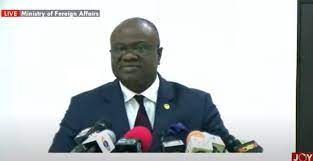
    The Ministry of Foreign Affairs and Regional Integration says the demolition of a facility on the premises of the Bulgarian Embassy in Accra was carried out by a private developer.

    “Government has got no hand in whatever the developer is doing,” the Deputy Minister for Foreign Affairs and Regional Integration, Kwaku Ampratwum-Sarpong, stressed at a press conference on Wednesday.

    He noted that efforts by the government over the period to halt the encroachment of the land belonging to the Bulgarian Embassy in Accra have proven unsuccessful.

    At a press conference, Mr. Ampratwum- Sarpong said, although there are legal documents backing ownership of the land in question by the Bulgarian Embassy, the private developer has failed to heed notices to stop work on the site.

    Outlining circumstances that led to the encroachment of the land some five years ago, the Deputy Minister for Foreign Affairs and Regional Integration, Kwaku Ampratwum-Sarpong, said workers seen on the site would be arrested.

    “The Ministry has also formally notified the Minister for Justice and Attorney General to take appropriate action on the encroachment on the subject property,” he said.

    The Minority caucus in parliament earlier demanded a public parliamentary probe into the demolition of the Bulgarian Embassy building in Ghana five years ago.

    Find below the full statement from the ministry

    PRESS STATEMENT  ON THE DEMOLITION OF THE BULGARIAN EMBASSY

    The attention of the Ministry of Foreign Affairs and Regional Integration has been drawn to an issue that appeared on social media on 16th March, 2022 regarding the demolition of the Bulgarian Embassy in Accra.

    The Ministry wishes to seize this opportunity to set the records straight on the property in question and the circumstances of the demolition.

    The Bulgarian Embassy leased the subject property from the late Theophilus Kofi Leighton in 1st February 1979, which lease was extended from 1983 for fifty (50) years for which an amount of One Million Old Ghana Cedis was paid by the Embassy with the option of renewal for another fifty (50) years. The lease expires in 2033.

    Upon the demise of the landlord, the Administrator of the Estate of the late Kofi Leighton attempted to forcefully repossess the property over alleged non-payment of rent arrears by the Bulgaria Embassy notwithstanding the latter’s full payment for the lease to the late Leighton.

    Mindful of its obligations under the Vienna Convention on Diplomatic Relations, 1961 concerning host states’ obligation to the inviolability of the premises of diplomatic missions, the Ministry summoned the parties to a meeting for an amicable settlement of the matter.

    Dissatisfied with the conciliatory approach of the Ministry at resolving the issue, the Administrator of the Estate of the late Leighton went to the High Court with a writ for declaration of title to the property housing the Bulgarian Embassy; payment of accumulated rent arrears; and order for ejection and recovery of possession of the property.

    Part of those reliefs was granted by the High Court. However, upon appeal, the Court of Appeal reversed the High Court’s decision.

    The case traveled all the way to the Supreme Court. In its judgment, the Apex Court reaffirmed the holdings of the Appeal Court, dated 21st July 2011, which overturned the decision of the High Court and affirmed the right of the Bulgarian Embassy in the leased property.

    The above judgment of the Supreme Court notwithstanding, the Successor of the late Leighton sold the leased property to a private developer, who later encroached on it.

    Still committed to its obligations under public international law, the Ministry, upon being informed of the encroachment of the Bulgarian Embassy, invited the parties and their lawyers to a series of meetings in January this year which were aimed at finding a peaceful resolution to the dispute.

    At those meetings, the Ministry referred the trespasser to the ruling of the Supreme Court, which reaffirmed the right of the Embassy in the unexpired residue of its lease. The parties were also encouraged to reach a mutually agreed settlement on the reimbursement of the amount of the residue of lease due to the Bulgarian Mission.

    The Ministry has also formally notified the Minister for Justice and Attorney General to take appropriate action on the encroachment on the subject property.