Category: News

  • Ghana’s balance of payment deficit widens

    Ghana’s balance of payment deficit widens

    By Elorm Desewu

    Ghana’s balance of payment deficit has more than doubled for the first quarter of 2022, according to the Bank of Ghana, (BoG).

    This was due to the capital and financial account recording some significant outflows from net portfolio reversals and net private capital outflows, which resulted in an overall balance of payments deficit of US$934.46 million for the first quarter of 2022, compared with a deficit of US$429.93 million, same time last year.

    However, the trade surplus improved significantly recording US$1.3 billion in the first four months of the year, compared with a trade surplus of US$778.00 million in the same period of last year.

    The trade surplus was offset by investment income outflows and net services payments, resulting in a current account deficit of US$128.15 million (0.2 percent of GDP) for the first quarter of the year, representing a marginal improvement from the current account deficit of US$197.0 million (0.2 percent of GDP) recorded in the first quarter of 2021.

    Commodity prices have remained volatile due to the on-going geopolitical tensions. Average crude oil prices gained 42.0 percent on a year-to-date basis to settle at US$106.2 per barrel in April 2022, supported by supply constraints arising from the geopolitical tensions between Russia and Ukraine.

    Gold prices also gained 8.1 percent to settle at US$1,935.89 per fine ounce, on the back of increased safe-haven demand amid global inflation concerns. Similarly, cocoa prices went up by 4.4 percent to settle at US$2,591.06 per tonne in April 2022, compared to the US$2,481.95 per tonne in December 2021, due to unfavourable weather conditions across West Africa.

    The improvement in export earnings was attributed to crude oil and non-traditional exports. Crude oil export receipts recorded significant growth of 61.0 percent to US$1.9 billion, due to price effects, while gold exports improved by 3.6 percent, also supported by price effects.

    Non-traditional export receipts crossed the US$1.0 billion mark in the review period and contributed significantly to the trade surplus. These developments far outweighed the 7.7 percent growth in total oil imports in the review period, on the back of compressed non-oil imports.

    Gross International Reserves (GIR), at the end of April 2022, stood at US$8.34 billion, equivalent to 3.7 months of import cover.

    This compares with US$9.70 billion, equivalent to 4.3 months of import cover at end-December 2021. 21. In the foreign exchange market, the Ghana Cedi depreciated by 15.6 percent against the US dollar, 13.1 percent against the Pound Sterling, and 13.6 percent against the Euro, during the first quarter of 2022.

    From the beginning of April through 18th May 2022, there has been some moderation in the rate of depreciation. The Ghana Cedi depreciated by 0.2 percent against the US dollar, but appreciated by 5.7 percent against the Pound Sterling and 5.4 percent against the Euro, bringing the year-to-date depreciation against these currencies to 15.8 percent against the US dollar, 8.2 percent against the Pound Sterling, and 8.9 percent against the Euro.

  • Ghana signs $69.88m renewable energy deal to enhance electricity access

    Ghana signs $69.88m renewable energy deal to enhance electricity access

    Ghana has signed a $69.88 million renewable energy agreement to enhance electricity access in the next four years.

    Under the agreement, about 6,890 households, 6,001 Small and Medium-sized Enterprises (SMEs), and 6,890 public buildings will be connected to electricity.

    About 1,350 schools and 500 health centres would also benefit from the project, which would include the design, engineering, supply, construction, installation, testing, and commissioning of mini-grids and standalone systems.

    Seventy communities across nine Island districts through mini-grids, 505 communities in 11 districts through standalone solar photovoltaic (PV) systems in the country.

    The “Scaling-up renewable energy Programme (SREP),” is to close Ghana’s 12.8 per cent electricity reach deficit by increasing access to clean and reliable energy and support socio-economic development.

    It is to also help reduce public sector electricity debt as well as bills for SMEs and households while supporting the implementation of environmental, climate, and social management plans in the country.

    Mr. Ken Ofori-Atta, Minister of Finance signed the protocol agreement with Dr Akinwumi Akin Adesina, President of the African Development Bank (AfDB) Group.

    He also signed the financial agreement of the project with Mr. Dominique Paravicini, AfDB’s Governor for Switzerland.

    Speaking at the signing of the agreement, Mr. Ofori-Atta, said the project: “Dovetails fittingly into an urgent global agenda and demonstrates our country’s commitment to enhance the economic and social viability of low carbon investments.

    It is also in support of the country’s commitment to creating new energy-efficient markets and stave-off a future energy crisis by achieving energy sufficiency.

    The project also: “Fully align with the Government’s overarching ambition of increasing the contribution of Renewable Energy in the generation mix to 10 per cent by 2030 while achieving our emission reduction targets,” he added.

    Mr. Ofori-Atta indicated that the project would provide stable and cheaper electricity to hundreds of people across the country and usher in new economic opportunities, particularly for women in rural areas.

    On his part, Dr. Adesina noted that the project would support Ghana in meeting its renewable energy requirement on the Sustainable Development Goals (SDGs) and build a resilient economy.

    “This project will increase access to clean and reliable electricity services and support low carbon socio-economic development of Ghana. It will directly support Ghana’s efforts in building resilience to the socio-economic impact of the COVID-19 pandemic.”

    This would be done through the provision of electricity to healthcare centres, Island communities, enabling the refrigeration of vaccines and testing facilities for COVID-19.

    “The project will facilitate the self-sufficiency of Ministries, Departments, and Agencies (MDAs), through rooftop solar power generation and storage under the net metering component,” he added.

    Mr. Paravicini, said that the signing of the agreement showed Switzerland’s continuous support to bring sustainable and affordable electricity to households and businesses.

    SREP would be implemented between 2022 and 2025, under three components; the first would comprise of the development of 38 mini-grids and standalone solar PV systems for 2,000 SMEs, 1,350 schools, 500 health centres, and 400 communities.

    The second component, which is net metering, aims at up-scaling existing projects to about 12,000 units of roof-mounted net-metered solar PV systems to reduce public sector electricity debt and bills for SMEs and households.

    The final component would be the supervision of works including operating costs for the SREP Project Implementation Unit, Distribution Utility, and the implementation of environmental, climate, and social management plans.

    Source: GNA

  • Utility tariffs increment: Make your voices heard – Chief of Staff to stakeholders

    Chief of Staff Frema Osei-Opare has said all the stakeholders must make their voices heard in the process of announcing new utility tariffs by the Public Utilities Regulatory Commission (PURC).

    “It is my fervent hope that all stakeholders will engage actively in this review process and make their voices heard so that the final outcome will benefit the generality of all stakeholders,” she at the inauguration of an office complex for the PURC in Koforidua.

    The Head of Public Relations and External Affairs of the PURC said the Commission will also consider the interest of the investor community and the interest of the utility companies before announcing the new tariffs.

    The PURC had earlier noted that this year’s approved tariffs for utility service providers will be announced on July 1, 2022.

    According to the PURC, the tariffs could be increased or decreased.

    Dr Eric Kofi Obutey, the Director of Research at PURC made this known on Accra 100.5 FM’s evening news on Thursday, May 12, 2022.

    He said, for now, the Commission is engaging all the stakeholders to arrive at tariffs that will serve the need of Ghanaians as well as the service providers.

    Dr Obutey mentioned some of the stakeholders as the Parliamentary Select Committee on Mines and Energy; Association of Ghana Industries (AGI), and Ghana Employers Association among others.

    He explained that the stakeholder engagement before the announcement of the approved tariffs is mandated by law.

    Dr Obutey was hopeful that all the engagements will end by June for a decision to be taken by July.

    The Electricity Company of Ghana (ECG) and Ghana Water Company Limited have proposed 148 per cent and 334 per cent hikes, respectively, in tariffs.

  • High volatility of Cedi to discourage investment in Ghana’s infrastructure – Fitch

    High volatility of Cedi to discourage investment in Ghana’s infrastructure – Fitch

    Adnan Adams Mohammed

    Fitch Solutions forecasts Ghana’s construction industry to grow by 4.1% year-on-year in 2022, a slowdown compared to the estimated growth of 5.7% year-on-year in 2021.

    The rating agency notes that, despite the market’s strong fundamentals, including a track record of private investment in energy infrastructure, comparatively high political stability and security, and a relatively diverse competitive landscape, it expects that a substantial depreciation of the cedi against the US Dollar in 2022 will, in the near term, make private investors more reluctant to invest in Ghana’s infrastructure sector.

    Further indicating that, it do not expect that private investment will meaningfully cushion the negative impact of subdued public infrastructure spending on the market’s construction industry growth, the agency said.

    “We forecast that in 2022, the Ghana cedi will depreciate by 22.7% against the USD, significantly increasing revenue risks for the foreign investors that rely on expatriation of revenues”, Fitch Solutions, thus, said. “We forecast government capital expenditure to shrink to 3.3% year-on-year of GDP in 2022 and 2.9% year-on-year of GDP in 2023, down from 3.7% year-on-year in 2021”.

    “While this puts capital expenditure levels above those in 2018-2020 when Ghana’s construction industry growth averaged -0.1% per year, it remains below the comparatively high annual average levels of 4% of GDP between 2010 and 2017.”

    During the period between 2010 and 2017, the construction industry growth average of 8.1% per year.

    But the Governor of Bank of Ghana, Ernest Addison, said developments in the global capital markets, combined with internal challenges that resulted in the rating downgrade of Ghana’s economy, have played out to exacerbate price and exchange rate pressures in the domestic economy.

    The Ghana cedi, he noted, came “under severe pressure in the first quarter of 2022 as offshore investors exited positions in domestic securities at a time when domestic demand for forex had increased”.

    Speaking at the 6th CEO Summit in Accra, last week, Dr Addison said: “The FX pressures, coupled with tight forex liquidity due to absence from the international capital markets, contributed to the significant currency depreciation”.

    Cumulatively, he said the Ghana cedi depreciated by 15.8 per cent against the US dollar in the year to 18th May 2022, compared with an appreciation of 0.5 per cent in the same period of 2021.

    “To ease off increased volatility in the foreign exchange (FX) market, the Bank extended the forward auctions to include the Bulk Oil Distributing Companies”.

    “This formed part of the measures taken by the Bank to address the FX liquidity constraints within the local petroleum sector and aid price discovery, especially for the general pricing window within the downstream sector”, he noted.

    Also, Dr Addison said recent price developments indicate elevated pressures from both domestic and external sources.

    These include the global energy and food price shock, and its consequential upward adjustments on domestic ex-pump petroleum prices and transportation costs, domestic food prices, as well as the passthrough effects of the recent exchange rate depreciation.

  • Ghana ranks best investment hub in the Sub-region and Africa

    Ghana ranks best investment hub in the Sub-region and Africa

    Adnan Adams Mohammed

    Ghana has been ranked the best nation among it peers in Sub-Saharan region for trading and investment, Fitch Solutions Operational Risk Index has indicated.

    Ghana’s Trade and Investment Risk assessment scored of 50.9 out of 100 to outperform the West Africa average of 36.4. The score also was the second best on the continent while ranking 88th out of 201 markets globally.

    Despite the global challenges facing the economy, the report pointed out that Ghana’s markets have strong fundamentals, including a track record of private investment in energy infrastructure, comparatively high political stability and security, and a relatively diverse competitive landscape. It however expressed worry about the depreciation of the cedi which it said will in the near term make private investors more reluctant to invest in Ghana’s infrastructure sector.

    It therefore does not expect private investments to meaningfully cushion the negative impact of subdued public infrastructure spending on the market’s construction industry growth.

    “We expect that a substantial depreciation of the cedi against the US dollar in 2022 will in the near term make private investors more reluctant to invest in Ghana’s infrastructure sector”, Fitch Solutions, the research arm of rating agency Fitch, has noted in the report released last week. “We thus do not expect that private investment will meaningfully cushion the negative impact of subdued public infrastructure spending on the market’s construction industry growth.”

    The index reported also concluded that, Ghana scored 51 out of 100 in the Crime and Security Risk parameters to outperforms the West Africa average of 33.3 and also ranked first place in Africa.

    Below is the full report from Fitch:    

    Lower Public Investment To Slow Down Ghana Construction Industry Growth

    Key View

    •       We forecast Ghana’s construction industry to grow by 4.1% y-o-y in 2022, a slowdown compared to the estimated growth of 5.7% y-o-y in 2021. Ghana’s infrastructure construction industry is unlikely to benefit from higher oil and gold prices, as we expect that increased public revenues will be channelled towards debt servicing and Ghana’s high public wage bill rather than capital projects.

    •       We expect that a substantial depreciation of the cedi against the US dollar in 2022 will, in the near term, make private sector investors more reluctant to invest in Ghana’s infrastructure and construction sector and offset the adverse impact of subdued public infrastructure spending on the market’s construction industry growth.

    We forecast Ghana’s construction industry to grow by 4.1% y-o-y in 2022, a slowdown compared to the estimated growth of 5.7% y-o-y in 2021. Unlike in other markets, Ghana’s infrastructure construction industry is unlikely to benefit from higher oil and gold prices, as we expect that increased public revenues will be channelled towards debt servicing and Ghana’s high public wage bill rather than capital projects, as Ghana’s access to international capital markets will be constrained in the near term.

    Accordingly, we forecast government capital expenditure to shrink to 3.3% y-o-y of GDP in 2022 and 2.9% y-o-y of GDP in 2023, down from 3.7% y-o-y in 2021. While this puts capital expenditure levels above those in 2018-2020, when Ghana’s construction industry growth averaged -0.1% per year, it remains below the comparatively high annual average levels of 4% of GDP between 2010 and 2017, which enabled the construction industry growth rates averaging 8.1% per year.

    In 2023, we forecast Ghana’s construction industry growth to accelerate slightly as we forecast the depreciation of the Cedi against the USD to slow down to 4.6% y-o-y.

    Generally, this will reduce revenue risks for foreign investors, while lower inflation will improve demand for residential and non-residential construction.

    However, Ghana’s access to international capital markets will remain constrained and will continue to weigh on public infrastructure spending as well as the market’s construction industry growth.

    Muted Public Spending Limits Construction Growth

    Ghana – Government Capital Expenditure, % of GDP; Construction Industry Value, real growth, % y-o-y

    Despite the market’s strong fundamentals, including a track record of private investment in energy infrastructure, comparatively high political stability and security, and a relatively diverse competitive landscape, we expect that a substantial depreciation of the cedi against the USD in 2022 will, in the near term, make private investors more reluctant to invest in Ghana’s infrastructure sector.

    We, thus, do not expect that private investment will meaningfully cushion the negative impact of subdued public infrastructure spending on the market’s construction industry growth. We forecast that in 2022, the Ghana cedi will depreciate by 22.7% against the USD, significantly increasing revenue risks for the foreign investors that rely on expatriation of revenues.

    Economic Openness Boosts Operating Environment In Ghana

    Ghana & Regional Average – Trade & Investment Risk

    Note: Scores out of 100; higher score = more attractive market. Source: Fitch Solutions Trade and Investment Risk Index

    At the same time, Ghana ranks in first place out of the 16 West African markets included in our proprietary Fitch Solutions Operational Risk Index.

    With a Trade and Investment Risk score of 50.9 out of 100, Ghana outperforms the West Africa average of 36.4 and ranks in a competitive 2nd position regionally, and in 88th place out of 201 markets globally.

    Similarly, with a Crime and Security Risk score of 51 out of 100 Ghana outperforms the West Africa average of 33.3 and ranks in 1st place regionally and in 90th place out of 201 markets globally.

  • E-cedi now accepted for transactions in Sefwi Asafo

    E-cedi now accepted for transactions in Sefwi Asafo

    Adnan Adams Mohammed

    The long awaited implementation of E-cedi is now accepted for daily transactions in Sefwi Asafo, a town in the Western North Region, on a pilot basis, the Bank of Ghana (BoG) has disclosed.

    The pilot is the offline version of the e-cedi which are used for buying daily necessities such as food, clothes etc.

    The e-cedi is a digital replica of the Cedi notes and coins which can be redeemed for physical cash and used for varied payments.

    “So far, the usage and uptake of the offline version of the e-cedi is being piloted in a small town called Sefwi Asafo, in the Western North Region”,  the Governor of the central bank, Dr Ernest Addison, last week, at the Ghana CEOs Summit in Accra.

    “Selected users in that community have been using the e-cedi for daily purchases such as food, groceries and drinks”.

    “The BoG will continue to work with these users to obtain the critical usage data that will inform the decision about the e-cedi’s future after the pilot.”

    He added, “these are clearly landmark events in providing digital leadership with the payment systems to lead to a digitalised economy in the near future.”

  • Dampare’s regrettable and misguided letter can jeopardize the enviable cordial bilateral relations between Ghana and Britain – NDC

    Dampare’s regrettable and misguided letter can jeopardize the enviable cordial bilateral relations between Ghana and Britain – NDC

    Read full statement below:

    FOR IMMEDIATE RELEASE

    31st May, 2022.

    The National Democratic Congress (NDC) has become aware of a letter from Ghana’s Inspector-General of Police, Dr. George Akuffo Dampare addressed to the British High Commissioner, H.E. Harriet Thompson which has now been widely published.

    The NDC takes the considered view that Inspector-General of Police, Dr. George Akuffo Dampare should have raised his concerns about the British High Commissioner’s tweet on Oliver Barker-Vormawor’s latest arrest with Ghana’s Foreign Minister through the Minister of the Interior for it to be addressed via the usual diplomatic channels.

    The IGP’s regrettable and misguided letter has the tendency of jeopardizing the enviable cordial bilateral relations between Ghana and Britain.

    Ghana and the UK have shared strong friendly bilateral relations and official communications must avoid tones and language which are considerably discourteous, offensive and needlessly provocative.

    The IGP’s rather ill-advised attack on the British High Commissioner for being meddlesome in Ghana’s internal affairs appears rather far-fetched, particularly considering the significant fact that the activist of interest is a student in the UK, and that matters of human rights are universal and cardinal.

    In any case, international relations of the modern era creates great accommodation for peer review—this has been on exhibition in recent times when the Ghanaian President criticized western nations including the UK in his 2021 UN address for apparently using COVID-19 vaccination policies as a discriminatory immigration tool against Africans.

    The Ghanaian Government was amongst the first nations of the world to condemn President Vladimir Putin for Russia’s invasion of Ukraine.

    In all these instances, no one has accused Ghana of violating the Vienna Convention on Diplomatic Relations, 1961.

    The NDC has on no occasion described these very recent examples cited above as tantamount to President Akufo-Addo meddling in the internal affairs of other nations.

    It is only autocratic regimes who have no regard for democratic principles that are averse to criticism and international scrutiny.

    The NDC calls on Ghana’s Foreign Ministry to immediately intervene in offering diplomatic guidance to the IGP and also taking concrete steps to ease tensions.

    The NDC wishes to caution the IGP against a posture of high handedness and insipid arrogance which creates the impression that the Ghana Police Service under his leadership is above reproach. He must also be reminded that he does not speak for the Ghana Armed Forces or the Government of Ghana.

    We request of of IGP Akuffo Dampare to rather focus his attention on the worsening security environment which has led to the gruesome loss of life of a lawyer, gold dealers in Asamang Tamfoe, and many other victims of unresolved police brutalities from the 2020 election killings to Ejura, Tamale, Akatsi, Asawase and Nkoranza.

    Signed.

    Johnson Asiedu Nketia- General Secretary

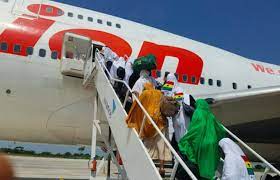
  • Woes of a Muslim Pilgrims Under Bawumia unbearable… Pilgrims are to pay GHC40,000

    Woes of a Muslim Pilgrims Under Bawumia unbearable… Pilgrims are to pay GHC40,000

    Mustapha Abubakar writes..

    What am I hearing? That Hajj fare is now *GHC40,000*? What a wow! In an economy where our living conditions continue to deteriorate?

    Under President Mahama, Hajj fares was pegged around *GHC11,900* ($3,450×3.45) per Pilgrim in 2016. Let me round it up to Ghc12,000. Then President Mahama also made sure that the rising cost of Hajj fares resulting from the exchange rate was not passed on to the pilgrims as he absorbed the difference to cushion them. That was a caring President!

    But what do we see today under a *Muslim Vice President, Dr Mahmud Bawumia*, Hajj fares moved from *GHC12,000* in 2016 to *GHC19,500* in 2019 and now, its *GHC40,000 ($5000)*. That is over *225%* increment.

    What happened to the promise Bawumia made in 2016 to help our Muslim Umma when he gets elected? What happened to our exchange rate which has ballooned to GHC8.0 to a dollar? And what am I hearing again; that those who paid their monies before March 2020 but couldn’t go for Hajj because of Covid, would be made to pay a difference of GHc2,000 and those who paid after March would be made to cough extra Ghc19,500 to add to the already Ghc19,500 they paid (twice the amount) before they embark on the Hajj? You punish Pilgrims after using their monies all these years?

    Don’t we fear Allah!

    My question is, was there a decision not to increase any fare for those who paid two years ago but couldn’t go? Well, lets wait for an answer.

    Is it also true that Pilgrims from the Northern part of Ghana cannot fly from the Tamale Airport this year? I pray its not true.

    I cringe for my fellow Muslim brothers and Sisters who are to cough out this outrageous amount of GHC40,000 to go and worship Allah.

    Why should Muslims continue to suffer rather under a Muslim Vice President?

    Like President Mahama has always said, Posterity will judge us all.

    May Allah make it easy for us.

  • Tariffs increment: will PURC consider economic hardship or face reality?

    Tariffs increment: will PURC consider economic hardship or face reality?

    Adnan Adams Mohammed

    The Public Utilities Regulatory Commission (PURC) has said this year’s approved tariffs for utility service providers will be announced on July 1, 2022.

    According to the PURC, the tariffs could be increased or decreased.  The Director of Research at PURC, Dr Eric Kofi Obutey, has said,  the Commission is engaging all the stakeholders to arrive at tariffs that will serve the need of Ghanaians as well as the service providers. The stakeholders as the Parliamentary Select Committee on Mines and Energy; Association of Ghana Industries (AGI), and Ghana Employers Association among others.

    The Electricity Company of Ghana (ECG) and Ghana Water Company Limited have proposed 148 per cent and 334 per cent hikes, respectively, in tariffs. This has triggered the anger of Ghanaians who complains that, the economy is already ‘burning the hell’ out of them, including policy analyst.

    Among the analysts who have reacted to the proposals is, Dr. Steve Manteaw. He has described the demand of increase in electricity and water tariffs as justifiable, saying, there is a strong basis for an upward adjustment, despite the inefficiencies of the utility firms. According to him, factors such as inflation and exchange rate losses justify the upward increment.

    “There is a strong basis for an upward adjustment; if you look at inflation rate, if you look at the cedi depreciation and all that. But what the companies haven’t told us is what component is made up of transmission losses and commercial losses. These are categorised us inefficiency cost”, The Executive Director of ISODEC said in an interview last week.

    “PURC has the mandate to ensure that inefficiency cost are not passed onto consumers. Of course to deal with inefficiencies, you need to make investments, but you don’t make investments from tariffs”, Dr. Manteaw expatiated.

    But, a Political Scientist and lecturer at the University of Ghana, Professor Ransford Gyampo, has questioned the proposal.

    Reacting to the proposed in a Facebook post, last week, he said: “You cannot propose an increment in utility bills across the board like that, at this time when the poor has already been hit hard.”

    He, therefore, wants “only article 71 officeholders, who have, but don’t pay, pay for such hikes,” to be made to pay the proposed increase by the utility service providers and “Leave the poor alone!”

    Apparently, a policy Think tank, Consumer Unity and Trust Society (CUTS) International, has backed the push for a review of utility tariffs by the Electricity Company of Ghana and the Ghana Water Company Limited.

    The think tank, however, maintains that there is the need to speedily address the inefficiencies within the system to make the companies sustainable.

    West Africa Regional Director for CUTS International, Appiah – Kusi Adomako, speaking in an interview explained that; “I support the principle that tariffs need to go up to make ECG able to fulfil its mandate. If ECG is deprived of increment, what it means is that ECG may not be able to invest. And we are told that most of the cables and other things are old and need replacement, or we might go back to the dumsor era. Water is also justifiable because the water company buys chemicals. These chemicals are imported into the country. Freight prices have also gone up, exchange rate has also gone up and even the cost of buying those items have also gone up between the last time tariffs were increased. So, we need to allow these firms to be able to get some increment so that the business will be sustainable. When it is sustainable, people will find them attractive to invest in,” he said.

    Furthering his argument, Dr Manteaw noted that, in normal business practices, shareholders are mandated to inject capital into the business with regard to equipment renewal and all the capital investments needed.

    “The shareholders in this case is the republic (government) and therefore we have to finance these major equipment renewal and maintenance activities from our taxes. They must be budgeted for through the budget and then in terms of the daily operations, you can actually finance through the taxes”, he added.

    He said the package given to Aqua Vitens Rand were far more and better conditioned than those given to Ghanaian entities, adding, “I do recall when we went through ECG privatization, we were prepared to do for PDS what we were not prepared to do for our Ghanaian managers”.

    For instance, he pointed out “when PDS took over, they asked that all the debts ECG had at the time were to be re-fenced. So it were not part of the account because those were legacy debts…they were not responsible. But we are not prepared to re-fenced for the old ECG”.

    “Again, a year before PDS took over, we had denied ECG tariff adjustment (upward adjustment). But when PDS took over, we gladly approved upward adjustment for PDS”, he added.

    Furthermore, Dr. Manteaw said “I tend to look at our utility companies sympathetically, a reason being that they really work under severe stress. And the conditions under which they work are not the type that any foreign multinational company will want to work under.”

    “I recall we brought in Aqua Vitens Rand, we improve water distribution in this country and by the time we abrogated – we actually refused to renew that contract – we had the phenomenon known as the Kufuor gallons. When the facility reverted to the Ghanaian manager, the gallons disappeared”, he stressed.

    Subsequently, the Ghana National Chamber of Commerce and Industry (GNCCI) says any adjustment must favour industries.

    According to the GNCCI, further increases, particularly in energy cost, will be detrimental to the private sector.

    The GNCCI notes that the PURC must consider cushioning the business community with a comparatively lower tariff that is reflected in the production capacity of manufacturing and key service sectors.

    Already, businesses are recovering from the impact of the pandemic in addition to rising cost of doing business.

    A statement issued by the GNCCI states that, “Energy is one of the critical cost components of business. While recognizing improvements in the energy situation over the last few years, energy cost to businesses remains too high (comprising up to 30% of cost of operation in some extreme cases). Businesses pay much higher energy in order to subsidize households. Whereas in many other countries, households pay higher energy cost to subsidize industry.”

    “As we move into the integrated African market zone, power tariff component of products will be a defining factor. Ethiopia and Kenya have better tariffs than Ghana; thus, making their products competitive.”

    In the proposal, ECG also wants 7.6% average adjustments between the periods of 2023 to 2026.

    The GWCL argues that while the average tariff per cubic metre in 2019 was 1.27 USD, it was reduced to USD 1.13 as a result of cedi depreciation.

    For the GWCL, the current domestic tariff of GHS3.29 per cubic metre to consumers within 0-5 cubic metres is less than what the poor in rural areas pay, which is about 10 cedis. The water company thus wants a 334% tariff hike.

    Considering the concerns and facing reality of the economic conditions at the a time inflation at reached all time highest in over 18 years to record 23.67 percent: Will the PURC consider the reality and dishonour or cut down the rate of increase being demanded by the utilities service providers, thus, ECG and GWCL; or it will consider the financial distress of the utility companies and give them what is due them to sustain their smooth operation?

    Ghanaians, ECG and GWCL are all now at the mercy of PURC decision to be announced on July 1.

  • Arise Ghana addresses Ghanaian on economy mismanagement and governance of impunity

    Arise Ghana addresses Ghanaian on economy mismanagement and governance of impunity

    Full Press Statement below:

    MAIDEN PRESS CONFERENCE BY “ARISE GHANA” TO ADDRESS CRITICAL ISSUES OF

    POLITICAL AND SOCIO-ECONOMIC IMPORTANCE TO OUR DEAR NATION.

    Wednesday, 25th May, 2022

    Good morning, ladies and Gentlemen of the press.

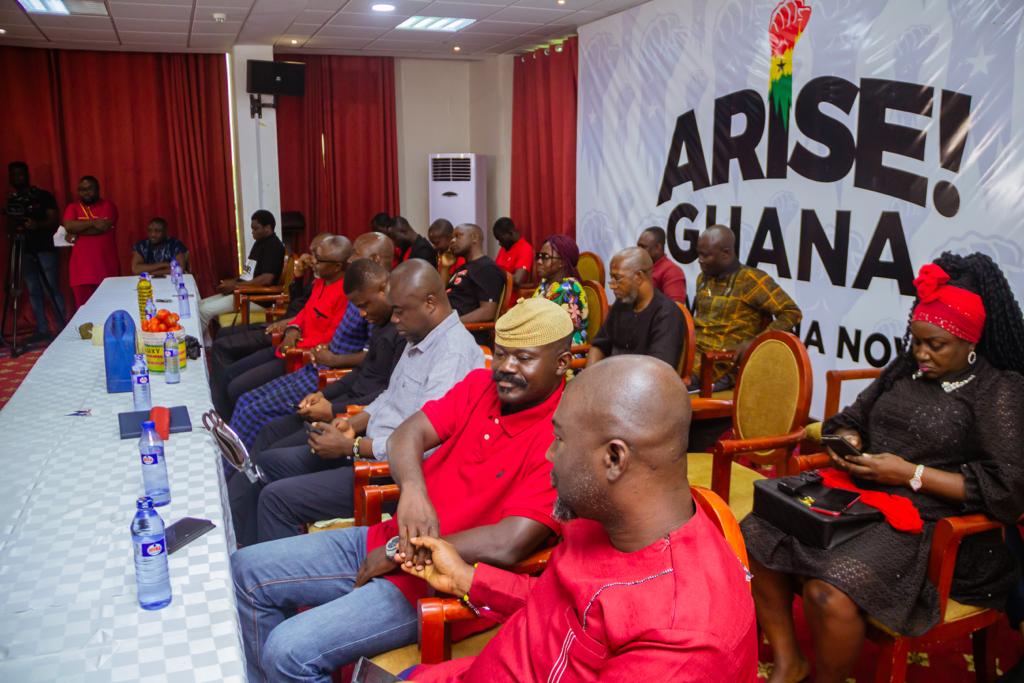
    We have the honour of welcoming you to this maiden press conference of “Arise Ghana”, a coalition of patriotic,

    conscientious and concerned Ghanaians drawn from various political parties, including the Peoples’ National

    Convention (PNC), the Convention Peoples’ Party (CPP), the Ghana Union Movement (GUM), the Great

    Consolidated Popular Party (GCPP), the All People’s Congress (APC), the New Patriotic Party (NPP), the

    National Democratic Congress (NDC), various Civil Society Organizations, the media, the creative arts industry,

    Driver Unions, Traders and citizens from all walks of life.

    Distinguished friends from the media, “Arise Ghana”, is an amalgamation of activists who through advocacy and

    nationalistic mobilization, will seek to lead a crusade against the continuous misrule, mismanagement and maladministration of our dear nation Ghana by today’s duty bearers.

    We are determined to relentlessly champion the common cause of the Ghanaian people, provide a voice for the voiceless and vigorously seek reforms that will bring about the needed change in the socio-economic, politico-social and general wellbeing of the Ghanaian

    citizenry.

    Ladies and gentlemen, we have come to a point in our nation’s history where to remain silent is not an option.

    This is so because, to be silent is to encourage the continuous triumph of evil. To remain quiet over the present

    state of affairs is to encourage the continuous slide of our country into the abyss. Choosing not to speak about the

    current state of affairs means being complicit in the ongoing state capture and the sacrifice of our collective future

    on the altar of instant gratification. We obviously cannot afford the option of remaining silent.

    Economic hardships.

    Friends from the media, there are hardly enough words to describe the harsh economic realities of Ghanaians

    today. Fuel prices keep rising at the pumps every day, with its concomitant effect on transport fares, prices of food and general goods and services in the country.The price of fuel in Ghana today remains one of the highest in Africa. As a result of this, the distance between Kwame Nkrumah Circle and Kaneshie, costs the ordinary man in a Trotro, Ghc3 as we speak. Today, the distance from Madina to Kasoa requires a transport fare of Ghc12 even in public transport. In fact, one requires a whopping Ghc200 to travel from Accra to Tamale, a distance that used to cost the commuter Ghc100 in the year 2019.

    Inflation rate continues to gallop at an alarming rate and stands today at 23.6%, the highest in 18 years, thereby

    spiraling weekly hikes in prices of foodstuffs. A recent survey by Metro TV which was published on Sunday, 22nd May, 2022 revealed that an Olonka of Maize which sold for GH12.00 only last week, now sells for GH15.00 this week, while a sack of maize which sold for GH450.00 only last week, now sells for GH650.00 this week. In similar vein, a sack of yam which was selling at GH350.00 last week is now selling for GH450.00 this week, while a box of tomatoes which hitherto was sold at GH1000.00 last week is this week going for GH1,200.00.

    From this market survey which was done over a period of just one week, it is clear that cost of living in Ghana today is at an all-time high. With Government’s much-touted Planting for Food and Jobs program remaining a monumental failure, coupled with the ever-increasing cost of agricultural inputs and mechanization services, the threat of food insecurity looms ever larger on us than before.

    In fact, the purchasing power of the ordinary Ghanaian has fast deteriorated due to the unbearable cost of living

    thereby inflicting untold hardships on Ghanaians. Things are continuously getting worse by the day with no end

    in sight.

    WORSENING ECONOMIC CONDITIONS

    Distinguished friends from the media, the economy continues to wallow in the doldrums, with all economic indicators nose-diving while Government looks on helplessly. The Cedi’s free-fall continues unabated as a result of the failure of Government to translate its rhetoric into action. Today, the Cedi trades at about Eight Cedis, fifty pesewas (GHC8.50 = $1) to the US Dollar.

    The continuous depreciation of our national currency against its major trading partners continues to wash away the profit margins and in most cases, the capital of many businesses and traders who

    depend on forex exchange to import vital goods into the country. This situation has further aggravated the alarming rate of inflation the nation is presently experiencing.

    Even more worrying is the alarming rate of joblessness and hopelessness in the country, especially among the youth. Today, the rate of unemployment has risen to an all-time high, having moved from 6% in the year 2017 to a staggering 13.5% as at 2021.

    Indeed, our dear nation is presently in a deep economic mess. The country has lost access to the international capital market due to our unsustainable debt position. Our Public debt has increased to unprecedented and unsustainable levels from GHS120 billion cedis to over GHS391.9 billion cedis only in the last five and half years. This means that at a minimum, this government alone, since 2017, has added a whopping Ghc271.9 billion to the national debt stock, with a chunk of this going into consumption. Debt to GDP ratio has galloped from 56%

    in 2016 to about 80% as we speak, while our debt service burden has moved from about GHS14 billion cedis as at December 2016, to a whopping GHS50 billion cedis.

    This economic situation which is our worst performance in the history of this Fourth Republic has worsened our credit worthiness and dampened investor confidence in our economy leading to our worst ever downgrades by reputable sovereign credit rating Agencies such as Moody’s and Fitch. Simply put, our beloved Ghana is broke and this is a direct product of the bad leadership, insensitivity, misplaced proprieties and gross economic

    mismanagement of the present Akufo-Addo/Bawumia administration.

    DRACONIAN TAXES

    While wages of the Ghanaian worker remain static, with almost all labor unions up in arms over poor wages in the wake of worsening economic hardships, the Akufo-Addo/Bawumia government continues to impose killer and draconian taxes on the already burdened taxpayer.

    The recent passage of the obnoxious E-levy and its subsequent implementation remains yet another slap in the face of the Ghanaian people. Never in the history of our country has a government behaved so obstinately in imposing a draconian tax measure on its citizens, despite

    loud public outcry.

    Government’s subsequent use of judicial shenanigans in an attempt to defend the illegal imposition of this E-levy remains yet another clear demonstration of how desperate and callous they are State capturing and land grabbing.

    THE ATTEMPT TO REINTRODUCE THE FRAUDULENT AGYAPA DEAL

    Distinguished friends from the media, one of the cardinal, yet regrettable legacies of President Akufo-Addo and Alhaji Bawumia remains the unprecedented levels of state capture we are witnessing today. The practice of state capture under this government has assumed such alarming proportions that the God-given resources of this country that are supposed to benefit present and future generations are being utilized by only a few greedy family,

    friends and cronies in government today.

    One of the most bizarre, yet brazen display of state capture has manifested itself in the unpopular decision of this

    Government to Monetize our mineral resources in perpetuity under a fraudulent scheme dubbed “Agyapa” for the

    benefit of a select few.

    It initially gladdened our hearts that the Ghanaian people spoke in unison against this organized heist called “Agyapa” and forced government to suspend same. We are however mortified to note that despite the public outcry over this deal, the NPP/Akufo-Addo government is headstrong and is seeking to reintroduce the “Agyapa” deal as recently announced by the Finance Minister. We wish to serve notice that this latest attempt to reintroduce the unpopular “Agyapa” Mineral Royalties deal shall be defeated, as we shall resist same with everything within us.

    GRABBING OF ACHIMOTA FOREST RESERVE LANDS

    Ladies and gentlemen of the media, we daresay that you, like many Ghanaians, were surprised by recent reports of a certain E.I 144 which seeks to declassify portions of the Achimota Forest as no longer a Forest Reserve.

    Well, as the saying goes, coming events cast their shadows, and indeed recent events have now given out the real

    motive and intent of the Akufo-Addo/Bawumia Government relative to this matter of the Achimota Forest

    Reserve. As we now know, President Akufo-Addo and his land grabbers in government were only hiding behind

    a certain historical claim by one Owoo Family to appropriate the Achimota Forest Reserve, a nature conservation of huge environmental importance to all of us, among themselves.

    It has now emerged through some leaked portions of the Will of the late Kwadwo Owusu Afriyie, aka Sir John, a former CEO of the Forestry Commission, that elements within the Akudo-Addo/Bawumia Government have already shared lands in the Achimota Forest Reserve among themselves. Indeed, portions of the lands are contained in the leaked Will Document making the rounds. This is a tragedy of national proportions and we condemn it in no uncertain terms. To imagine that the Achimota Forest, one of the few surviving nature reserves in Ghana, would become another subject of the state capture of President Akufo-Addo and his cabal of buccaneers in Government breaks our hearts greatly.

    Friends from the media, portions of the late Kwadwo Owusu Afriyie’s Will reveals several prime lands, including those at the Achimota Forest and the Sakumono Ramsar Site that the late CEO of the Forest Commission acquired within a very short stint in Government, which he in turn willed to his relatives prior to his death.

    These revelations are but a microcosm of the scale and magnitude of grabbing and plundering of state lands and other resources by President Akufo-Addo and functionaries in his government in a manner akin to the conduct of pirates on the high sea.

    CORRUPTION AND ABUSE OF THE PUBLIC PURSE.

    Distinguished friends from the media, corruption remains endemic and pervasive under President Akufo-Addo and Alhaji Bawumia who have turned themselves into the greatest enablers and promoters of same.

    Despite being the most resourced government in Ghana’s history, this government has wasted all the

    unprecedented revenues that have accrued to them totaling about GHS500 billion mainly through profligacy and

    corruption.

    At the risk of sounding monotonous, it bears reminding that corruption scandals such as the BOST scandal involving the illegal sale of five million liters of contaminated fuel to dubious entities, the Australian Visa Fraud Scandal, the Galamsey Fraud Scandal, the PPA Contracts for Sale scandal, the PDS scandal, the Missing Excavators scandal and the most recent Sputnik V Scandal remain unresolved instances of daylight heist that President Akufo-Addo has either turned a blind eye to or whitewashed the perpetrators.

    All attempts to demand accountability for the use of Covid-19 funds continues to be suppressed by President Akufo-Addo who has effectively doused the flame of accountability. There is little wonder therefore that corruption is at an all-time high under this current regime.

    Even more bizarre is the fact that at a time when majority of Ghanaians are suffering and experiencing excruciating hardships, President Akufo-Addo continues to travel in ultra-luxurious and hyper-expensive private jets at high expense to the already-impoverished Ghanaian taxpayer just to satisfy his creature comforts.

    CONCLUSION

    Distinguished friends from the media, our dear nation is on the verge of becoming a failed state. The center can no longer hold. Things are falling apart. It goes without saying that the current state of affairs calls for action.

    Every well-meaning Ghanaian is therefore duty-bound not only to speak against the ills of today, but also to act now in order to save the soul of our nation.

    This is why we in Arise Ghana are saying to all conscientious Ghanaians to arise and “Save Ghana Now”!

    DEMANDS

    1. We demand an immediate withdrawal of E.I 144 and an end to the land grabbing of the Achimota Forest Reserve lands. Caution is hereby served to President Akufo-Addo and his land grabbers to stay their hands off the Achimota Forest lands. We urge Parliament who are the representatives of the people to institute a bi-partisan probe into the matters relating to the sale of lands in the Achimota Forest immediately. This probe should be

    transparent and all persons, be they past or present government officials, civil or public servants, and all whose hands are soiled by this shameless grabbing of Achimota Forest lands should be named, shamed and the stolen Lands retrieved for the State.

    2. We demand an immediate and total cancelation of the Agyapa Royalties deal as same is not in national interest.

    We will never sit aloof and allow a few selfish and greedy thieves in government to appropriate our mineral royalties for themselves and their families.

    3. Also, we demand an immediate reduction in fuel prices through the scrapping of crippling fuel taxes such as

    the sanitation levy (“borla tax”) of 10 pesewas on every liter of diesel and petrol. We believe that this if done, will provide some respite to suffering drivers and Ghanaians as a whole.

    4. Additionally, we demand the immediate repeal of the obnoxious E-levy Act, which is nothing but naked thievery of the meager resources of the citizenry by the wicked Akufo-Addo/Bawumia government.

    In the light of the foregoing demands, “Arise Ghana” shall hold a Public Forum in the coming days to further expatiate on these important matters of considerable public interest.

    More importantly, we wish to announce for the information of all Ghanaians, that we shall be embarking on a mammoth demonstration on the 21st of June 2022 in the city of Accra to press home these demands. We therefore call on all Ghanaians who desire to see a change in the affairs of our beloved country to come out in their numbers and join us on the streets of Accra for this historic protest.

    This will be the first of a series of protest actions that we shall relentlessly be holding across the length and breadth

    of the country with the aim of bringing sufficient pressure to bear on the insensitive, corrupt and incompetent

    Akufo-Addo/Bawumia government to act in the best interest of Ghanaians.

    Ladies and gentlemen, Ghana needs to be saved now. And this must be done by you and I. We have had enough of the hardships government keeps inflicting on us; Enough of the broken promises; Enough of the naked thievery of state resources; Enough of the arrogance of power; Enough of the state-capture; Enough of the culture of impunity. We all have a role to play in the struggle to save the soul of our beloved country. The time to act is now!

    May God bless our homeland Ghana and make her great and strong through your collective efforts.

    Thank you for your attention ladies and gentlemen.

    Signed,

    Comrade Mordecai Thiombiano

    General Secretary, APC and leading Member of Arise Ghana

    (contact No.; 0279781055)

    Comrade Duncan Amoah

    Executive Secretary, COPEC Ghana and leading member of Arise Ghana

    (contact no.; 0243246570)

    Comrade Bobie Ansah

    Broadcast Journalist and Leading member of Arise Ghana

    (contact no.; 0243123620)

    Comrade Mensah Thompson

    Convener, ASEPA and leading member of Arise Ghana

    (contact no.; 0542120628)

    Comrade Osei Kofi Acquah

    National Youth Organzier, CPP and leading member of Arise Ghana

    (Contact no.; 0243388633)

    Comrade Ishaq Awudu

    Communications Director, PNC and leading Member of Arise Ghana

    (contact no.; 0244947573)

    Comrade Kojo Gold

    General Secretary, GUM and leading member of Arise Ghana

    (Contact no.; 0244782025)

    Comrade Rex Omar

    Musician and Leading Member of Arise Ghana

    (contact no.; 0556569304)

    Dzramado Selorm Dramani

    President, Unemployed Association and Leading Member of Arise Ghana

    (contact no.; 0241384810)