As the National Democratic Congress (NDC) prepares for its national delegates congress, this portal have picked reliable information that, the five regional representatives of the Tertiary Education Institution Network (TEIN) in the Northern Region have been replaced with their patrons.
According to our further checks, this is happening only in the Northern Region. Other regional representatives who voted in the Youth and Women conference at Cape Coast over the weekend are still eligible to vote in the national congress.
The NDC will have its national delegates congress this coming weekend, Saturday December 17, 2022, at the Accra sports stadium. However, it is surprising, why at the eleventh hour, these reps have their names changed from the delegates list after they voted in the Youth and Women elections.
“We are surprised with what is happening in our region. We don’t know why the executives here wants to twist our hands and take our privileges from us”, a source among the TEIN shared with anger.
“If they don’t change this diabolical and undemocratic decision immediately, we will boycott the party.”
This happening is a dent on the NDC party’s democratic dispensation when the youth are being manipulated for someone’s selfish interest.
Ghana’s fisheries sector is a major contributor to the country’s economy, providing jobs and nutrition to millions, but for a long time now the sector has come under severe pressure from illegal fishing activities. Activities of illegal foreign fishing trawlers are not only depleting fish stocks and affecting the livelihood of local fishers, but they are also a threat to the country’s food security.
The illegal activities, by both local and foreign actors, have over time eroded the gains made in the sector and pose a great threat to the sustainability of the local sector and to the country’s economy.
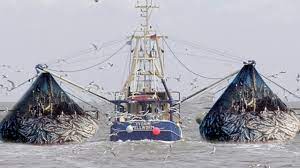
A worrying phenomenon that further compounds the woes of Ghana’s finishing industry is the sheer number of foreign trawlers in Ghanaian waters.
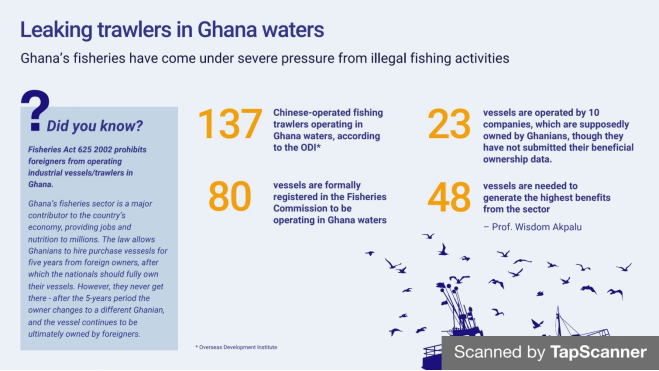
In our investigations into the fisheries sector, we found different data on the number of foreign vessels in Ghanaian waters. A study by the Overseas Development Institute (ODI) puts the number of foreign trawlers operating in Ghana at 137. These vessels are operating with impunity, while law enforcers look on, our sources told us.
A fisheries economist at the Ghana Institute of Management and Public Administration (GIMPA), Prof Wisdom Akpalu says the highest number of vessels ideal for Ghana’s fishing industry should be 48. He explains that with just about 48 vessels the country can generate the highest benefits from the sector.
Hit hard by the activities of these trawlers, local fishermen are expressing their frustrations over what they see as an invasion. They don’t even believe official statistics on foreign trawlers. Adjetey Tawia, the organizer of canoe and fishing gear owners association in Tema, said, “things have deteriorated because from 2001 when we received the Chinese trawlers into our oceans, a lot of damages have occurred in our ocean. We have 74 Chinese trawlers on our oceans but we the fishermen know it is more than that. How can you allow such a large number to work in our small oceans?” He said.
Meanwhile, data from the Fisheries Commission (FC) on registered vessels in Ghana’s territorial waters in 2021 alone indicates that a total of 80 vessels have been in operation.
A list of some of the registered fishing companies and licensed vessels. Source: Fisheries Commission
BO disclosures in the fisheries sector
While the fisheries sector is a capital-intensive investment sector, it appears the lawmakers did not include it in the beneficial ownership regime. But officials admit it should have been in.
Deputy Chief Company Inspector at the Office of the Registrar of Companies (ORC) Mrs Yayira Banini said unlike companies that operate in the financial, minerals, petroleum, insurance and real estate sectors among others, which are high-risk areas, “the fisheries sector is not part of the high-risk area and there will certainly be the need to amend the law to rope in the sector.”
“The fisheries sector has not been on the radar with regards to BO disclosures because the sector is considered not a high-risk area and so there will be the need for some amendments to the law,” she stated.
Mrs Banini, however, assured that even though the current law does not absolve low-risk companies from disclosing their beneficial ownership information, the ORC would critically focus on the fisheries sector and expand its scope to ensure that companies there comply with BO requirements.
“Being a new concept the ORC will keep updating and developing the BO registry to add up to the existing list,” she added.
Meanwhile, data from the ORC of a sample of eight (8) fishing companies registered in 2021, show no single company in the sector has filed their BO information. The data has only the usual information of shareholders and directors of the companies. But, it must be noted that the composition of the shareholders is both foreign and local, in accordance with the shareholding structure stipulated by Section 47 (1) (b) of the Fisheries Act, 2002, Act 625, though under the current arrangements, the general threshold for a BO is 10 percent or greater interest in a company, be it direct or indirect interest.
From the list of shareholding of the sampled companies, it is indicative by the given names that they are of Asian origin. For example, the directors of ‘Dong Sheng Limited’ are given as Xing Yanwei, and Yueke Bi but among the shareholders, Rongcheng Ocean Fishing Co. Ltd. holds the majority shares of 756,000.
Similarly, AFKO Fishes Company Limited has Yopungok Han being the highest stake of 2,000,000 among the six shareholders.
A group of fishermen mending their canoes, at Abrofo Mpoano in Cape Coast in the Central region of Ghana
According to the data, as of the 3rd and 4th quarters of 2021, there were 23 licensed fishing companies and 45 licensed fishing vessels or trawlers. In the same period of 2021, there were 13 tuna-licensed fishing companies operating through 28 vessels. The data suggested that four companies were foreign-owned. From the data, the BO regime has not significantly impacted the fisheries sector.
Fronting and abuse of rules
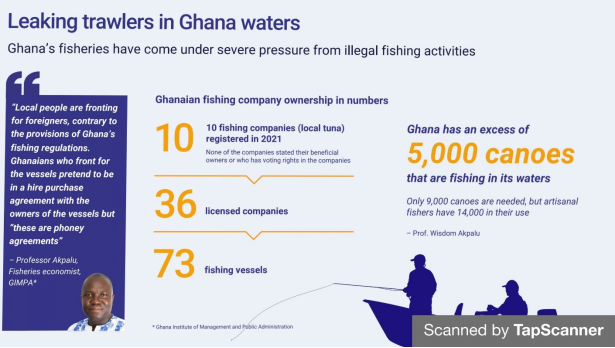
Even though about 44,000 companies in Ghana have so far complied with Ghana’s Beneficial Ownership Transparency initiative and submitted to submitted information about their corporate ownership structure or legal and beneficial owners to the ORC, according to the Centre for Extractive Development Africa, Fisheries economist, Prof Akpalu says local people are fronting for foreigners, contrary to the provisions of Ghana’s fishing regulations.
“At the end of the day, foreigners get almost all of the benefits. We get nothing,” he laments.
Prof Akpalu stressed that the Fisheries Act 625 2002 prohibits foreigners from operating industrial vessels/trawlers in Ghana. He explained that industrial trawling is a preserve of Ghanaians so those vessels are supposed to be fully owned by Ghanaians. But “the problem is that Ghanaians do not have the capital to acquire those vessels and the laws make provisions for hire purchase agreements, so if you don’t have money, you can buy on hire purchase and pay over time,” he explained.
According to the fisheries expert, Ghanaians who front for the vessels pretend to be in a hire purchase agreement with the owners of the vessels but “these are phoney agreements.”
“As per those agreements, the vessels are supposed to be fully owned by Ghanaians at the end of five years for example, but then we see that by the end of the five years, all they do is to change the name and a new person becomes the new owner who has gone into some hire purchase agreement with the same vessel so the same thing keeps rotating. This means that although we have laws that make it illegal for foreigners to operate those vessels in our waters, the provisions in the law that make it possible for one to go into a hire purchase agreement have been abused,” Prof Akpalu explained.
“The beneficial owners are foreigners,” the fisheries expert asserted.
Similarly, Nii Odametey, Chief Fisherman at the Tema Newtown Canoe Basin, alluded to the team “the trawlers are owned by foreigners, not Ghanaians.”
Background to Beneficial Ownership (BO) in Ghana
Ghana has in 2016, committed to implementing a BO regime. This was backed by signing on to several global conventions such as Extractive Industries Transparency Initiative (EITI), Financial Action Task Force ( FATF), Global Forum, Open Government Partnership (OGP), and United Nations Convention Against Corruption (UNCAC) among others.
The ORC was mandated to house the BO central register. The Companies Act 1963 (Act 179) was amended to include provisions on BO. This amendment was the Companies Amendment Act, 2016 (Act 920) and Act 992 (2019)
Currently, all new companies are required to provide BO details before registration while existing ones are required to update ORC with their BOs. Companies are to give the ORC their BO details at the time of filing annual returns and have a 2022 deadline, failing which sanctions will apply.
Depletion of fish stocks in Ghanaian waters
In 1992, the artisanal canoe fishers within a year could catch 35 tons of fish a year. In 2016/17, they were catching about 15 tons a year which is a sharp decline. And this is not peculiar to artisanal fishers. There is much evidence that certain fish stocks have completely gone extinct.
Chief Fisherman at Tema Newtown, and some of his council members in an interview with the team at Tema Newtown, in the Greater Accra region of Ghana.
For example, artisanal fishers have over 14,000 canoes that are fishing in Ghanaian waters. But then not more than 9,000 vessels are required in the waters. So, Ghana has in excess of 5,000 plus canoes that are fishing in its waters. This is actually a problem and to compound this problem they are competing with these same stocks they are catching. They normally catch the ones on the surface of the water like the anchovies, sardines and mackerel and these are the same stock the trawlers are targeting as their Saiko (term used in Ghana to refer to the transfer or ‘transhipment’ of fish at sea from industrial trawlers) meanwhile, they are not registered to catch these species that are free-flowing on the surface and mid-waters. They are licensed to catch bottom-dwelling species which are called the missile stock but they leave that or catch that and on top of it catch the ones supposed to be caught by artisanal vessels.
According to Prof Akpalu, “the main problem in our fisheries sector is the lack of political will to do the right things because we know the problems and we have been talking about this for a long time. The will to implement some of these policies that we have always recommended is our problem. If trawlers violate fishing regulations, for instance, we give them the option of either going to the courts or going to seek an alternative dispute resolution (ADR). And at ADR, the minister has so many powers and at the end of the day, he exercises an unfitted discretion on how much the trawler should pay.”
Laxity in the enforcement of the law
Most of the fishermen we spoke to in our investigations believe the challenge has to do with the enforcement of the country’s laws.
“This is why we have become an attractive place for foreign vessels that are just going around and looking for money. It will continue to be so when our punishments are not deterrent enough”, Adjetey Tawia asserted.
The way forward
To help salvage the situation in the fisheries sector of the economy, Prof Akpalu makes the following recommendations.
He suggested that “to be able to see what happens in the trawlers, authorised video (monitoring system) devices should be placed in all trawlers. This would show what types of fish they are catching and in what quantities.
“We should, with immediate effect, do away with the ADR option for foreign vessels, or if we should have ADR at all, they should be mandated not to set fines below the minimum that the court would have fined an individual who engages in illegality.
“We should have ways of verifying whether those fronting for the trawler vessels are true owners of it or not. We should do it in such a way that if the hire purchase is for five years, at the end of the fifth year, the vessels are owned by the Ghanaian or confiscated by the state. If this is done well, we will have only Ghanaian vessels fishing in our waters. They will obey the rules and regulations and once we get the industrial trawlers in check, the artisanal fishermen will have no reason not to obey the rules and regulations,” according to the Fisheries Economist
He added that the “government should stop subsidising premix fuel and use the money to support the artisanal fishing industry or communities by providing alternative livelihood empowerment for the youth.
“Oil Marketing Companies should be encouraged to set up fuel stations within the fishing communities to sell premix fuel at market rate and make sure it is always available by creating an enabling environment for private investors,” he opined.
Chief Fisherman at the Tema Newtown Canoe Basin, Nii Odametey and his council members reiterated calls on the Ghanaian government to adequately resource the Ghanaian Navy and marine police so they can effectively protect the waters and ward off the industrial trawlers who illegally fish in Ghanaian waters.
“We are of the view that poaching from foreign industrial trawlers which is a contributory factor to the depletion of fish stocks makes nonsense of the implementation by the sector ministry of the closed season which is meant to replenish stocks,” the fishermen told the team during focus group engagements.
Speaking to the issue, the Chief Fisherman in Cape Coast, Kobina Kakraba believes there were about 100 foreign vessels operating in Ghanaian seas. “When they see us, they run to the Ivorian border pretending to be working there and still bringing the catch here. When they see the navy is operating on the seas, they flee but once the navy leaves, they hurriedly return to do their illegal activities. Most of the trawler vessels belong to the Chinese. I believe that it is some ‘big’ men in the country who are behind their operations. Our own people are involved and it disturbs our work on the seas. The industrial trawlers are really disturbing us, they fish at places they are not supposed to,” Kobina Kakra lamented. He urged the government to sack all of the trawlers from Ghanaian waters.
The organizer of the canoe and fishing gear owners association in Tema, Adjetey Tawia, bemoans how illegal activities are affecting artisanal fishing. According to him, the trawlers target some particular fishes, if their nets get hold of the fishes they are not interested in, they discard them back into the sea. This activity pollutes the sea.
Fish production
The Ministry of Fisheries and Aquaculture Development 2020 Annual Progress report shows a total domestic fish production of 471,794.79 metric tons (mt) in 2020 as against a year target of 562,063.82 mt.
Data Source: Ministry of Fisheries and Aquaculture Development
Though the actual domestic fish production for 2020 fell short of the target by 16.1 percent, it was an improvement on that of 2018 (452,679.30) and 2019 (465,700.03). The total domestic production figures show a general increasing trend of 2.6 percent for the past three years with a decline of 0.09 percent between 2018 and 2019 and 0.49 percent between 2019 and 2020.
Domestic fish production is from three main sources namely marine, inland capture fisheries and aquaculture sub-sectors. The marine sub-sector contribution to domestic fish production in 2020 was 326,867.56 mt as against a target of 347,754.11 mt, a shortfall of 6 percent.
Analysis of the marine production figures from 2017 to 2020 shows a relatively increasing production trend of 4.6 percent. (This may be partly due to the overexploitation of marine fishery resources resulting from illegal fishing activities, climate change, and increased fishing efforts among others)
Data Source: Ministry of Fisheries and Aquaculture Development
The contribution of inland capture fisheries mainly from the Volta Lake in 2020 was 80,923.18 mt representing 17.2 percent of domestic fish production for the year.
A comparative analysis of the inland capture fisheries production for 2019 and 2020 shows a decrease in production level by 0.3 percent. It is noted from the data that aquaculture production for 2019 and 2020 fell below the production figure for 2018 by 31.68 percent and 16.47 percent respectively.
It is also noted that even though aquaculture production for 2020 showed a 22.3 percent increase over that of 2019, the target of 129,302.00 mt for the year was not met.
During the year (2020), a total of 193,226.87 mt of fish were imported to augment domestic fish production/supply to meet domestic fish requirements for the year, while total fish export was 69,152.43 mt. Fish imported are mostly low-valued but high-quality fish such as chub mackerel, horse mackerel and sardinella to offset the deficit in domestic fish production. Exported fish products include canned and raw tuna, frozen demersal fish, and dried and smoked fish.
The total fish supply for 2020 was 595,869.23 mt, which showed a shortfall of 12.1 percent against a target of 677,785.38 mt.
Commenting on the situation, Prof Akpalu says Ghana’s own local laws, the Fisheries Act 625 2002 and all the laws in the books do not permit foreigners to operate industrial trawlers in Ghana.
“The implication is that they fish in such a way that they destroy a whole ecological system, it destroys the ability of the system to produce more fish because when they fish using certain destructive techniques it destroys the benthic flow of the ocean and that leads to the environmental carrying capacity or the ability of the ocean to produce more fish for us.” Prof Akpalu says.
For an industry that plays a major role in sustainable livelihoods in several households and communities in Ghana, the fisheries sector must earn equal attention as others with regard to Beneficial Ownership.
It is hoped that Ghanaian authorities will step up their game.
Editorial team
This article is the result of investigations undertaken by the following journalists: Kizito Cudjoe (B&FT), Isaac Aidoo (The Finder), Emmanuel Wiafe Aboagye (Asaase Radio), Alberta Bissue Ansong (Metro TV), Adnan Adams Mohammed (newsguideonline.com) and Prince Appiah (Multimedia).
About the report
This study was supported by the Opening Extractives Programme jointly implemented by the Extractive Industries Transparency Initiative (EITI) and Open Ownership (OO) and supported by the BHP Foundation. Its contents are the sole responsibility of the author and can in no way be taken to reflect the views and positions of the EITI, OO nor BHP Foundation. Any errors or omissions are the responsibility of the authors
A private citizen, Adnan Adams Mohammed, has petitioned the Ghana Health Service (GHS) to punish the nurses who participated in the illegal strike on Friday, December 2, 2022, at the Manhyia Municipal hospital in accordance to its administrative laws and powers.
Mr Mohammed indicated that, failure on the part of the GHS to punish the illegally striking nurses, he will forced to petition the Supreme Court to force the GHS to apply it powers.
Below is the full petition:
From:
Hse No. KZ424/3, Kasoa Zongo
02/12/2022
To:
The Director General
Ghana Health Service
Accra
Dear Sir/Madam,
PETITION CALLING ON GHANA HEALTH SERVICE TO ENFORCE ITS ADMINISTRATIVE LAWS TO CALL ILLEGALLY STRIKING NURSES AT MANHYIA HOSPITAL BACK TO WORK AND TAKE PUNITIVE ACTIONS AGAINST THE NURSES FOR BREACH OF CONTRACT
In the interest of public order, peace and security, as a concern law abiding citizen of the Republic of Ghana, who upholds all legal frameworks of the land, I write to petition the Ghana Health Service to as a matter of urgency enforce its administrative laws to call the illegally striking nurses at the Manhyia Municipal hospital to return to post and punish same for breach of their contract.
Relative to the administrative legal framework for the engagement of the nurses under the Ghana Health Service supervision and management, the nurses have no locus to put the lives of innocent citizens in peril to seek for their private interest or make demands for which they have no any legal powers of determination.
In the matter where they ‘allege’ that, a colleague staff nurse has been abused by another public servant does not, in any way, guarantee their justification to sacrifice sick Ghanaians live to death and pains against their Conditions of Service as captured under the Code of Ethics of The Ghana Health Service.
Point three (3) of the Ghana Health Service Conditions of Service (Code of Ethics of The Ghana Health Service) stipulates that, “All Service personnel shall respect the Rights of patients/clients, colleagues and other persons and shall safeguard patients’/client’ confidence.”
The rights of patient to healthcare as promoted under the Directive Principles of State Policy (DPSP) of the 1992 Constitution, which among others requires the state to ensure the realization of the right to good healthcare for people living in Ghana, is been sacrificed illegal for the undue private interest and as against the code of ethics for which the nurses were engaged to work for the country.
Point one (1) of the GHS code of ethics enforce that; “All Service personnel shall be competent, dedicated, honest, client-focused and operate within the law of the land.”
The right to health is a fundamental part of our human rights and of our understanding of a life in dignity. The right to the enjoyment of the highest attainable standard of physical and mental health, and to give the right its full meaning, contradicts the reasons for which the nurses are trading and are subjecting Ghanaians who seek healthcare at the Manhyia Municipal hospital lives to pain, artificially caused inaccessibility to healthcare.
The Preamble of the Code of Ethics for the Ghana Health Service (GHS) defines the general; moral principles and rules of behavior for all service personnel in the Ghana Health Service. The Code also enforce that, “The Service shall be manned by persons of integrity, trained to a high standard to deliver a comprehensive equitable service for the benefit of patients/clients and society as a whole.”
But, the nurses here are trading the interest of patients for their reprieve.
It is for these reasons that, I call on the Ghana Health Service to enforce the administrative law governing its engagement terms and conditions with the nurses to ensure that the nurses return to post immediately. Failure on the part of the Ghana Health Service will push me to further petition the Supreme Court against their incompetence and neglect of their duty.
Also, the Ghana Health Service must outline and implement punitive actions against any of the workers at the Manhyia Municipal hospital who participated in the strike actions within two weeks starting from the date of petition.
The citizens deserve best form of services as part of their social contract for which they their taxes and same used to train and pay the nurses and other public and civil servants.
Look forward to your swift response to this petition for the utmost interest of national order, peace and security. Thank you.
The Bank of Ghana, (BoG) has expressed some potential risks to inflation due to the increase in the Value Added Tax (VAT) by 2.5 percent by the government.
The inflation forecast shows that in the outlook, inflation will likely peak in the first quarter of 2023 and settle at around 25 percent by the end of 2023.
According to the governor of the BoG, Dr Ernest Addison, “there are however some risks to this forecast that would have to be monitored, including additional pressures from the proposed VAT increase, and exchange rate pressures. Continued vigilance to the evolution of these potential price pressures in the outlook will be key”.
This forecast is conditioned on the continued maintenance of tight monetary policy stance and the deployment of tools to contain excess liquidity in the economy.
Inflation has remained elevated, with strong underlying inflationary pressures. Price developments suggest that the upturn of headline inflation in October 2022 was driven largely by food price pressures and to some extent additional pressures from the currency depreciation.
The headline inflation has increased further to 40.4 percent in October 2022, from 37.5 percent in September. Food inflation increased by 4.9 percentage points to 43.7 percent in October 2022 from 38.8 percent in September, while non-food inflation increased by 1.3 percentage points to 37.8 percent from 36.5 percent. Underlying inflationary pressures have also heightened further.
The Bank’s measure of core inflation, defined to exclude energy and utility prices, increased from 36.2 percent in September 2022 to 39.7 percent in October 2022, an indication of broad-based inflationary pressures. At the same time, consumer, business, and financial sector inflation expectations went up.
Interest rates on the money markets trended upwards across the spectrum of the yield curve, in line with the tightening of monetary policy stance. At the short-end of the market, the 91-day and 182-day Treasury bill rates increased to 31.53 percent and 32.61 percent respectively, in October 2022, from 12.46 percent and 13.16 percent respectively, in the same period of 2021. Similarly, the rate on the 364-day bill increased to 32.32 percent from 16.24 percent over the review period.
On the secondary market, rates on all bonds, from 2-year through to 20-years, almost doubled over the one-year review period.
The interbank weighted average rate increased to 23.98 percent in October 2022 from 12.66 percent in October 2021, consistent with the increases in the policy rate and the incremental hikes in the Cash Reserve Ratio from 12 percent in August 2022 to 14 percent in October. In tandem, the average lending rates of banks rose to 31.40 percent in October 2022 from 20.34 percent in the same period of 2021.
Some stakeholders have taken a swap against government’s decision to hike the Valued Added TAX (VAT) rate by a 2.5 percent.
They believe it will add up to the already unbearable cost of doing business in the country amidst the harsh economic hardship being experienced in the country owing to the hyper-inflationary trend and worst performance of the local currency.
Accounting firms, KPMG and PwC believe the imposition of an additional 2.5% VAT on standard-rated supplies would impact cost of doing business in the country. They, therefore, want government to focus more on compliance measures to ensure that those outside the tax net are brought in.
According to Tax Partner at PwC, Abeku Gyan-Quansah, most of the levies in introduced previously are not in compliance with the Earmarking Funds and Realignment Act.
“Let’s reform the VAT, the VAT is simply not working. We can have a standard accumulative VAT rate of 20% and make a claim for it totally. The levies and things you are doing is not in compliance with the Earmarking Funds and Realignment Act” speaking at the PwC 2023 Post Budget Forum, AbekuGyan-Quansah called for the revision of the tax laws.
In its post budget analysis, KPMG indicated that, “In these difficult times, increasing VAT will worsen the plight of taxpayers, leaving them with little disposable income”. It stressed that compliance is the way to go because it can rake in more revenue.
Also, an Executive Member of the Association of Ghana Industries, Charles Atuahene, have expressed worry about the increase in VAT, it is too aggressive which could stifle growth of the manufacturing tax.
“How long am I going to throw money that I have invested in the capital item, because the foreign exchange laws regime means that, liquidity is going out? Now my tax is going away and you say I should still give cash, where am I going to cash from and pay the tax”.
Meanwhile, Deputy Minister of Finance Abena Osei Asare stated that these tax measures are aimed at restoring macro-economic stability in the short to medium term.
“The 2023 budget was prepared with the view to bringing our debt levels to a sustainable level. Looking at all these things and government wanting to stabilize the economy first and then transform, certainly you will see some measures put in place to achieve this”.
But, Associate Professor at the Institute of Statistical Social and Economic Research, Prof. Charles Ackah believes government must focus heavily on agriculture to bring the economy back on track.
Meanwhile, Senior Partner at PwC, Vish Asghiagbor is urging businesses to be innovative in this austere moment to stay competitive in the market.
“Look I mean we are in a different period and none of us can escape those difficulties, so there is stress on businesses. At this point in time, businesses really have to think critically and be innovative on how they achieve cost efficiencies and how they leverage whatever competitive advantage they have in the market to grow their businesses”.
On other tax policies, KPMG believes that reducing the e-levy to 1% is a great idea but removing the threshold may wipe off the effective impact of the reduction.
“The situation of the vulnerable that were being protected when the law was passed has even become worse because of the current economic hardship. Government must reconsider the removal of the threshold”.
“Other areas government could consider is to place a cap on the levy based on a defined transaction threshold and consider other proposals for review of the exclusions under the levy to further enhance usage of digital payment platforms”, it added.
For some indirect tax measures, government intends implementing Customs Tariff with the 2022 version of the Harmonised Commodity Description and Coding System (HS Code) to enhance uniformity of trade within the region.
KPMG said there have been several discussions on the full restoration or withdrawal of the benchmark values.
“While others are of the view that withdrawal would make imports expensive and thus increase prices, it is also expected that withdrawal of the policy would boost local production to support our local industries”.
To be successful with this policy, it urged government to engage all stakeholders to reach a pragmatic consensus.
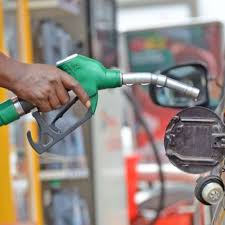
Fuel prices at the pumps have started coming down although slower than expectations of some downstream petroleum sector think-tanks.
GOIL, a market leader, reduced the pump prices for Diesel to GH₵19.77Petrol toGH₵16.26, this translate into about 3.5 percent reduction.
Although, the reductions were predicted in previous week by the Institute for Energy Security, the current reduction is slower than the rates it predicted. IES predicted rates of about 13.45% in petrol, 11.63% in diesel, and 1.88% in LPG prices.
“Prices of the various finished products will be affected by the 13.45% fall in the price of gasoline [petrol], the 11.63% fall in the price of gasoil [diesel], and the 1.88% fall in the price of LPG.
However, the IES said the price of Liquefied Petroleum Gas (LPG), is however expected to remain stable on account of the cedi’s depreciation.
The 3.09% depreciation of the cedi against the US dollar is expected to erode portions of the gains from the reductions in international fuel prices. The price of LPG is however expected to remain stable on account of the cedi’s depreciation”, the IES said.
Condequently, the Chamber of the Bulk Oil distributors has linked the reductions to improved supply of dollars from the Bank of Ghana and moves by the regulator to improve the liquidity of commercial banks.
This has helped improved lending to importers of petroleum products.
On the international market, Brent crude saw a 6.31% decrease in price over the previous window’s average price of $95.11 per barrel to the present average price of $89.11 per barrel.
The National Communications Authority (NCA) has come out to clarify the hanging pertinent issues concerning the fate of those individuals who do not have their Ghana cards as at now.
It said, individuals yet to obtain their Ghana Card will not be affected by the ongoing SIM deactivation.
The telecommunication companies, last week announced that subscribers who have failed to complete the biometric stage of registration will have some services disconnected. The services to be blocked are; voice, data (Mobile, phones, mifis, other data providing devices), SMS (incoming and outgoing) USSD, mobile money services and emergency services.
“For those who do not have their Ghana cards and have not been able to register, those people will be exempt from any punitive measures pending the NIA giving them their Ghana card,” the Director for Consumer & Corporate Affairs at the NCA, Nana Defie Badu, noted in an interview, last week.
She explained further that her outfit was opened to help address the concerns of the general public and their inability to register their SIM cards.
“We acknowledge that there are some people who actually got to the stage where they actually linked the sim to the Ghana card but unfortunately, after doing that their Ghana card were either lost, damaged or through no fault of theirs, they could not proceed to do stage two.
“So, for these people, we have actually asked that they should engage the NCA by calling our toll-free number. After we do an investigation and verify the issue, these people will also be put on the exclusion list pending them getting their Ghana cards reissued to them,” she said.
Consequently, the Chief Executive Officer of the Ghana Chamber of Telecommunications, Dr Ken Ashigbey, has said the blocking of some 9 million unregistered SIM cards will have a toll on the revenue of mobile network operators in the country.
Dr Ashigbey explained that if each of the nine million subscribers spends, at least, GHS20 every month on all the various networks; that’s a huge revenue loss.
That notwithstanding, the blocking of SIMs has to be done even though it is worrying, he said.
Since November 20, the telecommunications companies in Ghana have been blocking data services for subscribers who have only linked their Ghana Card and SIMs (Stage 1) but have not captured their biometric data (Stage 2) as part of the SIM registration process as directed by the Ursula Owusu-Ekuful-led Ministry of Communications and Digitalisation
The International Monetary Fund (IMF), in renewed effort to progress the stalled negotiation towards reaching a deal with Ghana has indicated that, the focus of support might shift from Balance of Payment to ensuring fiscal stability.
According to the fund, it is possible to change the terms of support request of the government to better suited terms that solves the current challenge the economy faces. It thereby indicated that increasing revenue mobilisation is critical for debt sustainability while safeguarding social spending.
The Fund has noted that, although it is premature to comment on the final form the financing programme for Ghana will take, In its latest Frequently Asked Questions (FAQ), said the Executive Board will decide the level of access (credit amount) and the final programme design. It further reiterated that the goal of the government’s economic programme, which would be supported by IMF financing, is to restore macroeconomic stability and ensure debt sustainability, support the credibility of government policies, restore confidence in the central bank’s ability to manage inflation and rebuild foreign exchange reserve buffers to make the economy more resilient to shocks.
“Specifically, in the fiscal sector, an important policy objective would be to increase revenues, critical for debt sustainability while safeguarding spending on health, education, and social protections”, the Fund posited.
A staff team, led by Stéphane Roudet, mission chief for Ghana, is visiting Accra from December1 to 13, 2022, to continue discussions with the authorities on the country’s post-COVID programme for economic growth and associated policies and reforms that could be supported by a new IMF lending arrangement.
Ahead of the visit, Mr Roudet said: “We have had productive discussions with the Ghanaian authorities over the last few months and look forward to our engagement in Accra”.
“Our objective for this visit is to make further progress toward reaching agreement on policies and reforms that could be supported by an IMF lending arrangement”.
“The IMF remains fully committed to help Ghana restore macroeconomic stability, bring relief to Ghanaians in this time of crisis, and lay the foundation for more inclusive growth.”
In Ghana’s 2023 budget, Finance Minister Ken Ofori-Atta said the government and the IMF have agreed on programme objectives, a preliminary fiscal adjustment path, debt strategy and financing required for an extended credit facility programme to be in line with the government’s Post-COVID-19 programme for Economic Growth (PC-PEG).
The PC-PEG is the government’s blueprint to restore macroeconomic stability, promote debt sustainability, sustain economic recovery and support structural reforms.
Updating the house on the negotiations so far, Mr Ofori-Atta said: “Mr. Speaker, since the government announced its engagement with the International Monetary Fund for a supported programme on July 1, 2022, we have made “substantial progress”.
The Fund, he said, has assured the government of its “strong commitment and support in these difficult times”.
On whether Ghana needs debt restructuring, the Fund said when an IMF member country requests financing, the Fund assesses whether the country’s policies are consistent with debt sustainability.
This assessment is based on a Debt Sustainability Assessment (DSA) conducted jointly by the IMF and World Bank to determine whether the government is able to meet all its current and future payment obligations.
The last DSA published in the 2021 Article IV Staff Report concluded that: “Public debt was sustainable conditional on a rigorous and credible implementation of the authorities’ medium-term consolidation plan to put debt on a declining trajectory and ensure continued market access.
In their recent 2023 budget statement, the government assessed the public debt as unsustainable over the medium term. In this regard, the government has announced its intention to conduct a debt operation to ensure debt sustainability.
The Fund said “we welcome the authorities’ intentions to implement policies that will ensure the sustainability of public finances. However, the nature of engagements and debt operations between Ghana and its creditors are sovereign decisions”.
I am highly disappointed and shocked at how you have denigrated and disgraced the noble nursing profession to the extend that, your members are seen as ‘nuisance’.
Your (Ghana Registered Nurses and Midwifes Association- GRNMA) reaction and unnecessary threats to the public with regards to the ‘mishappens’ at Manhyia hospital shows you are indeed shameless and selfish leaders and individual disguised under the uniform of a noble profession. Most of you do not deserve to be in that uniform.
I am shocked at how national security setup and the public are quiet and have been tolerating your unnecessary regular threats of withdrawal of national essential service.
It is indeed true and a fact that, most nurses failed their exams, but were able to find their way to nursing school through nepotism, favouritism, bribes payment and sex for favor. So such individual comes with moral decadence. You see them as a symbol of disrespect, arrogance, empty pride, and lack of shame.
Where on earth or in which profession can national executives be quick to issue threats of strike to affect public security and order, just because of a matter in which no official investigation has been done to ascertain the real cause and effect of an incident.
So should the innocent citizens suffer and die at the health facilities which you were trained with the ‘kobi and momoni’ sellers taxes?
Where are your senses dear executives? Did you think deep about the public security and order before issuing out such threats?
My wife is a staff nurse, if any nurse attempt any strike action as we have read from some news portal, I will sue the executives and all those nurses participating in the strike.
Have you been able to address the numerous public genuine claims, complaints and agitations against misconduct, unprofessional and negligence of your members which have caused a number of preventable death and pains to patients?
You are not concerned about the professional conduct and improvement of your services, but you demand public respect?
How do you discipline some members of the noble profession whom we see in numerous ‘sexleak tapes, nude pictures, sexy twerks, recordings of nasty talkings’ ?
Have you addressed how badly, unprofessional and with much disrespect some of your members treat patients at the hospitals and clinics?
My wife, who is a nurse, despite her noblest and service with humility at her post, suffered the worst of her life at the Mother And Child Hospital at Kasoa when she was pregnant. Two nurses at that very moment at the time suffered same in the hands of nurses.
The doctors present were somehow respectful and humble to the patients.
Yes, it is a fact that, at the hospitals and clinics today, the physician assistant and doctors are even more humble and respectful to patients despite their qualifications more than the certificate and diploma nurses some of whom did not even pass their WASSCE exams.
Dear nurses, haven’t you observed that, the respect the public used to have for nurses is no more?
Have the socalled executives and the NMC sat on table to think about why it is so and how to sanitize the profession?
The indiscipline in the nursing profession is too much. Address that first before you demand public respect.
Stop issuing ‘unnecessary and useless threats’ trying to redeem the destroyed image of the profession.
Check in the other countries how the nurses work and behave there.
I wish to see changes in your conduct and relation with patients at the health facilities soon, then some of us can start fighting for you.
You will be sued for any unnecessary threats of strike, negligence and misconduct henceforth.
Thank you for your attention and the sense of change you have just assured yourselves.
Signed
Adnan Adams
01/12/2022
DISCLAIMER: Publication on this news portal are the opinions of the authors and do not represent the opinion of www.newsguideafrica.com.