
Adnan Adams Mohammed and Fatima Majewa
Reporting from Maiduguri
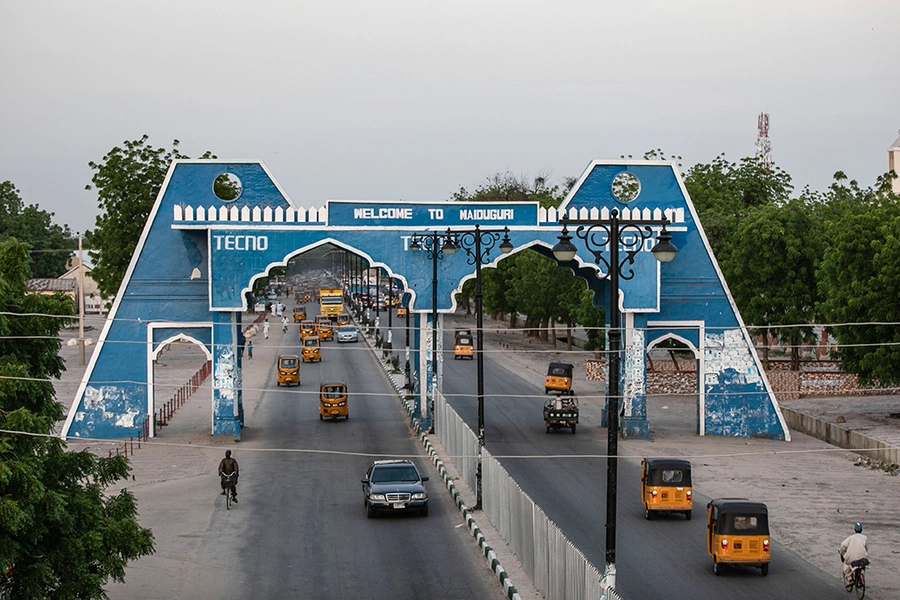
Spending the last one week in Maiduguri, from 11 to 17th March, 2023, once a danger zone with full of anxiety, once could feel the presence of restored peacefulness and serenity in the metropolis and the peri-urban areas.

Trading in Maiduguri
Normal activities going on with less anxiousness as trading booming, schools fully in session, civil and public services have fully restored after thirteen (13) years of being under siege by insurgency of Boko Haram.

School girls in Maiduguri peacefully chatting
Maiduguri, the capital city of the largest State by land size in Federal State of Nigeria (Borno State), is the principal trading hub for north-eastern Nigeria. Its economy is largely based on services and trade with a small share of manufacturing. Maiduguri is home to three markets which include a modern ‘Monday market’ that has a spectacular image view, the ‘Customs market’ and ‘Baga Road Market’.

Baga Road Market
During a fact finding mission to ascertain realism and aftermath of Nigeria’s worst experienced insurgency attack by ‘Boko Haram’, many of the people in Maiduguri feel hopeful and full of praises to all those that contributed to the peace restoration. But, as close as a 30 kilometer away from the metropolis is not yet assured of calmness as they do experience sporadic attacks by the insurgency.

“Normal trade and farming activities are ongoing now, Alhamdulilah”, said a civil servant at the Federal Secretariat who spoke to the team on basis of anonymity. “Although normalcy have been restored in some parts of the State and it is a little peaceful to move around now, it is not yet over. In some Local Government Areas (LGAs) attacks are happening there.”
“The last attack was about two weeks ago on lake in Dikwa LGA, about 60 kilometers away from Maiduguri metro, where about 30 fishermen were killed while on their fishing routine”, a top official at the Borno State Ministry For Reconstruction, Rehabilitation And Resettlement disclosed to the team unofficially.
However, he indicated that the situation is better now in the Borno State if compared to years back, where even within the capital city people lived under intense fear.
“About 90 percent of the displaced victims have returned to their various LGA after the government through the ministry rebuild individual houses, social, religious and security infrastructures that were destroyed during the attacks.
“With the 10% still in the metropolis, some are just not willing to return to their various LGAs as they have started meaningful life in the city of Maiduguri whiles others are out of fear of attack”, he added.
This is a sign the the tireless effort of the, political will of the government, security agencies and all collaborating agencies and the social work of Non-Governmental Organisations, para-militia volunteer groups formed by the individual residents within the LGAs.
Some of the NGOs helping restoring life to normalcy include: UNDP, UNHCR, World Food Program, INSO, Solidaire, IRC, IOM, Plan International, Save The Children, Federal Government Victims Support Fund, Empowerment and Education (Self Help Initiative) among others.
Borno State is a state in the North-East geopolitical zone of Nigeria, bordered by Yobe to the west, Gombe to the southwest, and Adamawa to the south while its eastern border forms part of the national border with Cameroon, its northern border forms part of the national border with Niger, and its northeastern border forms all of the national border with Chad, being the only Nigerian state to border three foreign countries.
According to history, it takes its name from the historic emirate of Borno, with the emirate’s old capital of Maiduguri serving as the capital city of Borno State. The state was formed in 1976 when the former North-Eastern State was broken up. It originally included the area that is now Yobe State, which became a distinct state in 1991.
Borno is the second largest in area of the 36 states, only behind Niger State. Despite its size, the state is the eleventh most populous with an estimated population of about 5.86 million as of 2016.
As a partially agriculturally-based state, the rural Borno State economy relied heavily on livestock and crops prior to the Boko Haram insurgency while state capital Maiduguri is a major regional trade and service center.
However, after years of the insurgency affecting development and forcing farmers from rural areas in the state, Borno has the thirteenth lowest Human Development Index in the country but as the insurgency has slightly abated since 2016, development has renewed.
As of 2022, much of Borno State has been occupied by the Islamic State’s West Africa Province (ISWAP) overpowering Boko Haram after the death of their leader, Abubakar Shekau in 2021 in a suicide bomb.

ISWAP is a militant group and administrative division of the Islamic State (IS), a Salafi jihadist militant group and unrecognised proto-state. ISWAP is primarily active in the Chad Basin, and fights an extensive insurgency against the states of Nigeria, Cameroon, Chad, and Niger. It is an offshoot of Boko Haram with which it has a violent rivalry; Boko Haram leader Abubakar Shekau killed himself in battle with ISWAP in 2021. ISWAP acts as an umbrella organization for all IS factions in West Africa including the Islamic State in the Greater Sahara (IS-GS), although the actual ties between ISWAP and IS-GS are limited.
