
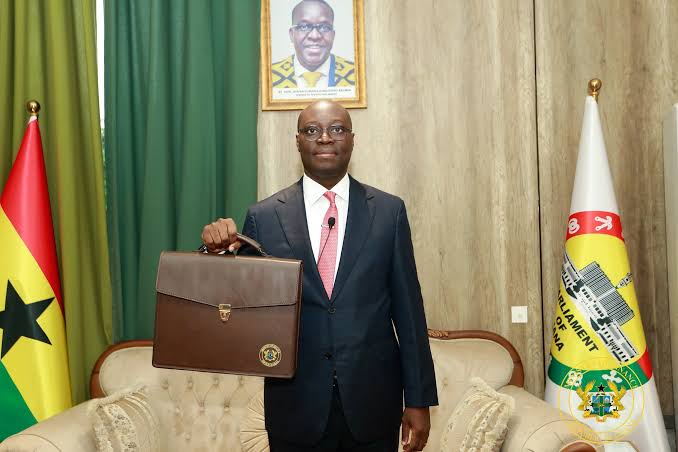
New economic direction targets worker pay, manufacturing, and informal sector protection
…as finance minister lay 2027 budget today
By Adnan Adams Mohammed
A coordinated national economic effort took shape today as Ghanaian authorities and international partners launched parallel initiatives targeting minimum wage increases, domestic industrial production, and expanded financial safeguards for informal workers.
The National Tripartite Committee finalized an agreement adjusting Ghana’s National Daily Minimum Wage upward from GH¢21.77 to GH¢25.04 starting January 1, 2027, followed by an increase to GH¢28.79 in 2028. The multi-year framework aims to establish clearer financial planning parameters for businesses while mitigating cost-of-living pressures on low-income earners across the country.
“The Committee urges all employers to comply with the new National Daily Minimum Wage effective January 1, 2027,” stated the committee, while also recommending that the government exempt baseline wages from income tax to maximize relief for workers.
Focus Shifts to Local Industry and Fiscal Reform
In tandem with the labor agreement, Finance Minister Dr. Cassiel Ato Forson held strategic discussions with the Asantehene, Otumfuo Osei Tutu II, and leaders from the National House of Chiefs to build support for the government’s upcoming fiscal strategy. The consultations precede the formal presentation of the 2027 Budget Statement and Economic Policy, scheduled for Thursday, November 12.
During the engagement at Manhyia Palace, Dr. Forson outlined a pivot away from short-term relief programs toward long-term domestic capacity.
“Their future cannot depend on moving from one temporary opportunity to the next,” Dr. Forson said during the consultation. “Africa must produce more of what it consumes, process more of what it produces, and build competitive businesses capable of creating jobs and competing globally.”
The strategy prioritizes support for local manufacturing, structural industrial expansion, and tighter fiscal oversight as core drivers of employment growth.
Building Financial Resilience for Informal Workers
Addressing broader financial vulnerability, the World Bank Group and the International Finance Corporation (IFC) hosted a roundtable at their Accra headquarters focused on adapting financial systems for informal-sector workers. Her Majesty Queen Máxima of the Netherlands, serving as the UN Secretary-General’s Special Advocate for Financial Health, joined financial regulators to address structural gaps in long-term savings and risk management.
Recent data shows that while 81 percent of Ghanaian adults hold a financial account, only 18 percent save formally for retirement, and 30 percent maintain sufficient savings to cover two months of lost income.
“Financial access is a critical enabler, but we must also look at savings, insurance, pensions, and broader financial resilience,” Queen Máxima remarked. “It is difficult to focus on retirement 30 years from now if you are worried about a financial emergency tomorrow.” She added that expanding financial health tools represents “a business imperative rather than simply a corporate social responsibility concern.”
Nathalie Kouassi-Akon, IFC Division Director for West Africa (Gulf of Guinea), reinforced the need for practical outcomes tailored to non-traditional earners.
“Financial inclusion, while essential, is not the finish line,” Kouassi-Akon said. “The real measure of success is whether people are able to build resilience, withstand shocks and improve their financial wellbeing over time. Our hope is that this conversation will lead not only to valuable insights, but also to practical actions and partnerships that help more Ghanaians move from financial vulnerability to financial security.”
The combined policy measures reflect a structured approach to improving immediate labor returns while reorienting domestic industry and safety nets for broader financial stability.
