
By Adnan Adams Mohammed
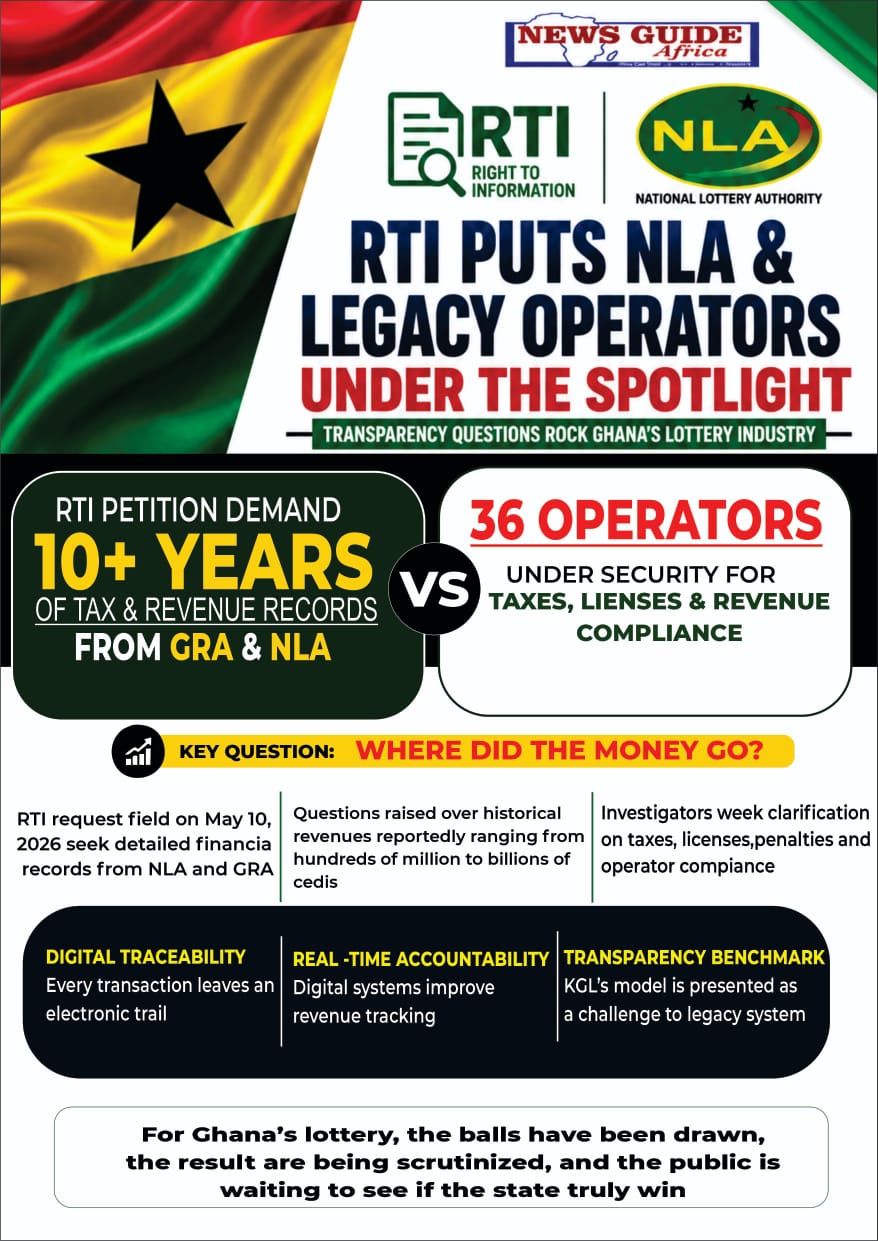
Ghana’s multi-billion cedi lottery and gaming ecosystem is facing an unprecedented demand for transparency, as a sweeping Right to Information (RTI) threatens to upend decades of financial opacity.
Through two formal RTI applications filed on May 10, 2026, Punch Newspaper Managing Editor, Mr. Ayisah Foster, has forcefully petitioned both the Ghana Revenue Authority (GRA) and the National Lottery Authority (NLA). The petitions demand a meticulous, line-item accounting of taxes, license fees, penalties, and revenues from dozens of operators spanning over a decade of lottery operations.
For a sector historically shielded by complex public-private partnerships, the move marks a critical turning point. It also highlights a growing industry schism: while legacy operators face compounding questions over regularizations and revenue leakage, tech-driven giants like KGL Technology Limited are challenging the old guard by setting a new baseline for transparency.
A Dragnet for Accountability
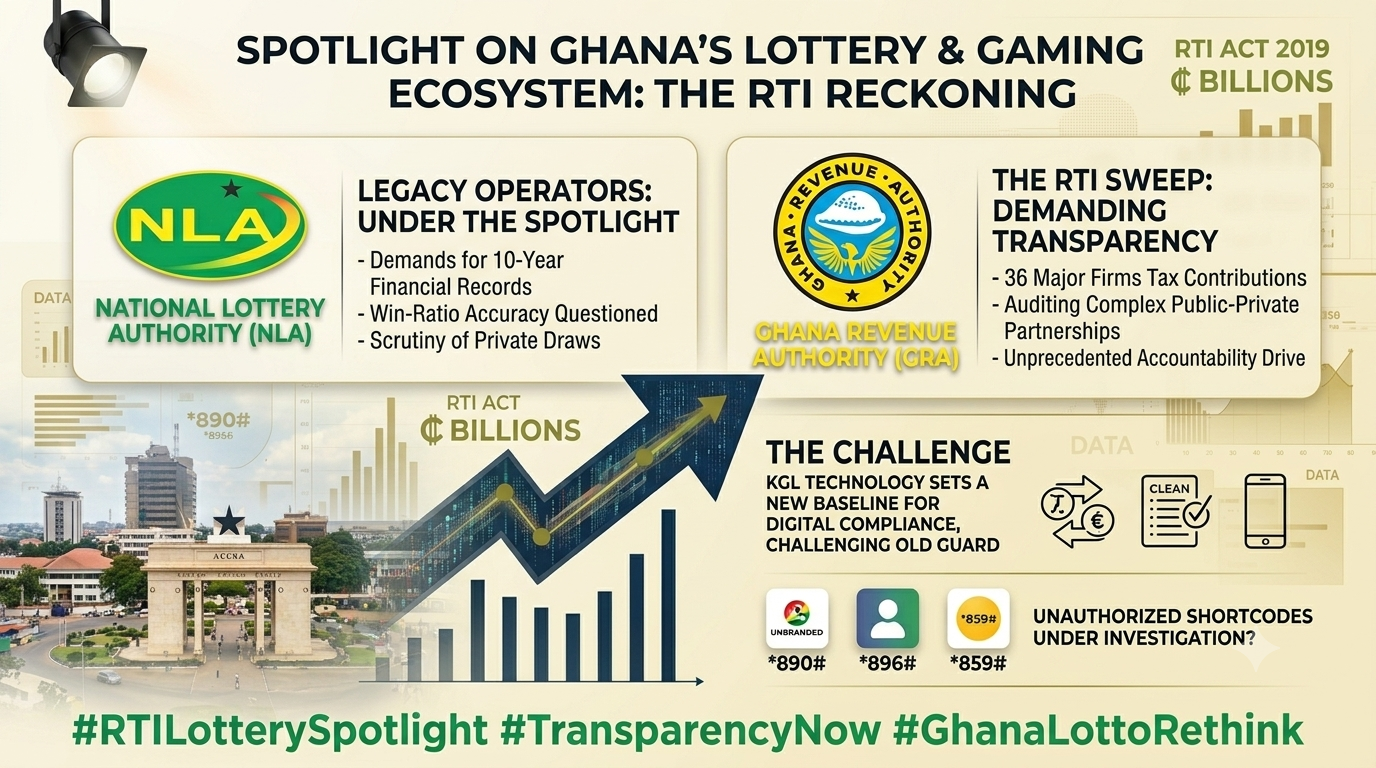
The sheer scale of the information requested under Section 18 of the RTI Act, 2019 (Act 989) indicates that the era of taking regulatory compliance on faith is over. The GRA has been asked to disclose the exact tax contributions of 36 major firms, while the NLA faces a barrage of queries ranging from historical current liabilities (2012–2020) to the specific win-ratios of 5/90 lottery products.
”For too long, the lottery sector has operated in a data vacuum,” noted an industry financial analyst speaking on condition of anonymity. “We hear massive numbers quoted regarding state contributions, but without granular validation, the public cannot distinguish true national revenue from corporate posturing.”
Indeed, one of the most damning prongs of Foster’s petition directly challenges the historical narrative of the NLA’s profitability. The newspaper is demanding hard financial data to prove whether the NLA genuinely generated between ₵500 million and ₵3 billion annually for the Consolidated Fund between 2007 and 2020.
The KGL Factor: Challenging the Legacy System
At the center of this legislative reckoning sits KGL Technology Limited. As a premier digital lottery partner to the NLA, KGL’s operational model has fundamentally disrupted how lottery revenues are tracked and audited.
Unlike the fragmented, cash-heavy operations of traditional Lotto Marketing Companies utilizing physical kiosks and point-of-sale terminals, KGL’s entirely digital framework leaves an immutable electronic trail. By integrating digital checkout systems and direct bank transfers, KGL essentially challenged a legacy system that was structurally prone to under-reporting.
”The digital transition led by KGL proved that you can scale lottery operations while ensuring every single pesewa is accounted for in real-time,” says Kojo Mensah, a digital governance expert. “By operating with an open-ledger ethos, they effectively raised the bar, making the murky operations of older shortcode and third-party applications stick out like a sore thumb.”
The stark contrast between audited digital compliance and legacy ambiguity is precisely what has triggered further scrutiny into other third-party shortcodes. Foster’s petition explicitly demands to know whether operators behind USSD codes like *890# (TekStart Africa), *896# (Alpha Lotto), and *859# (Onassis Sports) were ever officially authorized, or if they have been operating out of bounds.
The Legal Monopoly vs. Private Draws
The scrutiny further extends to the legal boundaries of drawing lotteries. Under Sections 23, 24, and 27 of the National Lotto Act, 2006 (Act 722), the NLA holds an exclusive mandate to conduct and supervise lotto draws. Yet, private operators have routinely broadcasted independent draws.
The RTI application takes direct aim at this friction point, demanding to see the exact revenue the NLA received from live draws conducted by Alpha Lotto Limited on Ghana Television (GTV).
”If the state has a legal monopoly on lottery draws to protect public revenue, any private concession must be tightly audited,” Foster stated in an interview regarding the filings. “We need to know if the state is getting its fair share, or if private entities are capitalizing on state infrastructure for pennies on the cedi.”
A Sector in Transition
With copies of the RTI requests served to the Ministry of Finance and the board chairs of both the GRA and NLA, the state apparatus has been put on notice.
The outcome of these requests will likely redefine the lottery landscape in Ghana. As modern tech operators continue to demonstrate that transparency is not just legally compliant but highly profitable, the pressure on legacy operators and regulators to open their books will only intensify.
For Ghana’s lottery business, the balls have been drawn, the results are being scrutinized, and the public is waiting to see if the state truly wins.
