

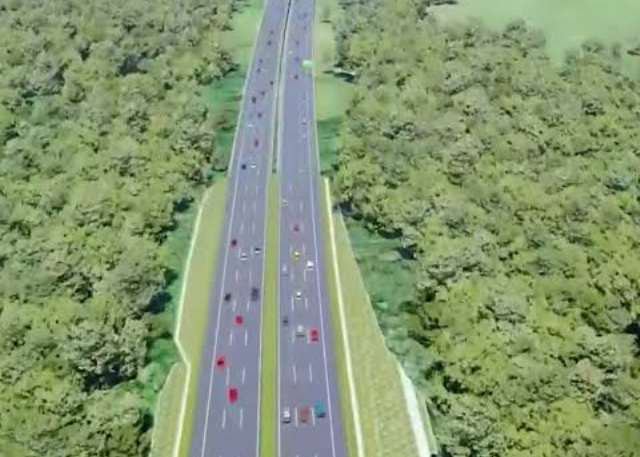
In an unconventional break from traditional developing-nation financing models, the government of Ghana has firmly ruled out external or domestic borrowing to fund the upcoming US$4 billion, 198-kilometer Accra–Kumasi Expressway.
Instead, the state has launched an aggressive fiscal policy overhaul to channel national petroleum revenues and mineral royalties directly into critical, high-impact infrastructure.
The strategic pivot ring-fences domestic resource wealth, seeking to permanently end the cycle of borrowing-led development while aiming to complete the modern six-lane corridor within a strict three-year window.
Speaking to international business executives and economic policy analysts at the Ishmael Yamson & Associates Business Roundtable, Finance Minister Dr. Cassiel Ato Forson detailed the alternative financing structure. He explained that the state has completely halted the practice of spreading oil windfalls across recurrent, low-impact line items, opting instead to pool state resources for high-value national assets.
“Granted, the Accra-Kumasi Expressway is going to cost us $4 billion. We’ll fund it without borrowing,” Dr. Ato Forson confidently declared. “In 2025, 2026, and 2027, we’ll be able to have US$4 billion to link Accra to Kumasi… We’ve said that we must use Ghana’s oil revenue only for infrastructure. All of the imprudent spending, we’ve stopped it. And we are targeting major infrastructure. After 2027, we’ll target another project.”
The government has already successfully mobilized a massive baseline by redirecting mineral royalties—previously held in the Minerals Income Investment Fund for short-term treasury bill investments—straight into the project’s primary development account. With government projections indicating an additional US$1.5 billion surge in petroleum and mining revenues over the current fiscal cycle, total available domestic cash is expected to reach US$2.5 billion by year-end, fully backing construction milestones without foreign debt.
Military acceleration and property compensation
The ambitious project, which stands as a central pillar of the national infrastructure agenda under President John Dramani Mahama, is already rapidly transitioning from design blueprints to active field operations. To bypass lengthy commercial procurement delays and ensure maximum fiscal efficiency, the Ghana Armed Forces are leading the initial clearing and alignment phases.
Providing an operational update, the Finance Minister confirmed that military engineering regiments have already completed extensive site preparations along the corridor.
“An update on the phenomenal work being undertaken by the Ghana Armed Forces on President Mahama’s transformational Accra-Kumasi Expressway project,” Dr. Ato Forson stated. “So far, about 51 kilometers of the entire stretch has been successfully cleared. Steadily, deliberately, and with remarkable professionalism, the foundation is being laid for what will become one of Ghana’s most strategic and economically transformative corridors.”
As heavy machinery moves along the cleared corridor, the state is concurrently addressing local community impact. The Ministry of Finance announced that formal compensation payments to residents and landowners along the alignment path will begin next month, following the completion of data verification assessments by relevant state valuation agencies.
Commuters and shippers anticipate relief from bottlenecks
The announcement has sparked widespread enthusiasm across the national logistics and transport sectors. While the ongoing dualization work on sections of the traditional Accra–Kumasi highway remains separate, this entirely new six-lane expressway is designed to completely reshape travel dynamics between the capital and the middle belt. Featuring eight major modern interchanges—including planned junctions at Accra, Adeiso, Asamankese, Akim Oda, Ofoase, and Kumasi—the high-speed road will bypass traditional traffic chokepoints entirely.
A representative from the national cargo transport unions noted that reducing travel times between the capital and the interior is critical to lowering food and product inflation across the country.
“The current road between Accra and Kumasi is plagued by severe traffic delays, vehicle wear-and-tear, and high accident risks,” the transport representative remarked. “A dedicated, high-speed express route means our cargo trucks can turn around in hours instead of days. If the government can truly deliver this without adding new debt to the national ledger, it will be a historic victory for Ghanaian business owners.”
A post-debt blueprint for West Africa
International economists are watching Ghana’s self-funding strategy closely, viewing it as a critical test case for infrastructural independence. Having recently stabilized its macroeconomic indicators through strict fiscal discipline, the state’s choice to rely on raw resource revenues rather than global credit markets marks a significant paradigm shift.
If the government hits its aggressive target to complete the 198-kilometer express link by 2029, the project could serve as an infrastructure blueprint for resource-rich nations across the continent, proving that sovereign assets can directly build national development.
