

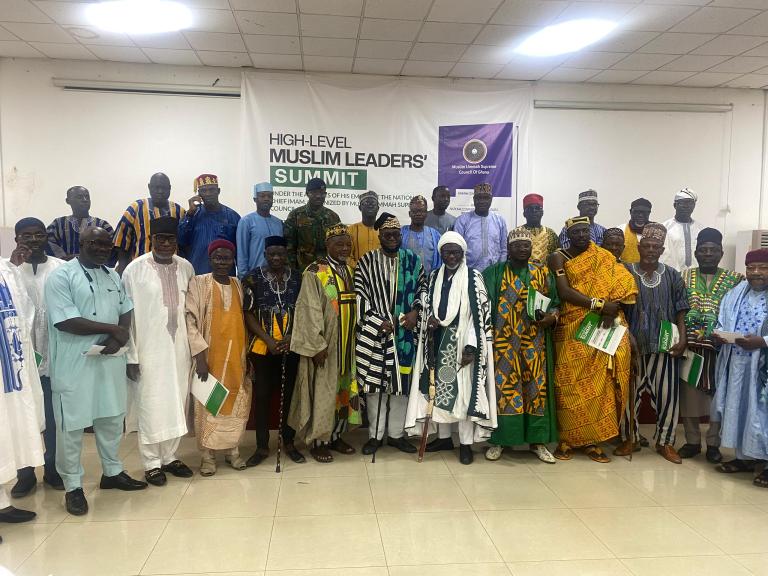
Muslim leaders from across Ghana have wrapped up a landmark summit in Accra with a renewed pledge to strengthen unity within the Ummah, formally endorsing a new constitution to guide Islamic practice and leadership, while also committing to tackle social issues such as youth drug abuse.
The meeting, convened under the authority of the National Chief Imam and organised by the Muslim Ummah Supreme Council of Ghana, brought together clerics and imams from major sects including Ahlusuna wal Jamaa, Shia, Tijaniyya and others. The summit ran under the theme “Towards a Unified Muslim Leadership: Strategies for Ummah Development.”
Northern Region Zango Chief, Sheik Dalhu Abdul Mumin, hailed the gathering as “a major milestone in efforts to build a united and orderly Muslim community in Ghana.” He stressed that the endorsement of the Ummah Constitution by the National Conference of Muslim Representatives represented “a turning point for Muslim leadership and organisation in the country.”
“This summit is all about creating a change in our attitude towards Islam ourselves and the Ummah at large. Allah tells us clearly in the Holy Qur’an that we must hold firmly together and not be divided, and when you look at the condition of Muslims today, the signal is not the best because we are highly divided. With the blessings of His Eminence the National Chief Imam, Sheikh Dr Osman Nuhu Sharubutu, the Ummah has now endorsed this Constitution, and I believe it is high time we move into it and look at the best way of implementing it so that we can be united, orderly and focused on one purpose,” he said.
Sheik Dalhu explained that a comprehensive report of the summit would be submitted to the National Chief Imam to guide the next steps. He noted that the broad participation of sect leaders would help ensure that the decisions reached are effectively communicated to communities at the grassroots.
He also raised concern about the growing prevalence of drug abuse among Muslim youth, particularly in northern Ghana. “It is very unfortunate that a greater portion of the usage of these hard drugs is relating to the Muslim youth. In Tamale and across the north, we have started serious campaigns against this menace. We have task forces working on it, we have used major events like the Damba Festival to spread the message with ‘No to drugs, yes to life’, and we continue to preach in the mosques to explain to the youth that what they are doing is destroying their future and the future of society. If we allow this to continue, it is not just individuals who will die, but whole communities will be destroyed, and that is why chiefs, clerics and security agencies must work together to stop it,” he said.
According to him, collaboration with the police, including interventions from the Inspector General of Police, has begun to show results, with drug-related activities gradually declining in some areas.
Legal practitioner Abdul Majeed Musah, a member of the drafting committee, also shed light on provisions in the new constitution regarding succession to the office of the National Chief Imam. “Succeeding the National Chief Imam is not going to be an election. There is a council through which nominations will come, starting from the community level, moving to the district, region and finally the national level. Representation is key, because if you do not have the majority of mosques or followers at a particular level, you cannot ascend to the next. This system allows Islam,” he said.
The adoption of the Ummah Constitution is widely regarded as a historic step towards strengthening Muslim leadership in Ghana, offering a framework for unity, accountability and development across the Ummah.
