Category: Profile

  • “Communication Is Policy”: PRINPAG and BoG partner to combat economic misinformation

    Dignitaries at the PRINPAG and BoG training workshop


    By Adnan Adams Mohammed


    In a strategic move to safeguard Ghana’s financial stability, the Private Newspaper and Online News Publishers Association of Ghana (PRINPAG) and the Bank of Ghana (BoG) have forged a new partnership to prioritize accuracy and ethical standards in economic reporting.


    The initiative was solidified during a specialized training workshop held at the Peace Holiday Resort, Ada, on Saturday, January 24, 2026. The event, themed “Resetting the Economy: The Role of Journalists, News Publishers and Media Owners,” featured high-level contributions from the central bank aimed at aligning media narratives with national economic recovery efforts.


    A “Launchpad” for Stability


    Delivering an address on behalf of the Governor of the Bank of Ghana, Dr. Johnson Pandit Asiama, the Advisor to the Governor, Dr. Francis Yao Kumah, underscored the progress made over the past year. He noted that Ghana enters 2026 on a stronger footing, with inflation plummeting from 23.8% in December 2024 to 5.4% in December 2025.


    Furthermore, gross international reserves have strengthened to over US$13.9 billion, providing approximately 5.7 months of import cover. However, Dr. Kumah warned that these gains are merely a “launchpad”.


    “Resetting the economy requires resetting expectations from short-termism to patience, and resetting behaviors across the information ecosystem that shapes public understanding,” he stated.


    The Media as an Economic Anchor


    The workshop highlighted the delicate nature of financial journalism, with the BoG emphasizing that “economic information carries weight”. Dr. Kumah argued that a well-informed media acts as an anchor for confidence by contextualizing data and countering misinformation that can trigger market volatility.


    “Our expectation is not compliance but responsibility,” the Governor’s address noted, underscoring the need for accuracy, balance, and appropriateness of context. The Bank cautioned that incomplete or de-contextualized reporting—particularly regarding foreign exchange (FX) markets—can amplify uncertainty.


    New Incentives for Excellence


    To foster this “New Partnership for a New Phase,” the Bank of Ghana announced several proactive measures to support newsrooms:


    Expanded Training: Scaling up specialized sessions on monetary policy, FX operations, and financial stability.


    Editors’ & Producers’ Forum: Establishing a regular forum to provide media gatekeepers with the context needed to guide coverage before major policy cycles.


    Annual Awards: Launching the Governor’s “Economic and Financial Story of the Year” Award. The winner will receive sponsorship to attend the IMF/World Bank Meetings, a move designed to encourage depth of analysis and clarity in reporting.


    Strengthening the Bridge


    PRINPAG leadership and workshop participants welcomed the central bank’s commitment to openness. The Bank’s communications team pledged to maintain open lines for timely clarifications and access to subject-matter experts to ensure every story is well-sourced and confidently delivered.


    “Communication Is Policy”


    Echoing these sentiments, the President of PRINPAG, Mr. David Tamakloe, delivered a powerful message centered on the mantra: “Communication Is Policy.”


    He argued that for any economic policy to succeed, it must be communicated effectively and accurately to the citizenry. “The way we report economic issues can either build investor confidence or destroy it. As journalists, we are partners in national development, and our pens must be guided by the national interest,” Mr. Tamakloe said.


    He noted that the workshop was part of PRINPAG’s broader agenda to build the capacity of its members, ensuring that private media outlets remain competitive and credible in an increasingly volatile information landscape.


    Tackling Misinformation


    The training session comes at a time when Ghana’s economic climate is under intense international and local scrutiny. Speakers at the event noted that “fake news” regarding exchange rates, inflation, and the banking sector often spreads faster than official rebuttals, creating a “perception-led” volatility in the markets.


    Participants were taken through modules on interpreting financial statements, understanding Central Bank operations, and the ethics of financial gatekeeping.


    Speaking to the participants, Dr. Bernard Ato Otabil, Director of Communications at the Bank of Ghana, underscored the delicate nature of financial journalism. He warned that in the modern era of rapid digital dissemination, irresponsible reporting could trigger unnecessary panic and destabilize the national economy.


    “Economic reporting is not just about the numbers; it is about the impact those numbers have on lives and markets,” Dr. Otabil stated. He urged media practitioners to move away from sensationalism and instead focus on evidence-based analysis to help the public make informed decisions.


    Dr. Otabil further highlighted that rising cases of misinformation—often fueled by social media—pose a significant threat to monetary policy. He challenged journalists to verify complex data with official sources before publication, noting that the BoG remains committed to transparency.


    Participants see the workshop as a timely intervention to strengthen the bridge between policy-makers and the Fourth Estate, ensuring that the “Policy of Communication” serves as a tool for economic growth rather than a source of confusion.


    As Ghana navigates a period of economic consolidation in 2026, the consensus from Ada was clear: when the media succeeds in its role, the public understands, and the economy functions better.


  • The Digital Architect: How Julius Neequaye Kotey is Reimagining Ghana’s DVLA


    Julius Neequaye Kotey, DVLA CEO


    By Adnan Adams Mohammed

    For decades, the mention of the Driver and Vehicle Licensing Authority (DVLA) in Ghana conjured images of endless queues, sweltering heat, and the omnipresent “goro boys” lurking in the shadows of the yard.

    It was a bureaucratic fortress that many citizens approached with a sense of dread.

    Fast forward to 2026, and a quiet but radical revolution has taken hold at the Authority’s Weija headquarters and beyond. At the center of this transformation is Julius Neequaye Kotey, the Chief Executive Officer whose leadership has turned a “bureaucratic dinosaur” into a modern, tech-driven powerhouse.

    From Debt to Digital Dominance

    When Mr. Kotey took the helm in January 2025, he didn’t inherit a polished machine. Instead, he met a staggering financial crisis—a debt totaling over $200 million in foreign currency and GH¢300 million locally. His first order of business wasn’t just survival; it was a total “review, reset, and restore.”

    Within just one year, the results are undeniable:

    Revenue Growth: A massive 37% increase in revenue by the end of 2025 alone.

    Efficiency: The clearance of a 440,000-backlog of driver’s licenses that had frustrated Ghanaians for years.

    Modernization: The replacement of chaotic aluminum “Drive From Port” (DP) plates with secure, digital DP Stickers featuring embedded QR codes.


    Bringing the DVLA to Your Doorstep

    Perhaps the most “compelling” aspect of Kotey’s tenure is the decentralization of services. Under his leadership, the DVLA has moved from the gated offices of Accra to the hearts of local communities.

    The 24-Hour Economy in Action: Aligning with national goals, Kotey launched Ghana’s first 24-hour public service centers, starting in Adenta. Citizens can now renew licenses or register vehicles at 2:00 AM, making the “come tomorrow” excuse a thing of the past.

    Going Global: Recognizing the Ghanaian diaspora, the DVLA has expanded its reach with international offices in London, Hamburg, Dubai, Toronto, and Washington. This ensures that Ghanaians abroad can renew their documentation without the “trauma” of long-distance middlemen.

    Community Outreach: From lorry terminal engagements to new offices in places like Mankessim and Bawjiase, the goal is clear: eliminate the “goro boys” by making the official service more accessible than the illegal alternative.

    The 2026 Vision: Smart Plates and Birthday Licenses

    Never one to rest on past laurels, Kotey recently announced a suite of forward-thinking reforms that are set to redefine road safety and compliance in Ghana.

    “My driving philosophy has always been that the day you recognize there is something wrong is the day of ratification,” Kotey noted during a recent stakeholder engagement.

    In January 2026, the Authority began rolling out RFID-embedded number plates. These “detective” plates are not just for identification; they enable real-time verification, help track stolen vehicles, and support the national toll system. Furthermore, in a move praised for its simplicity, driver’s licenses will now expire on the holder’s birthday, supported by an automated SMS notification system to remind motorists before their credentials lapse.


    A Leadership Built on Empathy

    Beyond the software and the security chips, Julius Neequaye Kotey’s leadership is defined by a commitment to the human element. Whether it’s pledging better healthcare and promotion structures for his staff or his “National Service to CEO” journey, he leads with the perspective of someone who has seen the system from every angle.

    As the DVLA continues its evolution into a world-class institution, one thing is certain: under Julius Neequaye Kotey, the “license to believe” in efficient public service has finally been issued to all Ghanaians.


  • DVLA CEO Reflects on One Year of Transformation and Service …as he engages the media

    The Driver and Vehicle Licensing Authority (DVLA) Chief Executive Officer, Mr. Julius Neequaye Kotey, has marked exactly one year since assuming leadership of the institution, describing it as a year of intense work, significant milestones, and shared commitment to excellence.


    In a message titled _Celebrating a Year of Transformation_, Mr. Kotey expressed profound gratitude to key stakeholders for their support. He thanked H.E. President John Dramani Mahama for his vision and confidence in leading the DVLA, and acknowledged guidance from Minister of Transport Hon. Joseph Bukari Nikpe and Chief Executive of DVLA, alongside the Board Chairman Spencer Quaye.


    Mr. Kotey also appreciated his deputies, Foster Akwasi Asante and Mr. Iddissah Yeboah Seidu, and the entire DVLA staff for their dedication. He highlighted the importance of transforming the DVLA into a world-class institution, focusing on digitalization, decentralization, transparency, and efficiency to make services seamless for Ghanaians.


    The CEO outlined plans to accelerate digital efforts, enhance service delivery, and ensure safer roads, positioning the DVLA as a global benchmark in driver and vehicle licensing. He concluded with a message of hope, stating, “The best is yet to come.”

  • Kesarev Akademia Offers Free Online Courses with Global Opportunities

    Natasha Sheiko, Partner at Kesarev


    Ghanaian students and young professionals can now access free online courses on public administration, Russian law, public policy, Russian language, and history through Kesarev Akademia, an online educational platform developed by experts at Kesarev.

    The courses provide a systematic understanding of how public decisions are made, how key institutions operate, and what factors shape political and legal processes.

    Upon successful completion, participants receive a certificate of completion from Kesarev Academy and may be eligible for internships at Kesarev and partner organizations in Russia and globally.

    Kesarev Akademia’s 5 Learning Platforms offer amazing benefits, including scholarships to study in prestigious Russian universities, paid internships across 40 international offices in Russia, and patent right to work in Russia.

    This is a unique chance to develop skills, expand networks, and open doors to new academic and professional possibilities.

    Registration link https://akademia-kesarev.com/en/register

    Contact: Micah Y.B Zing,
    Key Representative of Kesarev in West Africa
    +233544576100 / +79251665235 for further details

  • Abakah Reflects on True Leadership Amidst Party Growth

    Joseph Mensah Abakah, NDC Central Region Deputy Organiser


    In a midweek reflection, Joseph Mensah Abakah, Deputy Central Regional Organiser of the National Democratic Congress (NDC), emphasized that true leadership is rooted in service, loyalty, and grassroots commitment.


    “True leadership is not about titles, but about service,” he stated, highlighting the party’s strength lies in its branches and constituencies.


    Abakah reassured comrades of his dedication, keeping his doors open to address concerns and work collectively towards progress. He lauded hardworking branch and constituency executives, noting their resilience and sacrifice will yield results.


    “Our loyalty, resilience, and sacrifice are never in vain,” he said.


    Positioning himself as a facilitator and problem solver, Abakah affirmed his unwavering commitment to the party and its people, emphasizing the need for leaders who uplift the grassroots.


    “We need leaders who understand that when the grassroots rise, they also rise,” he stated, as the NDC continues to build towards a stronger future.


  • Sudan’s Path to Peace: Prime Minister Idris Presents a Homegrown Vision for Stability to the UN Security Council


    By Adnan Adams Mohammed

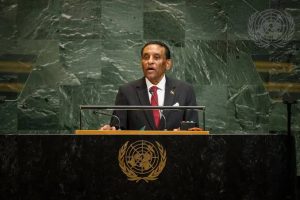
    New York, USA — In a powerful address delivered before the United Nations Security Council on December 22, 2025, H.E. Dr. Kamil El-Tayeb Idris, Prime Minister of the Republic ofI the Sudan, presented a decisive, Sudanese-led initiative aimed at ending the nation’s devastating civil war.

    Facing an existential crisis and an “unbearable price in human lives,” Prime Minister Idris called for a global partnership to replace chaos with order and secure a just future for the Sudanese people.

    The Prime Minister framed the “Government of Sudan Peace Initiative” not as an illusion of victory, but as a responsible choice to stop the bloodshed, protect civilians, and restore state authority. This framework, he noted, is designed to complement and build synergy with the existing American-Saudi Initiative.

    “Today, Sudan does not ask for sheer sympathy, it asks for partnership in securing peace, justice and dignity for its people,” H.E. Dr. Idris stated.

    A Roadmap for Recovery

    The initiative, detailed within the address, outlines a pragmatic, phased approach grounded in international principles and national ownership.

    Key components include:

    Immediate Ceasefire and Withdrawal: The plan demands a comprehensive ceasefire, supervised jointly by the United Nations, the African Union, and the League of Arab States. This crucial first step mandates the withdrawal of the rebel militia (formerly the Rapid Support Forces) from all occupied areas, consistent with the May 11, 2023 Jeddah Declaration of Principles signed by both parties.

    DDR and Accountability: The initiative emphasizes practical security measures, including gathering, registering, and screening militia fighters in designated camps. This process sets the stage for comprehensive Disarmament, Demobilisation, and Reintegration (DDR) programs for those eligible to return to civilian life or integrate into Sudan’s reformed, regular forces.

    Prime Minister Idris stressed that peace must include accountability. The plan carefully balances transitional justice for perpetrators of war crimes, genocide, and human rights violations with policies to regularize the status and ensure the rights of those not involved in atrocities.

    Humanitarian Access and Reconstruction: Addressing the unprecedented humanitarian disaster, the plan prioritizes the safe return of displaced persons and refugees and guarantees the unhindered flow of aid. Furthermore, it pledges the allocation of national and international resources for reconstruction projects in war-affected states like Darfur and Kordofan, supported by microfinance funds to stimulate economic recovery.

    The Path Forward

    Beyond immediate security concerns, the initiative provides a clear blueprint for Sudan’s political future. It mandates community reconciliation conferences to mend the social fabric, followed by a comprehensive Sudanese-Sudanese dialogue to manage the transitional period.

    The ultimate goal remains free and fair elections under international supervision to complete the democraticu transition.
    “History will not remember how complex this conflict was; it will remember whether the world acted when action was possible,” Prime Minister Idris urged the Council members.

    By seeking the Security Council’s undivided attention and full support, the Government of Sudan has presented a viable pathway for the international community to move from being a witness to the nation’s collapse to an active partner in its recovery.

  • Hurray! Non-Interest Banking Finally Here …as Investors and banks rush for license


    By Adnan Adams Mohammed

    The operational guidelines for non-interest banking (NIB) in Ghana have been published by the Bank of Ghana (BoG), marking a significant milestone in the nation’s financial landscape.

    This new framework is set to deepen financial inclusion, promote ethical finance, and integrate Ghana’s banking system with the global non-interest finance industry. The move has generated considerable excitement, with rumors of existing banks and new investors preparing applications for licenses.

    A New Frontier in Finance

    The culmination of this initiative is credited to the efforts of the Governor, Dr. Johnson Asiama, and the advisor on non-interest banking and finance, Professor John Gatsi.

    The updated guideline, following an exposure draft, provides a clear roadmap for operators, ensuring they function within established prudential and regulatory standards.

    This framework introduces a dual application system: existing conventional financial institutions can apply for a dedicated “window” to offer NIB products, while new investors can apply to establish full-fledged non-interest banks.

    Reports suggest at least five existing banks may apply for windows by the end of January, with large investors lining up for full-fledged licenses.

    Key Features of the BoG Guidelines

    The comprehensive Guideline for the Regulation and Supervision of Non-Interest Banking addresses critical operational and governance aspects:

    Corporate Governance: Licensed NIBIs must establish a Non-Interest Banking Advisory Committee (NIBAC) with at least three members who possess expertise in banking, finance, law, and NIB principles. This committee is responsible for ensuring products align with NIB principles and managing risks.

    Operational Segregation: Institutions offering NIB through a “window” must maintain strict operational and financial separation, including operating a separate Non-Interest Finance Fund (NIFF) that cannot be commingled with conventional funds.

    Capital Requirements & Liquidity: Capital requirements for NIBIs will align with existing central bank standards. NIBIs are prohibited from investing in interest-bearing securities and must maintain their reserves and liquid assets in NIB-compliant instruments.

    Tax Neutrality: The guideline also references tax neutrality, an issue expected to be determined by a joint team coordinated by the Ghana Revenue Authority (GRA).

    Accessibility: The BoG has emphasized that non-interest banking is open to all, regardless of religious affiliation, and participation is strictly voluntary.

    Future Outlook: Sukuk and Infrastructure Finance

    The introduction of non-interest banking extends beyond traditional banking services. The Securities and Exchange Commission (SEC) is collaborating with the BoG to develop a harmonized framework for non-interest capital market instruments.

    This collaboration is anticipated to lead to the future introduction of Sukuk (non-interest bonds), which can provide alternative and ethical financing for major infrastructure projects in Ghana.

    Non-interest banking is a significant step towards a more inclusive and resilient financial system, with the potential to revolutionize how the financial sector supports the real economy.

    Welcome to the new era of banking in Ghana!


    Read full Guideline on Non-Interest Banking in Ghana below:


    GUIDELINE-FOR-THE-REGULATION-AND-SUPERVISION-OF-NON-INTEREST-BANKING-IN-GHANA-130126

  • A Marketing Maestro’s Milestone Birthday 

    Mohammed Ali, Head of Marketing Mark at ADB


    as 2A Agency, Publisher of News. Guide Africa wishes Mr Ali Happy birthday 


    Industry leaders and colleagues are celebrating the birthday of Mr. Mohammed Ali, the esteemed Head of Marketing and Communication at ADB Ghana PLC. Described as a “gentle humble man” and “iconic gentleman”, Mr. Ali is being wished a birthday as “bold and innovative as his strategies”.


    In a heartfelt tribute, friends and well-wishers are praising Mr. Ali’s exceptional leadership, vision, and communication skills, which have made him an inspiration to many. “A titan of industry, a maestro of communication”, Mr. Ali is being celebrated for his contributions to ADB Ghana PLC and the marketing community.


    As he marks this special day, Mr. Ali is receiving wishes for “abundance of blessings”, “divine providence”, and “unparalleled triumphs”. Here’s wishing Mr. Mohammed Ali a happy birthday, filled with joy, promise, and fulfillment!

  • Ato Forson extols Sammy Gyamfi’s remarkable contribution towards Ghana’s economic recovery

    Walking the talk

    By Adnan Adams Mohammed

    Dr. Cassiel Ato Forson, Ghana’s Minister of Finance, has highlighted the significant milestones achieved in stabilizing the nation’s economy.

    According to him, pivotal to his success is the strong collaboration between the Ministry of Finance, the Central Bank, Ghana Gold Board, and the unwavering support of President John Dramani Mahama.

    Ghana’s youngest finance minister, in a recent interview on Radio Gold 90.5 FM reflecting on 2025, lauded the contributions of Sammy Gyamfi, praising his drive and determination.

    Sammy Gyamfi, CEO of Ghana Gold Board

    “Sammy Gyamfi has always come to mind. The President has chosen him and he’s a young man with drive. It’s difficult to get such kinds of people around. And you need someone not only with energy, but he has energy, the drive, the determination, and can-do spirit.” Further acknowledging the critical role of the Governor of the Bank of Ghana (BoG) in tightening the money supply and helping to bring down inflation.

    Strategic Reforms and Economic Stabilization

    Dr. Forson detailed the comprehensive measures taken to address inflation and structural issues. “Aside from that I had to tackle inflation, I had to tackle the structural issues like how do I build reserves to make sure the currency stabilizes,” he explained.

    A key initiative mentioned was the introduction of the Gold Bond, a long-term project designed to bolster the country’s reserves. This initiative, combined with the efforts of the Cocoa Board and reforms within the Central Bank, has played a pivotal role in strengthening Ghana’s economic foundation.

    The President’s Vision and Guidance

    Attributing much of the progress to President Mahama’s leadership, Dr. Forson emphasized the importance of the President’s daily involvement and guidance. “There was no way we could achieve even a quarter of what we’ve been able to achieve without the support of the President and his guidance. His vision he has – do this, don’t do this, go here, don’t go here, don’t worry, I’ll back you.”

    He noted that the President’s ability to simplify complex technical issues into layman’s terms has been instrumental in the effective implementation of economic policies.

    “The benefits of his guidance, the benefits of his support, is there for everybody to see,” Dr. Forson remarked.

    Looking Ahead

    With the current trajectory, Dr. Forson expressed optimism for the future of Ghana’s economy. He predicted that the people of Ghana will continue to see a tangible difference in their economic well-being within the next year.


  • NDC Official Urges Grassroots Mobilization for 2026

    Joseph Mensah Abakah new year message


    Joseph Mensah Abakah, Deputy Central Regional Organiser of the National Democratic Congress (NDC) has called on party supporters to rally behind the NDC’s vision for a better Ghana in 2026.

    In a New Year’s message, Abakah praised the party’s grassroots supporters for their loyalty, sacrifice, and resilience, describing them as the “true custodians” of the party’s collective vision.

    He emphasized the need for renewed energy, discipline, and unity among party members to drive inclusive growth and empower small traders, farmers, artisans, and youth.

    Abakah expressed confidence that together, the party can deepen grassroots empowerment and translate opportunities into tangible progress for Ghanaians.

    “Let 2026 be a year of action, unity, and results,” he said, urging party members to work towards building, protecting, and advancing the NDC’s ideals.