Category: News

  • Ato Forson courts support to scrap E-levy, betting tax in first budget

    Finance minister designate


    Adnan Adams Mohammed


    The Finance Minister designate, Dr Casiel Ato Forson, has assured Ghanaians that they can expect the first budget of the current administration – due in March 2025 and covering April to December –  to abolish electronic levy (E-levy), betting tax and the COVID-19 levy. He has insisted that those taxes are nuisance taxes of which he cannot easily identify their nature as to whether they are direct or indirect taxes.

    The betting tax brings in less than GHC50 million annually Dr Ato Forson posited, pointing out that therefore such a tax, if scrapped, cannot significantly affect the country’s fiscal position.

    Also, he explained that, the introduction of the E-levy fights the cashless economy agenda successive governments have tended to pursue. Therefore, the E-levy will be abolished in first budget within the 120 days of the social contract announced by President John Dramani Mahama as promised he said.

    In support of the stance of the minister designate, former Director-General of the National Lottery Authority (NLA), Sammy Awuku, has expressed his excitement over the government’s decision to scrap the betting tax. The current Member of Parliament for Akuapem North on the NPP ticket described it as a counterproductive measure that has failed to yield positive results in other jurisdictions.

    “I’m excited that the betting tax is going to be scrapped,” Awuku stated during an interview last week. “I’ve been consistent about it, even during the NPP era, and I said it is something that personally has not worked in many of the jurisdictions anytime you have introduced taxes on betting.”

    Further expatiating his reasons for his position against the betting tax, the former NLA director said, “Lottery was part of the betting tax. The National Lottery Authority, for instance, is owned by the government, and apart from the things that they do, at the end of the day, they must also contribute to the national kitty” he explained.

    This, he argued, created an unfair advantage for illegal betting operators, as players were more likely to choose operators who did not levy taxes on winnings.

    “If the government is taxing itself, then what will happen is that the underground operators that we call the illegal operators will become emboldened,” Awuku continued. “If you play with the government, you attract a 10% tax on what you win. But if you play with the illegals, you get

    your full money. So, I told them that, for me, it was counterproductive.”

    Awuku also expressed concern over the initial stance of the Finance Minister-designate, who had previously advocated for an outright ban on betting and lottery activities. “

    Meanwhile, the Member of Parliament for Tano North, Dr Gideon Boako, is cautioning the Mahama government against introducing alternative taxes in disguise following the resolve to scrap the e-levy and betting taxes, emphasising the potential implications of such a policy shift. Dr Boako believes it could result in significant revenue shortfalls that the government would struggle to address, arguing that, such shortfalls would conflict with the requirements of the International Monetary Fund (IMF), which demands robust revenue generation to meet debt servicing obligations.

    “I think by and large, he [Ato Forson] has done his part, but unfortunately, it wasn’t enough,” Dr Boako stated. “For instance, he was asked how he plans to make up for the revenue shortfalls from scrapping the taxes, and he said he would cut expenditure. However, cutting expenditure does not address the problem because the IMF focuses on debt service to revenue ratio, not debt service to expenditure ratio,” he said.

    The former economic advisor to the at the vice president office further explained that while expenditure cuts might offer temporary relief, they do not resolve the fundamental issue of generating enough revenue to match debt servicing obligations.

    He warned that the IMF would ultimately insist on finding new sources of revenue, which could lead to the introduction of additional taxes.

    “We don’t want a situation where you give with the right hand and take with the left hand,” he remarked, urging policymakers to consider the long-term impact of their decisions.

    He called for a more comprehensive approach to addressing Ghana’s fiscal challenges. He cautioned against creating false hope by abolishing taxes only to replace them with alternative levies, urging the government to be transparent and pragmatic in managing the country’s revenue needs.


  • Ghana’s economy to grow further amidst forex stability – Fitch

    Ghanaian currency and forex


    Adnan Adams Mohammed

    Fitch Ratings is optimistic of Ghana’s economy developing strong resistance against external shocks this year with real GDP growth projected to increase.

    The cedi’s exchange rate is expected to stabilise within the year and inflation also expected to decline.

    These improvements in the key  macroeconomic performance  indicators and the operating environment are predicted to absorb any further shocks to the banking sector’s capital base, following the deterioration inflicted by the domestic debt exchange programme and the surge in the non-performing loans ratio.

    “Solvency pressures stemming from Ghana’s (public debt) default have not translated into heightened liquidity pressures. This is primarily due to the sector’s funding structure, which is dominated by domestic deposits, and therefore includes limited market and external debt”, explained the latest Fitch report on Ghana, published last week.

    “Foreign-currency liquidity coverage is expected to remain high, but local-currency liquidity remains reliant on treasury bills.”

    The report added, “The Eurobond exchange, completed in October 2024, has improved Ghana’s access to international finance and lowered local-currency liquidity pressures, which resulted in Fitch upgrading Ghana’s Long-Term Local-Currency Issuer Default Rating to CCC+ from ‘CCC’.”


    Meanwhile, the Ghanaian banking sector is projected to have brighter prospects as solvency recovers from the sovereign default and operating environment pressures reduce.

    These factors come as the sovereign external debt restructuring nears completion and the economy begins to stabilise, says Fitch Ratings in its new special report.

    “These themes underpin our improving outlook for the Ghanaian banking sector in 2025. The sector’s strong profits in 2023 and 2024 were a result of high yields on treasury bills. High profits are driving a recovery in capital after the Domestic Debt Exchange Programme (DDEP) imposed large losses on the sector after its launch in December 2022. The full capital impact continues to be disguised by regulatory forbearance and accounting treatment, but we believe strong profits will support a further capital recovery in 2025, ensuring the vast majority of banks are capital-compliant by end-2025 when regulatory forbearance expires.”

    Ghana’s DDEP concluded in 2023 and Fitch expects the external debt restructuring to be completed in early 2025.

    While the sector shows signs of strength, challenges persist. The non-performing loan (NPL) ratio climbed to 22.7% in October 2024 from 18.3% a year earlier, the Bank of Ghana (BoG) reported in its November 2024 Monetary Policy Committee (MPC) statement.

    Fitch projects that high yields on government securities will continue to strengthen banks’ capital positions in 2025, setting the stage for sustained recovery. However, adherence to strict credit standards and effective recapitalisation will be critical to addressing lingering vulnerabilities.


  • Commodity markets outlook promising for cocoa and gold

    Commodity markets (cocoa and gold )


    Adnan Adams Mohammed

    Cocoa and gold have been projected to record strong performances on the commodity market, according to analysts.

    Databank Research’s market outlook for 2025 indicates that the Gold price, which surged by 25.6% in 2024 due to geopolitical tensions and inflation concerns are anticipated to rise further this year. Gold prices are expected to range between US$2,600 and US$3,100 per ounce, driven by potential interest rate cuts from the U.S. Federal Reserve and sustained demand for gold from central banks.

    Cocoa prices are also forecasted to remain elevated, closing this year between US$ 7,000 and US$ 9,600 per tonne. However, amidst the optimism cocoa and gold, Brent crude oil is projected to continuously face difficulties.

    Ghanaian investors are encouraged to diversify their portfolios by considering gold-backed securities, such as the Ghana Gold Coin introduced by the Bank of Ghana, as a hedge against economic uncertainties.

    Persistent supply challenges, exacerbated by the implementation of the EU Deforestation Regulation, are expected to constrain global cocoa output.

    Conversely, Brent crude oil prices, which declined by 20.31% in 2024, are projected to stabilize below US$ 76 per barrel in 2025. Factors such as high U.S. inventories, economic slowdowns in major consuming nations, and a global shift toward cleaner energy are likely to weigh on demand.


    With these trends, 2025 presents diverse opportunities for investors, particularly in gold and cocoa, while the oil market may require cautious navigation amidst ongoing challenges.


  • Dr Manteaw expresses confidence in Edward Bawa for the GNPC role on a 3-point criteria 

    Edward Bawa and Dr Steve Manteaw


    Adnan Adams Mohammed


    Energy industry expert, Dr Steve Manteaw, has expressed confidence in the appointment of Edward Abambire Bawa as the Acting Chief Executive Officer of Ghana National Petroleum Corporation (GNPC).


    Base on a three-point criteria used in his analysis of the fitness of any appointee to his or her, which are; academic qualifications, relevant experience to the mandate of the particular office and understanding of the challenges of the office. Per these criteria, Dr Manteaw marked the appointee (Mr. Bawa) as fit for the office.


    Dr Manteaw is an authority in the extractive and energy industry management and governance as a civil society activist.


    Edward Abambire Bawa, an experienced hands in the energy sector, has been appointed as the Acting Chief Executive Officer for the Ghana National Petroleum Corporation (GNPC).


    His appointment, effective Friday, January 17, 2025, under the authority of the President, John Dramani Mahama, is in accordance with Article 195(1) of the Constitution and Section 10(2) of the Ghana National Petroleum Corporation Act, 1983 (P.N.D.C.L.64).


    The appointment is pending the required advice from the Honourable Minister for Energy, in consultation with the Public Services Commission. The President’s decision underscores his commitment to ensuring effective leadership within the GNPC.


    In a letter signed Dr Callistus Mahama, Secretary to the President, Mr Mahama extended his congratulations to the former legislature.


    Mr Bawa comes to the office with Masters in Business Finance and  Management from University of Liverpool and with eight years of experience serving on the Parliamentary Committee on Mines and Energy.


    Dr Manteaw noted that, having encountered the Mr Bawa on a number of occasions, believes in his openness and responsiveness to criticism,  suggesting that if the appointee continues to conduct his official duties in such manner, he will succeed in the office.


    The expert advise the appointee to first work on uniting the staffs at GNPC as they are divided on NDC and NPP political lines. Although, he admitted that, Mr Bawa has a huge responsibility in ensuring industry players are compliance and ensuring due diligence.


    Edward Abambire Bawa (born on Saturday, 1 September 1973) is a Ghanaian politician and a two time Member of Parliament. He was a member of the Seventh and the Eighth Parliament of the Fourth Republic of Ghana representing the Bongo Constituency in the Upper East Region of Ghana on the ticket of the National Democratic Congress.


    Edward Bawa was booted out of parliament in the NDC Primaries as he was beaten by private legal practitioner Lawyer Charles Bawadua during their primaries in 2023.


    Mr Bawa served on the Poverty Reduction strategy Committee and the Mines and Energy Committee of the Eighth (8th) Parliament of the Fourth Republic of Ghana.


  • Sammy Gyemfi fixed: heads to PMMC in wait of GoldBod formation

    Sammy Gyemfi, Actg MD of PMMC


    Adnan Adams Mohammed

    The National Communications Officer of the NDC, Sammy Gyamfi ESQ have been appointed Acting Managing Director of Precious Minerals Marketing Company.

    He will serve in this capacity awaiting the establishment of the Ghana Gold Board within 60 days.

    The Ghana Gold Board (GoldBod) was promised by the NDC in its 2024 manifesto.

    Read statement below:

  • Fisheries sector stakeholders commends Mahama 

    Emelia Arthur, Fisheries Minister designate


    Adnan Adams Mohammed


    Stakeholders in the fisheries sector have commended President John Mahama and the NDC-led government for maintaining the Ministry of Fisheries.


    The stakeholders also extended appreciation to the president for nominating, Hon Emelia Arthur as the Fisheries Minister designate.


    The Covener of Fisheries Alliance, Kyei Kwadwo Yamoah, described the nominee as well qualified in that capacity.


    “We look forward to working with Hon. Emelia Arthur, when she is approved to deliver the important policies in the NDC manifesto on fisheries”, Mr Yamoah indicated in a statement.


    Read statement below:


    Open letter to the President. H.E. John Mahama


    Mr. President, Fisheries Stakeholders Appreciate your Commitment to the Fisheries Sector


    We thank Mr. President for maintaining the Ministry of Fisheries and Aquaculture and nominating a very qualified minister designate Hon. Emelia Arthur for the sector


    Your Excellency, this shows your commitment to developing the fisheries sector and we are very much appreciative of this commitment.


    We look forward to working with Hon. Emelia Arthur, when she is approved to deliver the important policies in the NDC manifesto on fisheries including:


    · Mo-NE-YO initiative to promote the uptake of special pension schemes for informal sector workers that includes fishermen.


    · Revitalize, the fisheries and aquaculture sector and promote the development of the Blue Economy through the establishment of the Blue Economy Commission to sustainably harness and regulate our marine and freshwater resources


    · Provide resources to support research and development in the fisheries sector


    · Enforce laws to sustain fish stock and fishing practices


    · Improve education in fishing communities and develop alternative livelihoods for fisher folks to improve their well-being and reduce pressure on fish stocks.


    · Support landing beach Committees to create Fisheries Services Center (FiSC) to supply necessary equipment and services to fisher folks.


    We know Hon. Emelia Arthur, will be able to deliver because she has extensive experience in fisheries, agriculture, natural resources management and gender inclusion. She has worked with fisheries stakeholders and various NGOs and stakeholders in Ghana, particularly in her role as Deputy Regional Minister and the Shama District Chief Executive. Hon Emelia Arthur has been involved in supporting initiatives related to the fisheries sector in Ghana. She advocated for the construction of state-of-the-art fishing harbors and fish processing plants, indicating her commitment to enhancing the industry and creating job opportunities. She has been involved in various initiatives, including the establishment of an Agriculture Support Scheme to benefit local farmers, fishers and enhance agricultural development in the area.


    Hon. Emelia Arthur established the IADI (Integrated Agricultural Development Initiative) which has several key goals aimed at enhancing agricultural productivity and sustainability. These include:


    Boosting Food Security: Ensuring that communities have access to sufficient, safe, and nutritious food through improved agricultural and fishing practices.

    Promoting Sustainable Farming and fishing Practices: Encouraging environmentally friendly and sustainable agricultural and fishing methods to protect natural resources.

    Increasing Farmer and fisher Incomes: Supporting farmers and fishers in increasing their yields and accessing markets to enhance their income potential.

    Empowering Farmers and Fishers: Providing training and resources to enhance the skills and knowledge of farmers and fishers, particularly women and youth.

    Strengthening Agricultural and Fisheries Value Chains: Creating a more efficient agricultural system by connecting farmers and fishers with suppliers, processors, and markets.

    Facilitating Access to Finance: Helping farmers, fishers and agricultural businesses access funding and credit facilities to invest in their operations.


    Kyei Kwadwo Yamoah

    Convener:

    Fisheries Alliance / CSOs SDG 14 Platform


  • Constituencies affected by galamsey call on Mahama to issue directives against galamsey

    Kyei Kwadwo Yamoah,
    Executive Director, HELP Foundation Africa


    Residents in constituencies affected by illegal mining (galamsey) have called on the President, H.E John Dramani Mahama, to as a matter urgency halt all small scale mining activities in forest reserves and along water bodies in accordance to his 120 days social contract promise.


    In a press statement signed by the Executive Director of HELP Foundation Africa, Kyei Kwadwo Yamoah, the residents reveals there is still mining activities on going currently in spite of the harmattan conditions.


    This has forced Ghana Water Company to stop water treatment and supply for public in some parts of Western Region since the sources of water have been heavily polluted.


    “Your Excellency, we respectively recommend that you make a bold Directive on ‘Galamsey’ to deter recalcitrant Illegal miners, who continue to degrade forest resources, cocoa farms and continue to pollute water bodies”, the statement urged.


    Read statement below:


    From Voices of Constituencies Affected by galamsey


    Your Excellency, we acknowledge that in your first 120 Days Social Contract with the People of Ghana, you have promised to: “Ban illegal and new mining activities in forest reserves. Roll out our ‘Tree for Life’ and Blue Water Initiative’ to heal and sustainably harness the environment by turning areas and water bodies degraded by illegal mining into economic and ecological recovery hubs.”


    We commend you for this very good call, we are however concerned that though there is change in government, illegal mining activities are still ongoing unabated with the continuous destruction of forest, cocoa and farm farms and pollution of water resources in most parts of the country. We are also worried that the illegal mining menace may escalate if there is no directive to immediately halt all illegal mining activities now.


    Your Excellency, we respectively recommend that you make a bold Directive on “Galamsey” to deter recalcitrant Illegal miners, who continue to degrade forest resources, cocoa farms and continue to pollute water bodies, etc.


    We also remind you Sir of your earlier commitment to:


    • Repeal the Environmental Protection (Mining in Forest Reserves) Regulation 2022 (L.I. 2462).


    • Enforce existing mining laws, investigate the allocation of mineral licenses in forest reserves and prosecute politically exposed persons and traditional leaders complicit in illegal mining.


    • Develop a comprehensive strategy to promote sound environmental governance, protecting our forests, rivers, and ecosystems for future generations.


    We believe that a decentralized approach to enforcing the ban on illegal mining with a direct charge to the District Security Council (DISEC) and the Regional Security Council (REGSEC) may produce the desired results.


    Kyei Kwadwo Yamoah

    Executive Director

    HELP Foundation Africa

    For Constituencies Affected by Galamsey


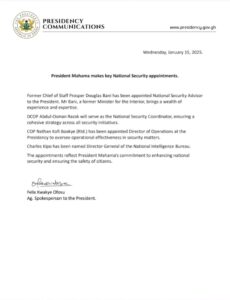
  • Kofi Boakye heads Security Operations at the Presidency.. Prosper Bani now National Security Advisor 

    President Mahama Security Team


    The Office of Presidency has released a statement announcing the heads of the national security.


    COP Nathan Kofi Boakye (Rtd) becomes Director of Operations at the Presidency in charge of security matters.


    Prosper Bani, former Interior Minister has been appointed National Security Advisor to the government with DCOP Abdul Razak Osman appointed, National Security Coordinator.


    Charles Kipo also heads the National Investigation Bureau.


    Read statement below:

  • Jinapor orders ECG to halt all payment amidst looming crisis… as Mahama considers ECG privatisation

    Electricity company of Ghana

    Adnan Adams Mohammed

    The Minister-Designate for Energy, John Jinapor, has directed the Electricity Company of Ghana (ECG) to immediately suspend all payments for supplies as part of a broader strategy to address inefficiencies and stabilize the power sector.

    Jinapor emphasized that this directive is backed by the Chief of Staff and aims to halt financial leakages within the company.

    Highlighting ECG’s financial struggles, Jinapor revealed that the company is grappling with significant revenue losses, with over 40% of generated power unaccounted for. He warned ECG staff, particularly those in the finance directorate, that ignoring the directive would lead to severe consequences.

    “The challenge of money emanates from inefficiencies,” Jinapor said in an interview last week after his nomination. “If ECG loses over 40% of its power generated, no matter what you do, you cannot find a solution.”

    He is worried that, while other countries are doing just about 2-4% losses. In Ghana, for each US$100 worth of power, ECG collects only 60%.

    “On top of that, there are numerous deductions for contracts, quality assurance, IT, and other provisions” he added.

    Jinapor also pointed out that ECG operates over 70 accounts, making effective monitoring and control nearly impossible.

    As part of his reform agenda, he pledged to streamline the company’s operations by consolidating its accounts and implementing measures to ensure financial discipline.

    “All those numerous accounts will be closed. We need some serious buffers to anchor the system. This sector needs reform, and we will reform it,” Jinapor stressed.

    The Minister-Designate assured the public that these measures are necessary to stabilize the power sector and improve service delivery, promising significant reforms to enhance the efficiency of ECG’s operations.

    Meanwhile, President John Dramani Mahama has signalled the potential privatisation of the Electricity Company of Ghana (ECG) as part of efforts to tackle longstanding inefficiencies in the country’s power distribution system. Speaking during a meeting with a World Bank delegation at his private office in Accra last week, President Mahama expressed confidence that private sector involvement could help resolve critical challenges such as operational inefficiencies, financial mismanagement, and poor service delivery within ECG.

    “If we don’t fix the Electricity Company of Ghana, we will continue to face major problems across the entire power value chain,” President Mahama said, underscoring the urgency of reforms. He asserted that privatising ECG’s distribution operations could introduce the efficiency required to modernise the energy sector and meet Ghana’s increasing energy demands.

    Reflecting on Ghana’s earlier engagement with the Millennium Challenge Corporation (MCC) Compact during his tenure as Vice President, Mahama emphasised the pivotal role of an efficient energy distribution system in driving national development goals.

    The President reassured stakeholders that any decision to privatise ECG would be approached cautiously, with extensive consultations to balance public interest and the sector’s need for improved performance.

    “We want to engage with the World Bank to leverage their expertise in implementing this initiative,” he stated.

    Mahama further explained that privatisation would form part of a broader strategy to modernise Ghana’s energy infrastructure, ensuring sustainability, reliability, and enhanced service delivery

    for citizens and businesses.

    Also, further to solving the dire, critical situation of ECG’s management, the Member of Parliament for Evalue-Ajomoro-Gwira, Arko Nokoe, has advocated for strategic reforms in Ghana’s power sector to minimize losses and enhance efficiency. The legislator, in an interview last week, expressed frustration over the bureaucratic processes in the retail chain, which he believes foster inefficiencies, wastage, and theft.

    “Why can’t ECG privatize the retail aspect of our power sector?” he questioned. “It’s incredible how customers struggle to acquire a new meter. This system needs a shake-up.”

    The MP emphasized the importance of introducing private sector players to the retail side of electricity distribution. He proposed reforms that would allow private entities to handle critical

    areas like the supply of transformers, metering, and the sale and purchase of electricity.


    “It’s about time we had other players within the retail aspect of our energy sector,” he stated, adding that competition and innovation would drive efficiency and improve customer satisfaction. “Government remains ECG’s largest debtor, accounting for over 80% of the company’s debt. This is unacceptable,” he lamented. “We cannot expect the ECG to function efficiently when its largest client fails to honor its obligations. It’s time for the government to lead by example and settle its debts promptly. If we want to see real progress, this must change.”

    The MP stressed that addressing the government’s debt and privatizing the retail aspect of the power sector could create the financial stability and operational efficiency needed to stabilize and transform Ghana’s electricity distribution framework.

    Nokoe’s call comes at a time when the new NDC government is faced with a looming “dumsor” challenge. His proposal adds to the ongoing discussions on how best to revamp the country’s energy sector for sustainable growth and development.

  • Mahama focuses on creating well-paying jobs for Ghanaians… as AGI calls for tax reforms

    Job creation


    Adnan Adams Mohammed

    In restoring the hopes of Ghanaians in the Ghanaian economy and improved living standards, President John Dramani Mahama has reiterated his commitment to create decent and well-paying jobs for Ghanaians.

    He vowed to prioritize the welfare of Ghana’s youth, focusing on job creation to tackle the country’s unemployment rate during his swearing-in ceremony last week.

    While acknowledging the hardships faced by Ghanaians due to poor governance and economic mismanagement by the previous administration, President Mahama in his speech emphasized his commitment to creating an inclusive government, where the voices of the people are heard.

    “My administration, along with my Vice President, will prioritise inclusivity, accountability, and innovation, forging pathways that will lead to the upliftment of all of our people”, he said. “In this resounding victory, I see a clarion call, particularly from the youth of Ghana, and this moment is a powerful affirmation that your voices matter and that your future must be our priority. Our policies will be tailored to sustain innovation and foster an industry that engages today’s young minds. We will create decent and well-paying jobs in collaboration with the private sector and captains of business.”

    Meanwhile, the Association of Ghana Industries (AGI) has urged President Mahama’s new government to promptly honor its commitment to streamline Ghana’s tax system. The association believes this would provide much-needed relief to struggling businesses. Highlighting the challenges faced by manufacturers, AGI noted that growth in the sector has been stifled by tax complexities that hinder efficiency and expansion.

    The Greater Accra Regional Chairman of the AGI, Tsonam Akpeloo, in an interview last week, stressed that simplifying the tax process is crucial to supporting the government’s ambitious plan for a 24-hour economy.

    “Our view is that this year should remain a year that would witness a proper cancellation of some of these nuisance taxes. And if we see that happen, you would begin to witness a situation where industry, especially the manufacturing component of industry, will grow tremendously. If you observed last year, even though there appeared to be an increment in the GDP growth rate of industry, the real manufacturing sector is actually not growing.”

    Tsonam stressed the need for a rationalized tax regime to ease the financial burden on businesses. He said these comprehensive tax reforms will stimulate growth, enhance competitiveness and attract investments to boost the economy. He also expressed optimism that under President Mahama’s leadership, the government will address the concerns of the business community and implement policies that foster industrial development.

    “The manufacturing sector is not growing because most of these taxes and other factors are making it difficult for us to grow. And so we want a situation where the issues are properly dealt with this year, especially to ensure that the government will essentially promise a 24-hour economy, will really take some of these bold steps, to promote proper industrialisation.”