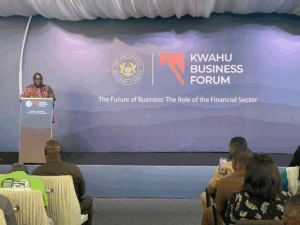
President John Mahama addressing business leaders at the Kwahu Business Forum, reaffirming his commitment to private sector-led growth.
Adnan Adams Mohammed
The President John Mahama administration has pledged to promote the private sector, to position it as a key driver of Ghana’s economic recovery and long-term development.
The president’s resolve follows a declaration he made last week that, government will not extend the ongoing Extended Credit Facility (ECF) programme with the International Monetary Fund (IMF) when it ends in April next year.
The ECF came with stringent conditions and reforms which have in some ways impacted negatively on private businesses and individual households due to enhanced domestic revenue mobilization through introduction of new taxes and increases in some already existing tax rates; reduction in the fiscal deficit through restraints in government spending; structural reforms in tax policy and public financial management; and comprehensive public debt restructuring to address high public debt levels. Also; the Bank of Ghana is required to maintain a tight monetary policy stance, which has affected lending rates and increased the cost of doing business.
“After we complete the programme, we will continue to manage government expenditure responsibly and maintain disciplined economic management, creating more space for private sector growth”, President Mahama affirmed while speaking to business leaders in a follow-up session at the Kwahu Business Forum.
“If the private sector thrives, the economy thrives. If the private sector is happy, the government is happy. It is the private sector that can absorb and employ the teeming youth graduating from all levels of our educational system”, he said.
Highlighting the limits of public sector employment, Mahama noted: “When you add up all government employees, from watchmen to chief executives, you’re talking about fewer than a million people — approximately 800,000 — in a population of 33 million.”
He stressed: “Even if we doubled that number, we would still face a major youth unemployment challenge. The only sector that can adequately absorb the growing number of young people entering the workforce is the private sector.”
Meanwhile, President Mahama reassured the business community of his government’s commitment to making revenue mobilization more business-friendly and transparent, emphasizing that his administration has no intention of introducing new taxes that could threaten the survival of businesses or encourage tax evasion.
“I noticed that when the Ghana Revenue Authority (GRA) was introduced, everybody applauded — you applauded the GRA. The GRA is your friend. I can assure you they are your friend, and they will become even more business-friendly because I believe the solution to our situation is not to pile on more taxes,” President Mahama said.
He further stated, “The solution is to make taxes more transparent and fair to encourage greater compliance. If you keep adding more taxes, people will inevitably find ways to avoid them. That was the same argument we made against the previous government’s introduction of the E-Levy.”
Reflecting on the impact of the E-Levy, President Mahama added, “We warned that people would find ways to avoid paying it — and they did. Instead of solving financial challenges as promised, people simply cashed out their wallets and reverted to using cash to sidestep the new levy.”
Nii Lantey Vanderpuye, National DRIP Coordinator inspects roads in Greater Accra
The Member of Parliament for the Bortianor Ngleshie Amanfrom Constituency, Hon. Felix Akwetey Okley, has assured residents of his constituency that the deplorable Old Barrier to Aplaku stretch of the Atta Mills Highway in the Constituency would be reshaped and maintained starting this weekend.
He was addressing drivers and commuters after an inspection tour of the road with Hon. Nii Lantey Vanderpuye, the National Coordinator for DRIP on Wednesday.
Together with officials of the Ga South District Assembly and J.A. Plant Pool, they walked on the bad road from the Old barrier taxi rank, through Downtown, and to Puma.
The National DRIP Coordinator assured the assembly officials that, he had instructed the engineers at J.A Plant Pool to temporarily release seven qualified machines and truck operators for this emergency.
Hon. Akwetey assured the District Coordinating Director of his willingness to fund the initial cost of the materials needed for the work.
Also, the Coordinating Director assured that she would immediately summon the works and roads engineers for an urgent meeting to address all pertinent issues in order to ensure a successful execution of the assignment.
The Atta Mills Highway connecting communities like Aplaku, Bortianor, Kokrobite, Oshihe, Tuba, Nyanyano, and Fetteh to the main Mallam/ Weija Highway at Old Barrier.
Ga Central Tour
Meanwhile, the National DRIP Coordinator, in response to residents calls in the Ga Central District paid a familiarisation visit to the CP area of the district to inspect the condition of their roads. He lamented the deplorable road network and assured the residents that he would liaise with the new District Chief Executive and the assembly to utilise the DRIP machines to effectively change the situation very soon.
Section of the CP road
“I can’t believe that these roads are in Accra and in the Greater Accra region. This is unacceptable, and we shall reset it soon. ” Hon. Nii Lantey Vanderpuye assured the people.
NIB and Goldbod officials addressing press with suspects standing
Adnan Adams Mohammed
The Ghana Gold Board security taskforce has swing into action barely a month of its operationalisation, arresting three foreign nationals in a gold smuggling syndicate.
The three suspects: Goutam Katriya, 35; Miraj Sarvaych, 22; and Manash Damani, 42, are Indian nationals who are in the business of trading gold in Kumasi and Accra for Unique MM, a company allegedly owned by one Musah Salifu.
The suspects were arrested at their private residence around Atinga Junction in Kumasi, which has been converted into a gold trading center. The suspects were arraigned before the Achimota Circuit court yesterday and remanded into custody for a period of two (2) weeks.
“The arrest was based on a tip off from a patriotic whistle blower that the suspects were purchasing gold at “black market” rate for the purpose of smuggling”, the Director of Investigations at National Security, Chief Superintendent Osman Alhassan, disclosed at a press conference in Accra. Further indicating that, “an amount of 1.9 million cedis, 4,500 rupees, 4.363 kilograms of gold, two counting machines, a CCTV recorder and an Indian passport were found in the possession of the suspects.”
Indian Gold Smuggling Suspects
Read statement below:
*THREE SUSPECTED GOLD SMUGGLERS ARRESTED BY GOLDBOD SECURITY TASKFORCE, REMANDED INTO CUSTODY BY CIRCUIT COURT*
29th April, 2025
Three (3) suspected gold smugglers have been arrested by the GoldBod security taskforce.
The three suspects — Goutam Katriya, 35, Miraj Sarvaych, 22, Manash Damani, 42, are Indian nationals who are in the business of trading gold in Kumasi and Accra for Unique MM, a company allegedly owned by one Musah Salifu.
The suspects were arrested at their private residence around Atinga Junction in Kumasi, which has been converted into a gold trading center.
The arrest was based on a tip off from a patriotic whistle blower that the suspects were purchasing gold at “black market” rate for the purpose of smuggling.
The suspects were arraigned before the Achimota Circuit court yesterday and remanded into custody for a period of two (2) weeks.
At a press conference in Accra, the Director of Investigations at National Security, Chief Superintendent Osman Alhassan, disclosed that an amount of 1.9 million cedis, 4,500 rupees, 4.363 kilograms of gold, two counting machines, a CCTV recorder and an Indian passport were found in the possession of the suspects.
Preliminary investigations by National Security so far revealed, that none of the three suspects possess a valid license that allows them to purchase or deal in gold in the country.
The suspects who been dealing in gold in Ghana for over a decade, have not been able to adduce any residence permit or work permit or tax payment records on their business operations.
Additionally, it’s been revealed that Musah Salifu, a Ghanaian, who is alleged to be the sole shareholder of the Unique MM, is only a front for Goutam Katriya, the real beneficial owner and alter ego of the company.
Chief Superintendent Osman Alhassan cautioned both Ghanaians and foreign nationals against violating the provisions of the Ghana Gold Board Act and other laws governing the gold trading sector of the country.
“This arrest is only the beginning of GoldBod’s ruthless war against illegal gold trading and gold smuggling. We know that the arrested suspects smuggle gold through unapproved border points into India. This has serious negative consequences for the Ghanaian economy. We are still gathering intelligence on several illegal gold traders and smugglers. And very soon, we shall take necessary action.” he said.
The suspects are to remain in NIB custody until May 12, 2025, when they are expected to reappear before the court.
In a related matter, the GoldBod has reiterated its directive for all foreigners in the gold trading sector to exit the market by 30th April, 2025.
All persons dealing in gold have also been directed to trade in Ghana cedis and at the Bank of Ghana Reference Rate.
A breach of these directive, shall constitute a punishable offense under the GoldBod Act, 2025 (ACT 1140). This was contained in a Press Release issued by the GoldBod dated 23 April, 2025.
President John Mahama’s Adwumawura Initiative targets 2000 businesses to receive comprehensive support in the phase one of its implementation.
With about 10,000 youth businesses receiving free business advisory supports yearly.
President Mahama yesterday launched the Adwumawura Programme Initiative, a flagship programme designed to create jobs and empower youth across the country.
The Adwumawura Programme aims to create, track, and monitor young businesses annually, with a special focus on the youth. This program is a fulfillment of his campaign promise to prioritize youth empowerment and job creation.
President John Mahama at the launch of Adwumawura Initiative
Speaking at the launch of the program at Prempeh Assembly Hall in Kumasi, President Mahama emphasized that the Adwumawura Programme would not be a mere fanfare, but a fully funded initiative with adequate allocation by the Ministry of Finance in the 2025 budget.
President Mahama said that the program is committed to stimulating youth employment through a nationwide selection to empower youth employment initiative programs. The program aims to provide access to funding, coaching, and mentorship to young entrepreneurs, enabling them to grow their businesses and create jobs.
“The Adwumawura Programme is not a mere policy initiative but a declaration of faith in the extraordinary potential in the Ghanaian youth. It is our commitment to nurturing the ambitions and translating their ideas into thriving enterprises that will drive our nation’s progress.
Adwumawura Programme seeks to stimulate youth employment entrepreneurship and innovation across key strategic sectors of our economy. Through a nationwide selection process, we will incubate its new businesses and accelerate existing ones,” he added.
According to him, about 10,000 youth are targeted every year for four years, with a focus on providing comprehensive business advisory services to support them.
The Adwumawura Programme is being implemented in partnership with the National Entrepreneurship and Innovation Programme (NEIP), which would provide machines and equipment for businesses, market access facilitation, and other forms of support.
He President noted that a neutral body would be used to select businesses, with some starting this year and others in the following year, based on their potential for creation.
He disclosed, “the selection process for the program would be inclusive, with opportunities for youth in vocational schools, tertiary institutions, and senior high schools,” stressing that about 60% of the beneficiaries would be drawn from unemployed youth, women, the disabled, and youth from rural areas, to help contribute meaningfully to global youth employment indicators.
The President urged interested youth to log onto the program’s platform to apply and create jobs, ensuring that their businesses would be supported. He also announced that there would be trade expeditions for all companies supported by the program to showcase their products, as part of efforts to address inclusivity, facilitate access to funding, and partner with markets.
President Mahama called on traditional leaders and civil society organizations (CSOs) to partner with the government to invest in the young people through the Adwumawura Programme. He expressed his expectation that the program would lead to an increase in job creation, employment, and economic growth, ultimately building a better Ghana.
The launch of the Adwumawura Programme Initiative marks a significant step towards addressing youth unemployment and promoting entrepreneurship in Ghana. With its focus on inclusivity, access to funding, and comprehensive business advisory services, the program has the potential to make a meaningful impact on the lives of young people across the country.
As the President , noted, the program is not just an initiative, but a commitment to stimulating youth employment and building a better Ghana.
In its first phase, the top 2,000 implementable business proposals will receive comprehensive support, including:
Business Development Training: Equipping young entrepreneurs with the skills and knowledge needed to succeed in business.
Mentorship: Pairing young entrepreneurs with experienced business leaders and mentors.
Access to Start-up Capital: Providing financial support to help young entrepreneurs turn their business ideas into reality.
Marketing and Networking: Offering platforms for young entrepreneurs to showcase their products and services, and connect with potential customers and partners.
“Stakeholders express optimism and caution as Ghana launches its Feed Ghana food security initiative.”
Adnan Adams Mohammed
Government’s efforts to tackle Ghana’s food security challenges with the launch of its Feed Ghana Programme have met with significant stakeholders concerns.
While some are optimistic of the outcome, others are skeptical fearing the usual political interference could derail efforts in the right direction. The Greater Accra Poultry Farmers Association (GAPFA) has expressed strong confidence in the Feed Ghana Programme, describing it as a transformative initiative capable of significantly enhancing Ghana’s food systems.
However, the Peasant Farmers Association of Ghana (PFAG) is calling on the government to avoid political interference in the rollout of the newly launched Feed Ghana Initiative. According to the Association, political involvement in the distribution of agricultural inputs under the previous Planting for Food and Jobs (PFJ) Programme—particularly in its second phase—significantly undermined the programme’s impact. They fear a repeat could jeopardize the success of the current initiative.
“Now that we’ve transitioned from PFJ to Feed Ghana, we must avoid the mistakes of the past. Political interference must be completely ruled out,” the PFAG Executive Director Bismark Nortey said in an interview last week following the launch of the Feed Ghana Initiative. “The Ministry of Food and Agriculture has competent technical staff at the national, regional, and district levels who are capable of managing this programme effectively. Let’s allow them to lead. Politicians should take a step back.”
PFAG believes that empowering technical experts rather than political appointees is key to ensuring the sustainability and success of agricultural policies in Ghana.
Spearheaded by President John Dramani Mahama, the Feed Ghana Initiative is a cornerstone of the broader Agriculture for Economic Transformation Agenda (AETA). Its objectives include modernizing farming practices, increasing food production, improving agricultural infrastructure, and establishing agro-industrial zones across the country.
The initiative also aims to generate employment, reduce food inflation, and promote national food self-sufficiency.
Meanwhile, President of the Executive Council of the Greater Accra Poultry Farmers Association (GAPFA), Anim-Somuah noted that the programme arrives at a critical time, as organized farmers are actively seeking opportunities to scale up their operations and boost productivity.
“As farmers, we have positioned ourselves to embrace this opportunity, expand our farms and feed this country. It is not beyond our scope or horizon to do this,” he stated.
According to Anim-Somuah, GAPFA is not just any farming group, but a well-established force in Ghana’s agricultural landscape, with a dynamic network of around 800 active poultry farmers. In addition, many non-members frequently rely on the association for their poultry-related needs.
“We can help in this direction, because the Greater Accra Poultry Farmers Association can pride itself on being the largest organized poultry farmer association in Ghana. We can boast of the greatest membership,” he noted confidently.
In a sector often dominated by men, GAPFA also distinguishes itself with one of the largest women farmer groups in the country—an asset that, according to Anim-Somuah, uniquely positions them to help drive the success of the Feed Ghana Programme.
“Our numbers give us strength. With them, we can support this programme and support it very well,” he emphasized.
Consequently, many economists have called on the government to prioritize agricultural productivity as a buffer against growing global trade tensions.
This comes after the International Monetary Fund (IMF) has just revised its global economic growth forecast for 2025 down to 2.8%, a notable drop from the 3.3% projection made in January.
The downward revision is largely attributed to escalating trade disputes—especially between the United States and its trading partners—stemming from new tariffs.
Among such economists is, Prof. Godfred Bokpin, who has shared his view that the current economic situation should be a turning point for Ghana to revamp its agricultural sector.
“If you look at Ghana, we’re not even producing enough to feed ourselves, let alone think about exporting,” Prof. Bokpin said. “We rely heavily on imports from countries like Burkina Faso, Mali, and Niger—so there’s definitely room to grow.”
He emphasized that current challenges also present opportunities: “We have the potential to transform our economy through agriculture, agribusiness, and agro-processing. Once we achieve self-sufficiency, we can look toward exporting to neighbouring countries. Africa’s food deficit runs into billions of dollars—there’s a huge market waiting.”
“Ghana prepares to regulate cryptocurrency trading with the introduction of the VASP Act.”
By Toma Imirhe
Following the announcement by the Bank of Ghana Governor, Dr Johnson Asiama that the central bank will commence regulating the issuance, trading in and use of cryptocurrencies by September this year, the financial services industry and digital currency dealers and users have started warming up for what they see as a new era of financial trading opportunity.
The impending Virtual Assets Service Providers (VASP) Act will grant the BoG authority to license and supervise cryptocurrency exchanges, wallet providers, and other virtual asset services. This aligns Ghana with regional peers like Nigeria, Kenya, and South Africa, which have already introduced crypto regulations.
While the final text of Ghana’s VASP law is pending, details of the impending regulatory framework have begun to be gleaned from official statements.
One relates to licensing and oversight. Under this component the BoG will mandate licensing for all virtual asset service providers, including exchanges, brokers, and wallet operators. Unlicensed entities face severe penalties, mirroring Kenya’s model, where unlicensed operators risk fines up to 20 million shillings (about. US$150,000) or imprisonment. A dedicated Digital Assets Unit within the BoG will oversee compliance, echoing similar structures in Nigeria and South Africa.
Anti-Money Laundering (AML) and consumer safeguards will also be provided under the law. Providers must implement AML/CFT (Combating Financing of Terrorism) measures, including customer due diligence and transaction monitoring, in line with the Financial Action Task Force (FATF) standards. Data protection and cybersecurity protocols will be enforced, requiring adherence to frameworks like Ghana’s Data Protection Act (2012) and Cybersecurity Act (2020).
With regards to financial stability and market integrity, the BoG will emphasize capital adequacy, solvency requirements, and risk management for licensed firms to prevent systemic shocks. Initial Virtual Asset Offerings (IVAs, akin to Initial Capital Offerings) will require regulatory approval to curb fraudulent schemes.
Foreign-owned crypto businesses must cede 30% equity to Ghanaian investors, a rule already applied to fintech firms under existing laws. Licensed entities must maintain a registered office in Ghana, ensuring accountability and easier enforcement
The BoG Governor’s announcement, made in Washington in the United States against the back drop of the Spring meetings of the International Monetary Fund and the World Bank, marks a pivotal shift in the country’s financial regulatory landscape. Over the past seven years the BoG and the Securities and Exchange Commission (SEC) had maintained a cautious stance, issuing warnings about the unregulated nature of digital assets like Bitcoin and Ethereum. In 2018, the BoG explicitly cautioned financial institutions against facilitating crypto transactions, citing volatility and fraud risks. Rather the central bank had focused its efforts on launching its own national digital currency to be known as the e-cedi, in line with similar efforts being pursued by several central banks around the world.
However, the rapid adoption of cryptocurrencies for cross-border payments, remittances, and investments coupled with the rise of virtual asset platforms has necessitated a structured regulatory approach a stance which has been made even more imperative by the strong support for cryptocurrencies expressed by America’s President Donald Trump .
“World Bank and IMF revise growth projections amid global economic uncertainty.”
Adnan Adams Mohammed
The World Bank Group has revised its projection on Ghana’s 2025 Gross Domestic Product (GDP) growth rate downwards by 0.4 % to 3.9% from its earlier projection of 4.3%.
The Bretton Woods institution explained that; persistent inflationary pressures and ongoing external vulnerabilities were the key reasons for the downgrade. Highlighting climate-related risks (particularly, unpredictable weather patterns that have disrupted cocoa production in Ghana), it also warned that, climate-induced events such as floods and droughts continue to erode national budget revenues across Africa by up to 9%, causing economic setbacks of between 2% and 5% in terms of growth.
The Group’s revised rate, as contained in the April 2025 edition of the Africa’s Pulse report, is significantly different from other major projections on Ghana’s economic growth in 2025. The Standard Bank has projected the highest growth rate forecast of 5.4% for Ghana in 2025 with the African Development Bank Group also forecasting 4.3% growth for Ghana in 2025 while DataBank Research predicts the lowest growth rate forecast, of 3.6% for Ghana in 2025. However, Ghana’s 2025 budget targets a real GDP growth rate of at least 4.0% and a non-oil GDP growth rate of at least 4.8%.
Meanwhile, over the medium-term, the World Bank remains cautiously optimistic about Ghana’s prospects, projecting a rebound to 4.6% growth in 2026 and 4.8% in 2027 rating Ghana among a few African economies showing early signs of recovery from 2025.
“Business activity in Mozambique and Ghana rebounded in February 2025,” the Group noted in its new report published last week. “The modest uptick in Ghana was driven by increased demand and a resurgence in new business engagements.”
High-frequency indicators, particularly the Purchasing Managers Index (PMI), suggest an uptick in business activity. Ghana’s PMI rose from 47.9 in January to 50.6 in March, indicating improved demand, easing supply bottlenecks, and renewed investor confidence following the December 2024 presidential elections.
Across the region, Sub-Saharan Africa’s economic growth is expected to rise slightly from 3.3% in 2024 to 3.5% in 2025, with further acceleration to 4.3% by 2026–2027.
However, the continent’s overall trajectory remains constrained by expected weak performances in its three largest economies—Nigeria, South Africa, and Angola. Excluding these, the rest of Sub-Saharan Africa is projected to grow by 4.6% in 2025, rising to 5.7% by 2027.
Still, the World Bank has warned that elevated downside risks—including global policy uncertainties, climate shocks, and fiscal constraints—pose ongoing threats to a sustained and inclusive recovery across the continent.
In related news, the International Monetary Fund (IMF) has sharply cut its global growth forecast 2.8% in 2025, a significant drop from the 3.3% forecast made in January, as contained in the newly published IMF’s April 2025 World Economic Outlook (WEO), which cites escalating trade tensions with the United States announcing a wave of new tariffs and trading partners responding with their own countermeasures, creating ripple effects across global supply chains and dampening investor sentiment.
It also cites mounting policy uncertainty as the other main culprit behind the lower growth forecast.
“Since the release of the January 2025 WEO Update, a series of new tariff measures by the United States and countermeasures by its trading partners have been announced and implemented, ending up in near-universal US tariffs on April 2 and bringing effective tariff rates to levels not seen in a century.
“This on its own is a major negative shock to growth. The unpredictability with which these measures have been unfolding also has a negative impact on economic activity and the outlook and, at the same time, makes it more difficult than usual to make assumptions that would constitute a basis for an internally consistent and timely set of projections.
“Given the complexity and fluidity of the current moment, this report presents a ‘reference forecast’ based on information available as of April 4, 2025 (including the April 2 tariffs and initial responses), in lieu of the usual baseline. This is complemented with a range of global growth forecasts, primarily under different trade policy assumptions.
“The swift escalation of trade tensions and extremely high levels of policy uncertainty are expected to have a significant impact on global economic activity. Under the reference forecast that incorporates information as of April 4, global growth is projected to drop to 2.8 percent in 2025 and 3 percent in 2026—down from 3.3 percent for both years in the January 2025 WEO Update, corresponding to a cumulative downgrade of 0.8 percentage point, and much below the historical (2000–19) average of 3.7 percent,” part of the report read.
In advanced economies, growth is now expected to slow to 1.4% in 2025, with the U.S. economy seeing a notable downgrade—now projected at 1.8%, nearly a full percentage point below previous estimates.
In emerging markets and developing economies, growth is expected to slow down to 3.7% in 2025 and 3.9% in 2026, with significant downgrades for countries affected most by recent trade measures, such as China. Global headline inflation is expected to decline at a pace that is slightly slower than what was expected in January, reaching 4.3% in 2025 and 3.6% in 2026, with notable upward revisions for advanced economies and slight downward revisions for emerging market and developing economies in 2025.
The IMF has flagged intensifying downside risks, warning that a deeper trade war, rising financial instability, and fragile policy buffers, could worsen the economic landscape. Vulnerable emerging markets could face capital flight, currency pressures, and increasing debt burdens.
The Fund however noted that a reversal or de-escalation of current trade policies could offer a reprieve and potentially revive global growth.
“Intensifying downside risks dominate the outlook. Ratcheting up a trade war, along with even more elevated trade policy uncertainty, could further reduce near- and long-term growth, while eroded policy buffers weaken resilience to future shocks. Divergent and rapidly shifting policy stances or deteriorating sentiment could trigger additional repricing of assets beyond what took place after the announcement of sweeping US tariffs on April 2 and sharp adjustments in foreign exchange rates and capital flows, especially for economies already facing debt distress.
“Broader financial instability may ensue, including damage to the international monetary system. Demographic shifts and a shrinking foreign labor force may curb potential growth and threaten fiscal sustainability. The lingering effects of the recent cost-of-living crisis, coupled with depleted policy space and dim medium-term growth prospects, could reignite social unrest. The resilience shown by many large emerging market economies may be tested as servicing high debt levels becomes more challenging in unfavorable global financial conditions.
“More limited international development assistance may increase the pressure on low-income countries, pushing them deeper into debt or necessitating significant fiscal adjustments, with immediate consequences for growth and living standards. On the upside, a de-escalation from current tariff rates and new agreements providing clarity and stability in trade policies could lift global growth,” it added.
The report calls for coordinated policy action, urging nations to work together to restore predictability in trade, strengthen debt sustainability, and address long-term structural challenges like demographic shifts and migration.
A recent meeting between the Women of Dignity Alliance (WODA) and media representatives from a prominent organization shed light on the pressing issues faced by sex workers, including stigma, discrimination, and limited access to justice and healthcare.
The discussion emphasized the need for responsible and ethical reporting on these issues, highlighting the impact of sensationalized stories and stereotypes on vulnerable populations.
The meeting brought to the forefront the importance of understanding the complexities of sex work and the need for nuanced reporting that considers the human aspects and emotional challenges faced by sex workers. Participants stressed that the media plays a crucial role in shaping public perception and influencing policy, and therefore, it is essential to prioritize accuracy, empathy, and respect in reporting.
The organization’s advocacy efforts aim to initiate a conversation on the decriminalization of sex work, emphasizing the need for collaboration with powerful stakeholders, including the police and media, to address stigma and discrimination faced by marginalized female sex workers. By working together, the goal is to create a safer and more supportive environment for vulnerable populations.
Key concerns raised during the meeting included the barriers preventing sex workers from accessing justice, healthcare, and other support services, largely due to the criminalization of sex work and societal stigma. Participants also highlighted the importance of prioritizing safety, security, and ethical considerations when reporting on sensitive topics, particularly those involving vulnerable populations.
The discussion also touched on the benefits of decriminalization, including improved access to healthcare and reduced stigma. The organization shared examples of support services, such as commodities, healthcare, and empowerment training, that help sex workers navigate their circumstances.
Ultimately, the meeting underscored the need for a balanced and informed approach to reporting on sex work, one that prioritizes the dignity and well-being of individuals and promotes a more nuanced understanding of the issues at hand.
The Ghana Gold Board (GoldBod) has officially opened its portal to facilitate online application for gold trading and related services licensing.
In line with earlier announcement of revocation of all previous licenses under the previous gold trading regime pursuant to the GoldBod operationalisation, all gold traders and service providers effective today, Wednesday, 23 April, 2025.
In a press statement signed by the Media Relations Officer, it listed the categories of licenses that can be applied for effective immediately are as follows: Aggregator license; Self-financing Aggregator license; Buyer license (tier 2); and Buyer license (Tier 1).
“Other licenses such as Refining License, Smelting License, Fabrication License, Storage License, Transportation License, Importation License among others, may be applied for effective July 2025”, the statement said.
Read Full Press Statement Below:
PRESS STATEMENT
23 April, 2025
For Immediate Release:
GOLDBOD COMMENCES LICENSING OF SERVICE PROVIDERS
The Ghana Gold Board (GoldBod) wishes to inform the general public, particularly stakeholders in Ghana’s gold trading sector, that we are commencing the licensing of Service Providers effective today, Wednesday, 23 April, 2025.
A Ghanaian, 18 years and above or a fully-owned Ghanaian company may apply to the GoldBod for a license online via the GoldBod’s official website, goldbod.gov.gh or physically, at the license office of the GoldBod located at our main office in Accra.
The categories of licenses that can be applied for effective immediately are as follows:
• Aggregator license
• Self-financing Aggregator license
• Buyer license (tier 2)
• Buyer license (Tier 1)
Other licenses such as Refining License, Smelting License, Fabrication License, Storage License, Transportation License, Importation License among others, may be applied for effective July 2025.
All relevant information about the mandate, policies and operations of the GoldBod can be accessed from our website, goldbod.gov.gh.
A person may send a message to or make inquiries from the GoldBod through our website.
An applicant must carefully read, understand and accept the Terms and Conditions of a license before proceeding to apply for same.
The GoldBod wishes to reiterate its earlier directive to all foreigners to exit the local gold trading market effective April 30, 2025. A breach of this directive shall constitute a punishable offense under the Ghana GoldBod Act, 2025 (ACT 1140). A foreigner may however apply to the GoldBod to off-take gold from the GoldBod.
Additionally, the GoldBod in line with its mandate to oversee and regulate the gold trading sector, reiterates its earlier directive for all gold traders to buy and/or sell gold at the official Bank of Ghana (BoG) Reference Rate published on www.bog.gov.gh.
The GoldBod looks forward to working with all stakeholders to restructure and streamline the gold trading sector to optimize national benefits. We count on the full cooperation of the public and shall continue to prioritize your feedback.
Julius Debrah speaks at Kwahu Business Forum, 2025
Adnan Adams Mohammed
Government has assured of its full commitment to facilitate all necessary assistance to indigenous Ghanaian businesses in the agri-business chain and export focused businesses following the Kwahu Business Forum.
As government promise to financially resources over 600 businesses through banks and financial institutions, targeting 5 businesses per a bank at a time each year from the 16 regions of Ghana, it has tasked the Presidential Advisor on the Economy to spearhead the initiative
into an export focused national policy.
The concept of the forum birthed from the presidency, has high potent of success as government dedicate much attention to it.
“The President has directed that in the addition to all the effort being made by the Minister for Trade Industry and Agri-bussiness is also nominated the Presidential Adviser of Economy, Seth Terkper, at the Presidency to have an oversight responsibility on this project” Julius Debrah, Chief of Staff said in his closing remarks at the just ended maiden edition of the Forum.
“Anybody who is having challenges in regard to an objective set here can always reach out to the Presidency and attention will be paid to and ensure that the time you spent here has not been wasted in vain.
The Chief of Staff, who hosted the event in his hometown, has also dedicated his personal commitment to plant a legacy that will elevate indigenous businesses to international standard.
“Next year is going to see an expanded event more of trade fair, an international standard event that will have a fair alongside the forum.
“There are going to emerge indigenous business Advisory Council where they will select very indigenous people that are going to ensure that they really grow the bussiness groups and will be attached to the President on his international trade and investment trips outside the country to mount an exhibition of Ghanaian products with international standards finishing to help position Ghana as the leading exporter in the West African countries”, Mr Debrah added.