Category: News

  • Cedi rebounds from world’s worst to best performing currency

    “The cedi’s rebound is underpinned by booming gold and cocoa exports, IMF-backed reforms, and monetary tightening.”

    By Toma Imirhe

     In a remarkable turnaround, the Ghanaian cedi has emerged as the world’s best-performing currency in 2025 – according to data from Bloomberg – appreciating nearly 16% against the U.S. dollar since April and trading at GH₵13.20 as of early May 2025.

    This resurgence marks a stark contrast to its status as the worst-performing currency in 2022, when it lost over 55% of its value amid a debt crisis and inflationary spiral, with the exchange rate peaking at over GHc16 to US$1 subsequently. The cedi’s rebound has injected optimism into Ghana’s economy, easing inflation to 21.2% in April and revitalizing business confidence.

    To be sure, many economists and financial market analysts, not drawn into politically motivated pessimism, had expected that the cedi’s sharp depreciation since late 2022 – including 19% depreciation in 2024 alone – would be stemmed upon the assumption of office of a more fiscally restrained and measured President John Mahama administration, but even they have been surprised by the sheer intensity of the currency’s rebound.

    Several factors have driven the cedi’s dramatic rebound, one of them being the strategic interventions of the country’s central bank. The Bank of Ghana (BoG) has played a pivotal role through aggressive monetary tightening and forex market interventions. In March 2025, the BoG surprised markets with a 100 basis-point hike, raising the policy rate to 28% to curb inflation and attract foreign capital. By April, it injected US$490 million into the forex market, stabilizing liquidity and driving the interbank rate from GH₵15.36 to GH₵14.91 overnight. These measures, combined with a shift to spot-market forex auctions, have reassured businesses of dollar availability, reducing speculative dollar hoarding.

    Another pivotal factor has been the commodity revenue windfall arising out of the ongoing price surges in two of Ghana’s main traditional exports, gold and cocoa. Ghana’s status as the world’s sixth-largest gold producer has proven transformative. Surging gold prices—from US$2,000 per ounce in 2024 to US$3,400/ounce in May 2025— boosted export revenues to US$11.6 billion in 2024,up from US$7.6 billion in 2023. This trend is now accelerating further. Instructively, Ghana earned US$2.72 billion from gold exports alone during first four months of 2025 up from US$900 million during the corresponding period of 2024.

    Cocoa prices nearing US$10,000 per ton have further bolstered inflows, combining with gold, oil and non- traditional exports to take Ghana’s trade surplus to a long term high of US$4.3 billion in 2024 – despite continued cocoa production sluggishness and a backlog of unfulfilled supply contracts from the previous crop season that are now having to be met at barely a quarter of current market prices.

    Yet another factor has been the impacts of the ongoing three year International Monetary Fund programme, which includes a US$3 billion financial bail out and an insistence on a return to demand management economic management policies to restore macroeconomic stability after the near-chaos that reigned from late 2022 to late 2023. The current government’s austerity measures—halting GHc 65 billion in arrears payments and reducing treasury bill yields from 28% to 15%— have curbed debt pressures and attracted renewed investor confidence. Political stability post-2024 elections, marked by President Mahama’s decisive reforms, have further solidified market trust.

    There has been a key external factor too in that the dollar’s depreciation, driven by U.S. tariff wars and a falling Dollar Index (DXY) from 108 to 99 in 2025, have amplified the cedi’s relative strength. At the same time retaliatory tariffs from China and the EU have weakened global dollar demand, diverting capital flows to emerging markets like Ghana.

    Going forward, government and optimistic financial analysts are looking up to the Gold Board initiative, the spike in gross international reserves to US$9.4 billion by the start of May, rising cocoa production – most of which is now being sold at close to the relatively high spot market prices – and the falling cost of imported petroleum products, to cumulatively discourage speculative demand for forex and further strengthen the cedi’s exchange rate over the coming months.

    However, they acknowledge that potential pitfalls exist as the rebound remains fragile for now.

    While the cedi’s rally is commendable, its longevity hinges on addressing structural vulnerabilities

    One is Ghana’s commodity dependence amid global markets price volatility. Ghana’s reliance on gold and cocoa exports—accounting for 60% of forex earnings—leaves it exposed to price swings. A downturn in gold prices or cocoa yields (due to climate or disease) could reverse gains. The IMF warns that import dependency (especially on items such as, fuel and machinery) and a US$3.6 billion Eurobond repayment schedule between 2025 and 2028 could strain reserves


    There are also monetary policy potential pitfalls. Despite inflation easing, the BoG remains cautious about rate cuts. Economists note that utility price hikes and lingering inflation threats – with inflation still more than twice the upper end of the 6–10% target – may delay monetary easing. Overly aggressive rate cuts could reignite inflation or speculative attacks on the cedi..


    Then there are political and fiscal risks. Ghana’s public debt-to-GDP ratio, though improving, remains elevated at over 70%. The success of the Debt Sustainability Plan, to be unveiled in July 2025, is critical for maintaining investor confidence. Political strategy shifts or lax fiscal discipline could undermine reforms.

    Finally the threat of global headwinds remains a clear and present danger. The U.S. Federal Reserve’s interest rate trajectory and China’s economic slowdown pose risks.


  • Inflation to fall further… as global food inflation expected to decline

    “Lower global food prices and a resilient local currency have contributed to easing inflation in Ghana.”


    Adnan Adams Mohammed


    Ghana’s rate of inflation declined to 21.2 percent in April, 2025, the lowest in eight months.


    The improvement from the 22.4% recorded in March reflects the fifth consecutive month of disinflation.


    This means consumer prices fell by 0.8% month-on-month during the period under review as analysts attribute the improvement to a stronger local currency which has helped curb import-related price pressures.


    Both food and non-food inflation moderated during the period, contributing to the downward trend.


    Food inflation slowed to 25.0% in April from 26.5% in March, while non-food inflation decelerated to 17.9% from 18.7%.


    “The Consumer Price Index (CPI) for April 2025 was 258.6, up from 213.3 recorded in April 2024. This represents a year-on-year inflation rate of 21.2%, meaning that the general price level in April 2025 was 21.2% higher than in April 2024”, Government Statistician, Alhassan Iddrisu, announced in Accra last week. “This marks a 1.2 percentage point decrease from the previous inflation rate of 22.4%, indicating that inflation slowed by 1.2 percentage points over the period. Encouragingly, this is the fifth consecutive time that inflation has declined.”


    Meanwhile, analysts had projected a further slowdown in Ghana’s inflation for April driven by relatively stable petrol pump prices and a steadier cedi.


    A report by Databank Research anticipated that the disinflation trend will persist, supported largely by improved food supply dynamics. However, on the broader outlook, the report warned that sustaining this downward momentum will hinge on monetary policy decisions.


    It warns that any premature interest rate cut, particularly at the upcoming May 2025 Monetary Policy Committee meeting, could reverse the gains, despite the policy rate having been raised to 28 percent in March.


    “These marginal drops indicate a balanced contribution from both sectors of the consumer basket”, the Government Statistician added.


    Consequently, global food prices are expected to decline for a second consecutive year in 2025, driven primarily by a significant slump in rice prices, as abundant global supplies and relaxed export restrictions weigh on the market.


    The World Bank’s latest Commodity Markets Outlook forecasts a 7% year-on-year decrease in its food price index, with each of its three main sub-categories, grains, oils and meals, and other food items, projected to record declines.


    Grain prices are expected to see the steepest fall, dropping by 11%, largely due to a projected 29% plunge in rice prices.


    This outlook is attributed to strong global production and the easing of India’s export restrictions.


    India, which accounts for about 40% of global rice exports, is projected to increase output by 5% in the 2024-25 season. Globally, rice production is forecast to rise by 2%.


    Despite this short-term weakness, rice prices are expected to remain relatively stable in 2026, as both supply and demand are projected to grow in tandem, according to early estimates from the International Grains Council.


    Wheat prices are also likely to trend downward through 2026, amid concerns about trade-related demand. However, the decline may be cushioned by tight supply conditions.


    While global wheat output is close to record levels, it is anticipated to fall slightly below consumption, resulting in reduced inventory levels.


    Maize prices, on the other hand, are expected to ease by 2% in both 2025 and 2026. Weaker crude oil prices, dampening ethanol demand, alongside growing U.S.-China trade tariffs are likely to suppress demand.


    Additionally, maize’s price advantage over wheat and soybeans is expected to encourage expanded cultivation, adding further downward pressure.


    Even so, the fall in prices could be limited by historically low stock levels, which are set to reach their lowest in over a decade.


    The Ghana Statistical Service (GSS) is urging coordinated efforts from households, businesses, and government to maintain the country’s current disinflation path, following a marginal drop in the national inflation rate.


    Dr Iddrisu encouraged households to be prudent in their spending. “Continue to manage expenditures cautiously and remain responsive to changes in prices of items such as food and transport, which have shown volatility.”


    He called on businesses to leverage the easing cost environment to stabilise operations, particularly in areas reliant on transport and imported inputs such as restaurants and accommodation services. He further urged the government to stay the course on macroeconomic measures and maintain ongoing social intervention programmes to protect lower-income households.


    These include initiatives like the Livelihood Empowerment Against Poverty (LEAP), the Capitation Grant, and the School Feeding Programme.


    In his remarks, he highlighted the need for closer monitoring of food markets, particularly high-inflation items like ginger, beans, and vegetable oil.


    He also emphasized accelerating support for agriculture, saying the government must “fast track the implementation of the Agriculture for Transformation Programme to reduce food inflation, particularly on vegetables, tubers, and plantains which have a high weight in the CPI basket.”


    Dr. Iddrisu concluded by stressing the importance of inflation literacy, urging that “public education on inflation dynamics be strengthened to promote informed household decision-making.”


  • Cedi’s buoyant performance driving inflation down …but still faces risk

    “Ghana’s cedi leads global currency performance, helping ease inflation, but analysts warn of risks if fiscal and monetary prudence waver.”


    Adnan Adams Mohammed


    Ghana’s local currency (Cedi) has remarkably appreciated in value against the major international trading currencies over the weeks with Bloomberg rating it as global best-performing currency as at last week.


    The Cedi, which experienced significant depreciation to cross GH¢17 to a dollar rate on the retail market in 2023, traded around GH₵13.4 against the dollar last week according to Bank of Ghana data, showing signs of resilience and remarkable recovery.


    However, market analysts want both monetary and fiscal authorities to consolidate the recent gains of the Ghana cedi and guard against a potential reversal. They have noted that, the performance is being driven by a mix of improved forex liquidity, but cautioned against any slippage in fiscal discipline.


    “Ghana has a history of improved market sentiment following elections and changes in political leadership, particularly reflected in a strengthened exchange rate. However, this trend isn’t new, and the key issue now is how to sustain the momentum”, Macroeconomic Research Manager at GCB Bank PLC, Courage Boti, said in an interview last week.


    “The tone at the top is good but we have seen this before, so the question is about what to do to sustain it. We have talked about fiscal discipline, we have talked about bringing inflation down”.


    “The responsibility lies with the Finance Minister and the government to back their promises with action by maintaining investor confidence and economic stability by demonstrating real progress in revenue generation and expenditure control without accumulating excessive arrears.”


    According to Bloomberg analysis, the Cedi has appreciated 16 percent against the US dollar since the start of April 2025.


    Analysts believe the currency’s rally has helped ease inflationary pressures, contributing to Ghana’s lowest inflation rate in eight months.


    The Government Statistician, Alhassan Iddrisu, announced in Accra last week that Consumer Price Inflation fell to 21.2 percent in April, down from 22.4% in March. Monthly price increases slowed to 0.8%, driven largely by falling import costs due to the cedi’s strength.


    Non-food inflation dropped to 17.9% from 18.7%, while food inflation also eased, declining to 25% from 26.5%.


    “A rally in the cedi reduced the cost of imports,” Iddrisu confirmed, crediting the currency’s appreciation with driving much of the recent inflation relief.


    Despite this progress, analysts say it’s unlikely that the Bank of Ghana will rush to lower interest rates at its upcoming policy meeting. “It tightened at its last meeting to mop up any excess liquidity,” said Dr. Agyapomaa Gyeke-Dako, an economist and senior lecturer at the University of Ghana Business School. “So now the central bank action going forward may not readily reduce the monetary policy rate yet because there might still be some threats to inflation coming from the hikes in utility prices.”


    The Monetary Policy Committee (MPC) had surprised markets in March with a 100 basis-point hike, raising the key rate to 28% as part of efforts to stabilise prices. The central bank has indicated it will continue to assess inflation trends before easing its stance.


    “Easier monetary conditions could rekindle inflationary pressures,” warned Mark Bohlund, senior credit analyst at REDD Intelligence, cautioning that the Bank of Ghana may hold off on any near-term rate cuts.


    However, there is cautious optimism for rate relief later in the year if disinflation continues. “As the monetary authority sees the next readings of inflation and we see declines, the committee will reassess the scope for a gradual easing in the policy stance,” Governor Johnson Asiama said following the March meeting.


    Inflation in Ghana has remained above the central bank’s target band of 6 per cent to 10 per cent since September 2021, following a debt crisis that triggered a sharp depreciation in the cedi and sent import costs soaring. The MPC forecasts inflation could fall to around 16% by the end of 2025, and gradually return to the target range by the second quarter of 2026.


    The International Monetary Fund (IMF), which is working closely with Ghana under a support programme, also expressed optimism. “It makes us very confident that inflation is going to go down in the next few months toward the program objectives,” said Stéphane Roudet, IMF Mission Chief to Ghana, during a recent briefing in Washington.


    As the West African nation continues efforts to restore economic stability, the resurgence of the cedi has emerged as a bright spot—both a symbol and a tool of recovery.


    Meanwhile, the Ghana Union of Traders’ Associations (GUTA) has commended the Bank of Ghana (BoG) for the recent appreciation of the cedi, noting that the local currency’s improved performance has provided much-needed relief to businesses.


    In a statement signed by its President, Dr. Joseph Obeng, GUTA acknowledged the steady strengthening of the cedi against major international currencies since the beginning of the year.


    The association highlighted that the trend has boosted business confidence and contributed to a more stable economic environment.


    “We wish to highly commend the Governor and his team for efficiently managing the forex market to this extent,” the statement said, highlighting the role of the Central Bank’s prudent policies and the government’s fiscal discipline in achieving this stability.”


    “Importantly, it has also brought a positive speculation and predictability around the foreign exchange space, thereby eroding the notion that the foreign currency is a store of value in the Ghanaian community”, the statement read.


    GUTA attributed the cedi’s resilience to the BoG’s prudent management of the foreign exchange market, coupled with the government’s commitment to fiscal discipline.


    According to the traders, these efforts have helped restore stability and predictability for importers and traders, who have long grappled with currency volatility and rising operational costs.


    The commendation from GUTA follows a broader sentiment of optimism among private sector players, as the cedi’s recent performance contrasts with periods of sharp depreciation that previously threatened margins and pricing stability.


    “These prudent measures, if sustained, would lead to full economic recovery and make businesses competitive”, the release added.


    The  Member of Parliament for Okaikwei Central Constituency in the Greater Accra Region, Patrick Yaw Boamah, has attributed the development to global economic trends and local fiscal interventions.


    In a statement issued last week, the MP pointed out that emerging market currencies have experienced substantial gains against the US dollar over the past two months, with the US dollar index falling by 4.7% in April alone.


    Among the currencies that have appreciated against the greenback are the euro, pound sterling, Australian dollar, Chinese yuan, and several others, driven largely by ongoing US-China trade tensions, shifts in US Federal Reserve policy, and growing investor confidence in emerging markets.


    “The Ghanaian cedi has gained about 6.82% against the US dollar in April 2025, with the exchange rate dropping from GH¢15.49510 to GH¢14.43811 per a US Dollar as of the end of the month,” Mr. Boamah noted.


    He cited multiple factors contributing to the cedi’s strength, including: a weakening US economy amid prolonged tariff disputes, delayed fiscal payments in Ghana which have constrained local spending and an injection of approximately US$1 billion into the economy by the Bank of Ghana, sourced in part from the International Monetary Fund (IMF).


    Mr. Boamah expressed optimism that the cedi’s recent performance would support business confidence, planning, and predictability, especially for both local entrepreneurs and international investors.


    However, he stressed the need for continued reforms to sustain the gains.


    “A lot more has to be done in the area of revenue mobilisation, and strict enforcement of some policies by the central bank,” he stated.


  • Blooming economy; boosted investor confidence: Mahama extolled amidst call to sustain gains

    “President John Mahama praised for steering early economic recovery in his first 120 days in office.”


    Adnan Adams Mohammed


    Several economists, analysts and the business community have appreciated the President John Mahama administration for the remarkable and unprecedented turnaround of the economy in the first 120 days of his government.


    The key stakeholders of the Ghanaian economy including the ordinary citizens have all been amazed and jubilant as the local currency (Cedi) has in the past weeks appreciated against the US dollar and other foreign currencies amidst tax cuts and notable governance reforms.


    A Managing Partner of Konfidants (an advisory firm), Michael Kottoh, noted a steady recovery in business confidence following a prolonged period of economic turbulence. He pointed out that past economic challenges such as; inflation, the domestic debt exchange programme, currency instability, and turmoil in the banking sector, had severely weakened investor sentiment beginning in 2022. However, he observed that the current macroeconomic environment has shown signs of stability, which have begun to restore optimism among business owners and investors.


    “In the past 120 days, we have seen some macroeconomic stabilization, which is restoring a degree of business confidence. This is essential because without confidence, businesses are unlikely to invest, expand, or create jobs, even if broader economic indicators show signs of recovery,” Kottoh remarked during a radio discussion last week.


    “We can talk about all the macros, [but] if the macro-economy situation is bad, and there’s no business confidence, industry is not going to invest. They are not going to employ, they are not going to create jobs. They’re not going to be able to pay taxes.”


    He concluded by emphasizing that sustained macroeconomic stability is essential to creating a business environment conducive to investment, job creation, and long-term private sector growth.


    In related development, the Ghana Union of Traders’ Associations (GUTA) has commended the Bank of Ghana for its effective management of the foreign exchange market, which has contributed to the strengthening of the Ghanaian cedi against major foreign currencies since the beginning of the year.


    In a press statement signed by GUTA President Dr. Joseph Obeng and Head of Business and Economic Bureau Charles Kusi Appiah Kubi, the association noted that the recent gains in the cedi’s value have brought relief and renewed confidence to the business community.


    “We wish to highly commend the Governor and his team for efficiently managing the forex market to this extent,” the statement said, highlighting the role of the central bank’s prudent policies and the government’s fiscal discipline in achieving this stability.


    GUTA acknowledged that the strengthening of the local currency has helped businesses recover some of the capital lost during the recent years of economic volatility. More importantly, the group said, it has helped shift perceptions that foreign currencies are a more reliable store of value, fostering renewed trust in the local economy and currency.


    “This has brought hope to the business community in recouping some of the lost capital during the last couple of years,” GUTA noted, adding that the current stability has also improved predictability in forex transactions, a key concern for importers and exporters alike.


    The traders’ union encouraged the government and the central bank to maintain these economic measures, expressing optimism that sustained efforts would accelerate full economic recovery, enhance productivity, and help reduce the high cost of living.


    “These prudent measures, if sustained, would lead to full economic recovery and make businesses competitive,” the statement concluded.


    Additionally, some economic, trade, and agribusiness analysts are also calling for deliberate policy reforms and targeted investments to sustain the early gains achieved in the first 120 days. They point to the removal of certain taxes, consistent easing of inflation, and a stronger cedi as bold measures that have boosted business confidence and improved the overall investment climate.


    Associate Professor Agyapomaa Gyekye-Dako of the University of Ghana Business School has highlighted the current administration’s efforts to streamline revenue sources and control public expenditure, while, praising the improvements in inflation and foreign exchange rates but cautioned against complacency, raising concerns over the recent decline in treasury bill rates.


    “To send a signal that he’s committed to fiscal reforms is important for boosting confidence in the economy, which would impact many more macroeconomic variables,” she explained.


    “However, the sharp drop in treasury bill rates suggests the government is reducing domestic borrowing. While this is positive, I believe the process should have been more gradual.”


    Professor Gyekye-Dako also noted that with Ghana effectively locked out of the international capital markets, reliance on domestic borrowing strategies must be carefully managed to avoid unintended consequences.


    Out of the 28 promises made under the 120-day social contract, 19 have been fulfilled, with seven still outstanding.


    Among the key achievements are the successful hosting of a National Economic Dialogue, the launch of the One Million Coders programme, the abolition of the betting tax, and the establishment of the Accelerated Export Development Council.


    The government has also operationalized the Women’s Development Bank, providing seed capital to support its launch. These initiatives have been cited as part of broader efforts to revitalize the economy and promote financial inclusion.


    However, some major initiatives remain incomplete. These include the review of taxes on vehicles, the removal of the one percent COVID-19 levy, the commencement of the 24-hour economy initiative, and amendments to the Customs Act of 2020.


    The government is yet to provide revised timelines for the completion of these outstanding promises.


    Renowned economist, Professor Patrick Asuming, praised the government’s efforts, noting that despite financial constraints, the administration has performed appreciably well.


    “Considering the circumstances, I think they’ve done fairly well. It’s very difficult coming into power under the conditions they faced. They did well setting up the core team relatively quickly. Some of the major promises, particularly related to taxes, have seen good progress. However, naturally, some elements of the 120-day contract will take more time. Perhaps the government underestimated the duration needed for full implementation,” Professor Asuming said.


    He emphasized the need to complete the remaining initiatives to sustain public trust and support economic recovery.


    “Overall, I think the appointments have been good, aside from maybe one or two exceptions, particularly regarding communication of the strategy. But generally, they’ve done well, and I would give them a very good score,” he added.


  • Ga Mantse Calls for Collective Action Against Prostate Cancer

    Paul Kobla Mensah Kudonoo, President of The Cancer Project Foundation Ghana


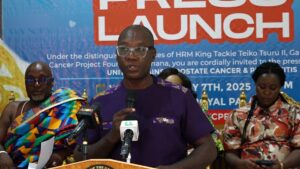
    In a powerful call to action, His Royal Majesty King Tackie Teiko Tsuru II, Ga Mantse, has urged Ghanaians to join forces to combat prostate cancer and prostatitis, two pressing public health issues that affect countless men in the country.


    Speaking at a press conference held today at the Ga Traditional Council, King Tackie Teiko Tsuru II emphasized the need for collective responsibility and national awakening to address the silent threats to men’s health. The campaign, themed “Men United Against Prostate Cancer and Prostatitis,” aims to raise awareness, promote early screening, and demand better access to treatment across all regions of Ghana.


    According to the Ga Mantse, too many men in Ghana are suffering in silence, unaware or afraid to speak about their prostate health due to myths, stigma, and lack of accessible healthcare. He stressed that the time has come for Ghanaians to speak boldly and act decisively to change this narrative.


    King Tackie Teiko Tsuru II, who has accepted to lead and support the campaign alongside The Cancer Project Foundation Ghana and other stakeholders, called on traditional leaders, political authorities, medical professionals, civil society, and the media to join hands in this noble cause.


    The campaign will be officially launched on July 2, 2025, but the Ga Mantse emphasized that the press conference marks the beginning of a united front against prostate-related diseases. He urged Ghanaians to unite, educate, and advocate until no man suffers or dies needlessly from these diseases.


    The Ga Mantse’s call to action has been welcomed by stakeholders, who are eager to join forces to combat prostate cancer and prostatitis. As the campaign gains momentum, Ghanaians are encouraged to support this noble cause and make a difference in the lives of men affected by these diseases.

    Campaign Launch Details:

    – Date: July 2, 2025

    – Theme: “Men United Against Prostate Cancer and Prostatitis”

    – Partners: The Cancer Project Foundation Ghana and other stakeholders

    Let’s join hands to make a difference and ensure that no man suffers or dies needlessly from prostate-related diseases.

  • President Mahama to address nation at 8pm on 120-Day Social Contract update 


    Adnan Adams


    President John Dramani Mahama will address the nation today at 8pm on all major radio, television, and online platforms, providing a comprehensive update on his administration’s 120-day social contract progress.


    This special national broadcast will give Ghanaians an opportunity to assess President Mahama’s performance and compliance with his campaign promises.


    During the broadcast, President Mahama will highlight key achievements under his 120-day action plan. He will discuss the implementation of a leaner government structure designed to reduce public expenditure, a move aimed at optimizing resource allocation.


    The President will also touch on the organization of a National Economic Dialogue and an Education Dialogue, initiatives that seek to chart a course for long-term recovery and policy realignment in these critical sectors.


    Furthermore, President Mahama will provide updates on the launch of the “Tree for Life” and “Blue Water” environmental initiatives, as well as the rollout of the “One Million Coders” program. This program aims to enhance digital skills and promote youth employment, aligning with the administration’s commitment to empowering the youth.


    H.E John mahama will also shed light on the establishment of the Mahama Cares Health Fund, a key initiative aimed at improving healthcare delivery. Additionally, he will discuss the abolition of the E-Levy, Bet Tax, and Emissions Levy, as well as the funding of the Women’s Development Bank. These moves are expected to have a positive impact on the economy and the lives of Ghanaians.


    Moreover, President Mahama will throw more light on the Code of Conduct for all government appointees, underscoring his commitment to transparency and accountability. This initiative seeks to promote ethical leadership and ensure that government officials serve with integrity.


    Ghanaians are encouraged to tune in to the broadcast to assess the progress made so far and draw their own conclusions about the administration’s compliance with its campaign promises.


  • NDC in control of Adansi Asokwa: a foundation laid by Lawyer Evans Amankwah

    Lawyer Evans Amankwa


    By Adnan Adams,
    Journalist

    Lawyer Evans Amankwah, the heated-protostar that never got hydrogen infusion (for better understanding read below the how a star is formed), the ‘uncelebrated’ bedrock of NDC’s historic success in Adansi Asokwa constituency in the 2024 parliamentary and presidential elections.

    Arguing on the adage that ‘Rome was not built in a day’; the contribution of the three term parliamentary candidate of Adansi Asokwa (2004,2012 and 2016), Lawyer Evans Amankwah, in the Constituency and the Ashanti Region as the head of the legal team can never be overemphasized.

    As Africans, we are accustomed to saying ‘let celebrate (reward and appreciate) our hero’s before they die’.

    Aftermath of 2024 elections; while almost all NDC top guns and grassroots were jubilating, dinning and wining from one victory party to the other, Lawyer Evans Amankwah was critically and busily burning midnight candles studying the electoral laws of Ghana to fight for the ‘stolen seats’ for NDC.

    Been a three term parliamentary candidate to a bully-character like K. T. Hammond, who has always used thugs to intimidate citizens and state security to rig elections in his favor, Lawyer Evans Amankwah knows how it feels to be rigged off a verdict wrongfully, so his resolved to sacrifice his precious time, happiness and resources for the course of the party as NDC needed those seats for a convincing two-third majority in Parliament.

    However, it seems the hero is being forgotten, while the victory cake is been eaten to the last bite.

    As a journalist and a bona fide member of the NDC, I had a field encounter with Lawyer Evans Amankwah in the run up to the 2016 elections in a company of three other journalists left our homes in Accra to pursue a specialised campaign for selected constituencies in the Ashanti Region we had assessed that, with a little more efforts NDC could win those seats.

    We spent five days in the twin constituencies of Adansi Asokwa and Fomena to emback on specialized door-to-door campaign in the heart of the Adansi Asokwa, the hometown of KT Hammond but on our fourth day, the unfortunate happened where we were nearly killed had it not been the bravery and timely intervention of Lawyer Evans Amankwah.

    Even with NDC in control of political power and control of government, the police service in the Adansi municipality was compromised and puppetly-controlled by KT Hammond, who could command the the Police commander to do as he wishes and used the police against Lawyer Evans and the NDC during the elections.

    Having been around Lawyer Amankwah for the days of our stay, we were amazed and appreciated the clandestine effort in mobilising and holding up the base of the party members in that hard rock NPP dominated areas.

    Then we asked, Lawyer how are you able to finance all these activities and support for party members single-handedly? He looked at us and smiled, it is all for the love of the party and my people, because once you are tagged as NDC in those areas of the country, it is as you are an alien. So the little he could do to comfort the NDC members was to be there for them.

    Such a personality, professional, a three-term parliamentary candidate and a legal team lead in the entire Ashanti region should not be enjoying the leftovers of the victory cake.

    We appeal to the appointing authorities to speak to their pillows so they could remind them the name of Lawyer Evans Amankwah.


    Before The Star Shines

    To appreciate this piece in perfect language, let’s reflect on how a star is formed:

    “Stars are formed from massive clouds of gas and dust called nebulae, which collapse under their own gravity. This collapse leads to the formation of a protostar, a hot, dense ball of gas. As the protostar continues to contract and heat up, the core eventually becomes hot and dense enough to initiate nuclear fusion, where hydrogen atoms fuse into helium, releasing tremendous amounts of energy. This energy creates outward pressure that balances the inward pull of gravity, resulting in a stable main sequence star.”

  • Govt’s drive to diversify minerals portfolio receiving industry backing


    Nickel discovery in Ghana’s Oti Region signals new opportunities in critical minerals as government pushes for diversification.


    Adnan Adams Mohammed


    The Ghana Chamber of Mines has pledged its support to the government’s efforts to diversify the country’s mineral portfolio and boost value addition along the battery supply chain.


    This commitment follows reports of potentially mineable nickel deposits discovered in the Oti Region. The discovery emerged from ongoing iron ore exploration activities conducted by the Ghana Integrated Iron and Steel Development Corporation (GIISDEC) and the Ghana Geological Survey Authority.


    Preliminary drill samples have revealed nickel concentrations exceeding 1%, a threshold considered commercially viable, positioning Ghana to potentially join the global race for critical minerals. Although certified laboratory results are still pending, officials have described the initial data as promising.


    “We need to wait for more details from the Minerals Commission to determine the size and commercial viability of the deposit. If it proves economically viable, the government has mechanisms for engaging investors, and we are prepared to support these efforts,” the Acting CEO of the Ghana Chamber of Mines, Dasana Nantogmah, said reaffirming the Chamber’s readiness to collaborate with the government to explore and develop the new resource.


    “Successfully developing this resource could diversify our portfolio, create jobs, and generate revenue to advance Ghana’s development agenda.”


    Meanwhile, Mr Nantogmah urged the government to scrap the Value Added Tax (VAT) on exploration activities.


    “Our position has always been clear: exploration is the lifeblood of mining. Without exploration, mining cannot occur. The discovery of nickel is a direct result of exploration. However, exploration companies are currently burdened with VAT on key activities like assaying and drilling. We have consistently engaged the government on the need to remove VAT to encourage more exploration,” he noted.


    The Chamber of Mines also called on Parliament to expedite the ratification of Atlantic Lithium Limited’s Ewoyaa mining lease, cautioning that further delays could have serious consequences for the company and its stakeholders. However, suggesting that the terms of the lease may require a review, given the recent slump in global lithium prices.


    Since 2016, Atlantic Lithium has invested approximately US$70 million into the development of what is set to become Ghana’s first lithium mine. The project, located in the Central Region, was expected to position Ghana among the world’s top 10 producers of spodumene concentrate, a key source of lithium.


    However, a sharp decline in lithium prices—dropping by more than 80% from their peak in November 2022—has cast a shadow over the project’s future prospects.


    In an interview with Citi Business News, the Acting CEO of the Chamber, Ahmed Dasana Nantogmah, stressed the urgent need for ratification to prevent further disruptions.


    “When you look at the concessions under the deal, the precious price concessions were different. Now the prices have fallen. They have to look at it,” Nantogmah explained. “Recently, Atlantic Lithium had to lay off staff because of the delay, so you can understand the repercussions. Any contracts that were signed while awaiting ratification may now have to be abrogated or renegotiated.


    “The impact is significant across the entire value chain—for stakeholders, companies, and even communities that were anticipating income and employment opportunities. These benefits will remain stalled until the deal is ratified in a way that is both economically and socially sustainable.”


    Nantogmah also expressed the Chamber’s support for the government’s decision to implement a one-year transitional arrangement with Gold Fields regarding the takeover of the Damang Mine.


    “We believe it opens the door for negotiations, dialogue, and broader stakeholder engagement, demonstrating that Ghana is a law-abiding country where concessions cannot be forcibly taken. Agreements must be reached through negotiation and mutual understanding,” he said.


    “This is a positive development, and we look forward to continuing dialogue that will shape the policy direction of Ghana’s mining industry.”


  • Atlantic Lithium and GoG in renegotiation of mining lease terms​

    Atlantic Lithium’s Ewoyaa project awaits parliamentary approval as market challenges prompt renegotiation of lease terms.


    By Toma Imirhe

    Atlantic Lithium’s Ewoyaa Lithium Project is now awaiting Parliamentary approval to start construction of Ghana’s first lithium mine, but a recent sharp decline in global market prices for spodumene – the main source of lithium – is forcing the company to seek a renegotiation of the terms of the mining lease granted by the Government of Ghana.

    Atlantic Lithium secured the final major regulatory approval—the Mine Operating Permit—from Ghana’s Minerals Commission in October 2024, marking a critical step toward construction . The permit validated the project’s technical and environmental plans, paving the way for a Final Investment Decision (FID). However, the company still awaits parliamentary ratification of its 15-year Mining Lease, which was delayed due to legislative recess and ongoing negotiations

    Initially targeting a late-2024 construction start, Atlantic Lithium now expects to break ground by mid-2025, with production potentially commencing in late 2026 or early 2027. The revised timeline accounts for delays in lease ratification and funding reassessments amid market volatility.

    The latter problem has arisen because the project’s viability has been jeopardized by an 80% drop in lithium prices since their 2022 peak, from over US$6,000 per tonne to about US$800 currently, driven by oversupply and slower-than-expected Electric Vehicle adoption . Atlantic Lithium’s internal rate of return (IRR) has plummeted from 105% to just 13.6%, rendering the project borderline unprofitable under current fiscal terms

    In response, the company is seeking concessions from the Ghanaian government, including reduced royalty rates (from 13% to 5%, aligning with gold sector rates); a sliding-scale royalty tied to lithium prices; and tax relief, including waivers on import duties for capital equipment.

    Government has not made a public statement on its response yet.

    Despite this, Atlantic’s CEO Neil Herbert remains optimistic, saying: “We look forward to securing ratification in line with due parliamentary process, together with additional fiscal assistance from the government, which represents a key milestone on the Company’s path to achieving first production of lithium in Ghana.”

    Atlantic has also upgraded its estimate for feldspar resources at Ewoyaa to 36.8 million tonnes, underlining the site’s potential to deliver valuable by-products alongside spodumene concentrate, the main source of lithium. Feldspar is commonly used in ceramics and glass manufacturing, offering an extra commercial stream for the project.

    Despite market headwinds, Atlantic Lithium has secured key financial backing. Piedmont Lithium, its second-largest shareholder (22.5% stake), has committed to funding 70% of the US$185 million development costs . A US$10 million share placement in late 2024, led by Assore International Holdings, bolstered pre-construction reserves Also, a proposed merger between Piedmont and Sayona Mining could further stabilize funding by expanding access to North American and Australian markets.

    The company is also engaging with development finance institutions and project finance banks to secure additional capital

    Ewoyaa is strategically positioned to supply spodumene concentrate to the U.S. and global EV markets, with an estimated annual output of 350,000 tonnes over 12 years . A key advantage is its by-product potential, including feldspar for Ghana’s ceramics industry, which could reduce operating costs by 15–20%.

    Atlantic’s executives have stressed the importance of the Ewoyaa project’s low operating costs in ensuring resilience, even at suppressed pricing levels and noted that Ewoyaa could bring over 900 direct and up to 2,500 indirect jobs to Ghana’s Central Region, making it a catalyst for regional economic development.

     However, the company has already laid off 25 employees in October 2024, with another 50 job cuts expected by May 2025, reflecting financial strain.

    Ghana views the project as a gateway to diversifying its mining sector beyond gold, with potential annual revenues of US$15–20 million for the government .

    Atlantic Lithium holds 560 square kilometres of tenure in Ghana comprising significantly under-explored, highly prospective licenses.

  • Fitch, World Bank revise Ghana’s growth forecasts

    Economic institutions revise Ghana’s 2025 growth forecast, with gold exports playing a stabilizing role amid global uncertainty.


    Adnan Adams Mohammed


    Within the past two-weeks, Fitch Solutions and World Bank, both having globally respected economic views have released separate revised projections of Ghana’s economic growth projection for this year.


    Fitch Solutions, last week, reaffirmed its projection that Ghana’s Gross Domestic Product, a measure of Ghana’s total economic output, will grow by 4.2% in 2025. This projection is 0.3% higher than the World Bank’s revised projection of 3.9%.


    Ftich’s projection also slightly exceeds the International Monetary Fund’s forecast of 4%, but is far lower than Standard Bank’s projection of 5.4%, the highest growth rate projection so far for  Ghana in 2025. The African Development Bank Group meanwhile has projected a 4.3% growth.

    The UK-based research and sovereign ratings firm attributes its upbeat outlook to historically high gold prices, which are expected to cushion the Ghanaian economy against a global slowdown triggered by rising tariffs.


    “Higher gold prices are anticipated to strengthen government revenue, enhance foreign exchange earnings, and help sustain currency stability”, Fitch said in its latest report.


    The report also points out that Ghana is relatively less vulnerable to increasing trade restrictions from the United States, given that its primary exports—gold and crude oil—are not directly affected by the tariffs introduced by President Trump’s administration.


    Moreover, the US constitutes only about 4% to 5% of Ghana’s total exports. In contrast, Ghana’s trade relations are more heavily oriented toward China and European countries, particularly Switzerland and the Netherlands.


    While acknowledging potential risks from broader global economic headwinds, Fitch Solutions believes the anticipated gains from gold exports will likely offset these challenges by bolstering international reserves and supporting exchange rate stability through central bank interventions.


    Fitch’s report on Ghana’s economic growth projection comes a week after the World Bank Group revised its projection downwards by 0.4 percent to 3.9% from its earlier projection of 4.3%.


    The Bretton Woods institution explained that; persistent inflationary pressures and ongoing external vulnerabilities are key reasons for the downgrade. Highlighting climate-related risks (particularly, unpredictable weather patterns that have disrupted cocoa production in Ghana), it also warned that, climate-induced events such as floods and droughts continue to erode national budgets across Africa by up to 9%, causing economic setbacks of between 2% and 5% as contained in the April 2025 edition of its Africa’s Pulse report.


    In the medium-term, the World Bank remains cautiously optimistic about Ghana’s prospects, projecting a rebound to 4.6% growth in 2026 and 4.8% in 2027. It rates Ghana among a few African economies showing early signs of recovery in 2025.


    “Business activity in Mozambique and Ghana rebounded in February 2025,” the Group noted in the new report published last week. “The modest uptick in Ghana was driven by increased demand and a resurgence in new business engagements.”


    High-frequency indicators, particularly the Purchasing Managers Index (PMI), suggest an uptick in business activity. Ghana’s PMI rose from 47.9 in January to 50.6 in March, indicating improved demand, easing supply bottlenecks, and renewed investor confidence following the December 2024 presidential elections.


    Across the region, Sub-Saharan Africa’s economic growth is expected to rise slightly from 3.3% in 2024 to 3.5% in 2025, with further acceleration to 4.3% by 2026–2027.


    However, the continent’s overall trajectory remains constrained by weak performances in its three largest economies—Nigeria, South Africa, and Angola. Excluding these, the rest of Sub-Saharan Africa is projected to grow by 4.6% in 2025, rising to 5.7% by 2027.


    Still, the World Bank warned that elevated downside risks—including global policy uncertainties, climate shocks, and fiscal constraints—pose ongoing threats to a sustained and inclusive recovery across the continent.


    In related news, the International Monetary Fund (IMF) sharply cut its global growth forecast 2.8% in 2025, a significant drop from the 3.3% forecast made in January as contained in the published IMF’s April 2025 World Economic Outlook (WEO), which cites escalating trade tensions with the United States announcing a wave of new tariffs with trading partners responding with their own countermeasures, creating ripple effects across global supply chains and investor sentiment.


    It also cites mounting policy uncertainty as the main culprits behind the slowdown.


    “Since the release of the January 2025 WEO Update, a series of new tariff measures by the United States and countermeasures by its trading partners have been announced and implemented, ending up in near-universal US tariff hikes on April 2 and bringing effective tariff rates to levels not seen in a century.


    “This on its own is a major negative shock to growth. The unpredictability with which these measures have been unfolding also has a negative impact on economic activity and the outlook and, at the same time, makes it more difficult than usual to make assumptions that would constitute a basis for an internally consistent and timely set of projections.


    “Given the complexity and fluidity of the current moment, this report presents a “reference forecast” based on information available as of April 4, 2025 (including the April 2 tariffs and initial responses), in lieu of the usual baseline. This is complemented with a range of global growth forecasts, primarily under different trade policy assumptions.


    “The swift escalation of trade tensions and extremely high levels of policy uncertainty are expected to have a significant impact on global economic activity. Under the reference forecast that incorporates information as of April 4, global growth is projected to drop to 2.8 % in 2025 and 3%  in 2026—down from 3.3%  for both years in the January 2025 WEO Update, corresponding to a cumulative downgrade of 0.8 percentage points, and much below the historical (2000–19) average of 3.7%,” part of the report read.


    In advanced economies, growth is now expected to slow to 1.4% in 2025, with the U.S. economy seeing a notable downgrade—now projected at 1.8%, nearly a full percentage point below previous estimates.


    In emerging markets and developing economies, growth is expected to slow down to 3.7% in 2025 and 3.9% in 2026, with significant downgrades for countries affected most by recent trade measures, such as China. Global headline inflation is expected to decline at a pace that is slightly slower than what was expected in January, reaching 4.3% in 2025 and 3.6% in 2026, with notable upward revisions for advanced economies and slight downward revisions for emerging market and developing economies in 2025.


    The IMF flagged intensifying downside risks, warning that a deeper trade war, rising financial instability, and fragile policy buffers could worsen the economic landscape. Vulnerable emerging markets could face capital flight, currency pressures, and increasing debt burdens.


    The Fund also noted that a reversal or de-escalation of current trade policies could offer a reprieve and potentially revive global growth.


    “Intensifying downside risks dominate the outlook. Ratcheting up a trade war, along with even more elevated trade policy uncertainty, could further reduce near- and long-term growth, while eroded policy buffers weaken resilience to future shocks. Divergent and rapidly shifting policy stances or deteriorating sentiment could trigger additional repricing of assets beyond what took place after the announcement of sweeping US tariffs on April 2 and sharp adjustments in foreign exchange rates and capital flows, especially for economies already facing debt distress.


    “Broader financial instability may ensue, including damage to the international monetary system. Demographic shifts and a shrinking foreign labor force may curb potential growth and threaten fiscal sustainability. The lingering effects of the recent cost-of-living crisis, coupled with depleted policy space and dim medium-term growth prospects, could reignite social unrest. The resilience shown by many large emerging market economies may be tested as servicing high debt levels becomes more challenging in unfavorable global financial conditions.


    “More limited international development assistance may increase the pressure on low-income countries, pushing them deeper into debt or necessitating significant fiscal adjustments, with immediate consequences for growth and living standards. On the upside, a de-escalation from current tariff rates and new agreements providing clarity and stability in trade policies could lift global growth,” it added.


    The report calls for coordinated policy action, urging nations to work together to restore predictability in trade, strengthen debt sustainability, and address long-term structural challenges like demographic shifts and migration.