Category: News

  • ‘Gold for Oil’ deal suffers critical scrutiny…gov’t told to take a second look at it

    Adnan Adams Mohammed


    The ‘Gold for Oil’ policy has faced critical scrutiny by stakeholders challenging the government’s white wash claims that the policy as implemented has been a success.


    Newest to add his voice to the critics is an Energy Strategist who is advising government to take a second look at the ‘Gold for Oil’ Programme as it has not impacted on prices of petroleum products at the pumps.


    Last week, some Oil Marketing Companies withdrew from the programme due to unresolved concerns. The government’s gold for oil policy as a government strategy was borne out of the country becoming strapped of foreign exchange. The policy is to enable the government directly exchange gold for oil while avoiding to use foreign currency, particularly the dollar, as a means to control the country’s inflation. The Strategist, who believes the intended purpose of the policy has not been achieved, wants a review of the programme.


    “The problem is that it’s not being able to stabilise the cedi that we want to stabilise. At best maybe it has minimised the depreciation rate and that’s not what we wanted”, Dr Yussif Sulemana pointed out to the managers of the economy.


    “It’s quite unfortunate and the champions of the programme will have to relook at it and look at the successes and weigh against what we are trading on”.


    He quizzed “Are we ready to disturb these institutions [OMCs] just to stabilise the cedi that we are not able to have a firm handle on?”


    “At this point in time and in that case, I think the programme needs to be reviewed and if it cannot be reviewed, then we have to just advise ourselves”, he added.


    Also, some Civil Society Organisations (CSOs) in the energy sector have challenged government to publish the names of third-party dealers involved in the ‘Gold for Oil’ programme.


    The call comes after some Oil Marketing Companies pulled out of the programme due to unresolved concerns.


    The Ghana Chamber of Bulk Oil Distributors has announced that some of its members are also unhappy with concerns raised on the implementation of the programme.


    Energy Analyst, and Co-Chair of the Ghana Extractive Industries Transparency Initiative, Dr Steve Manteaw said the government must publish the names of all intermediary dealers in the programme to promote transparency.


    He added that the current mode of the programme creates room for some operators to take advantage of the system.


    “There is no disclosure in terms of who is financing the domestic gold purchasing in this transaction. We are going to resort to the services of a third party. For instance, who is selling Ghana’s gold? if it’s a broker then the broker services have to be disclosed”.


    Dr Manteaw stated lack of transparency will encourage corrupt acts that may defeat the purpose of the programme.


    “I think it’s fair to ask questions. How much is the broker being paid and how does it affect what we receive as a country in terms of reserves”, he quizzed.


    In recent publication, a key player in the extractive industry, the Chairman of Ghana Chamber of Bulk Oil Distributors, Dr. Patrick Kwaku Ofori, says the government’s gold for oil policy has cornered bulk oil distributors working in the country.


    Noting that, none of the BDCs had anticipated such a policy as it places them in a tight spot in competition against the government.


    Dr. Ofori, speaking in an interview indicated that, the policy will have a toll on the regulators’ revenue generation, “because none of the BDCs or those BDCs who have paid their license fee did not necessarily pay for a license fee to be cornered a percentage of the matter.”


    “They want to be given the right climate to conduct their business. And also don’t forget these private entities also employ Ghanaians and they also pay their taxes.


    “So it’s a bit of a tricky situation there, and the programme obviously impacted on private sector participation judging from how private sector can also assess the proceeds of the revenue coming from the gold purchases.”


    He however suggested that government could change their policy to allow private sector engagement.


    “But if government intends to change their policy with regards to the gold for oil and allow private sector participation and say that ‘well as a country, all our revenue that we’re going to generate from maybe gold export, we’re going to use maybe a percentage of it to finance our refined product importation .


    “And by so doing, either through the Central Bank reactivating the forex option so that both the private sector and the public entities who are interested in importing refined products can go through those competitive processes to be able to have the product.’”


    He also stated that another option was for the Bank of Ghana to surrender all gold proceeds and revenue in a way to guarantee forex availability to the commercial banks for all importers to have access to them.



  • Ghana securing a $10.5bn debt relief looks bleak – Economist predicts

    Adnan Adams Mohammed


    An economist has predicted that Ghana may find it difficult to get a debt relief of about US$10.5 billion from external creditors including bilateral lenders.


    The economist asserts that, experiences from Zambia and others suggest that the road ahead for the nation to secure US$2.6 billion annually in debt relief for the next four years will be difficult.


    Already, Fitch rating agency has indicated that Ghana has a long way to go to restructure its more than US400 billion debt and predicting a second round of Domestic Debt Exchange Programme (DDEP). The country has already submitted a proposal on debt restructuring to its official creditors. Speaking in an interview, the economist said, the country may not get a favourable deal from the external creditors.


    “It’s going to be a bit difficult because we’ve seen similar instances with the likes of Zambia. But there’s been a major contestation around how we treat certain creditor groups”, Policy Analyst and Economist, Dr. Theo Acheampong posited.


    However, a team of experts from the International Monetary Fund (IMF), led by Stéphane Roudet, have concluded their visit to Ghana, which took place from June 8 to June 15, 2023.


    The visit aimed to engage with Ghanaian authorities and stakeholders to assess recent economic developments and review the implementation of the Fund-supported program approved on May 17, 2023.


    In a statement issued at the end of the visit, Mr. Roudet acknowledged positive signs of stabilization in the Ghanaian economy.


    “In discussing progress on the debt restructuring operations, we reiterated that timely restructuring agreements with creditors are essential to secure the expected benefits of the Fund-supported program.”


    Apparently, furthering his argument, Dr Acheampong thinks Ghana is too much exposed to Eurobonds and other commercial loans.


    “So I think, the road ahead is going to be quite challenging in the sense that all the $2.6 billion they [creditors] need to get every year, it probably will not amount to that and this is just on the basis of some of the evidence we’ve seen with other countries that have attempted to go down this road”.


    “It does make it quite difficult largely because most of the commercial creditors have different obligations to their shareholders, but also because Ghana in a way defaulted on making the interest payment on a number of these debt obligations since December of last year”.


    Again to him, it does make the process rather much more complicated since Ghana has already indicated that it is looking at haircuts of about 30% to 50%.


    “I think that is going to be a bitter pill to swallow for a number of these commercial creditors”, he added.


    The move could be seen as a major step for the government to get the Official Creditor Committee including the Paris Club formed in May 2023 to consider the country’s debt restructuring programme.


    This also signifies the beginning of a more detailed negotiating process that will likely see a number of proposals being exchanged.


    Although, Reuters have said, the ‘working proposal’ is however not legally binding.


    The Common Framework process was set up by the G20 in 2020 to bring China and other newer creditor nations into joint sovereign debt restructuring negotiations, for its external debt rework.


    Ghana is hoping to cut about $10 billion out of a total of $52 billion over the next three years to successfully implement the International Monetary Fund programme.


    The country’s debt to China and members of the Paris Club is estimated at $5.4 billion. As of December 2022, the total external debt stood at $28.9 billion.


    It has already completed a Domestic Debt Exchange Programme in February 2023 in which about 65% of bondholders took part in the exercise.


  • Ghana economy to grow at 1.6% in 2023 – World Bank projects

    Adnan Adams Mohammed


    The Ghanaian economy is projected to record a 1.6 percent Gross Domestic Product (GDP) growth in 2023 according to the World Bank latest projection.


    This is in line with the International Monetary Fund’s projection of a 1.6% growth rate. The projection is far lower than the expected 3.2% for Sub-Saharan Africa and places Ghana in the 42nd position in Sub-region.


    The June 2023 Global Economic Prospects Report says Ghana’s economy is however projected to expand by 2.9% in 2024.The report stated that the slowdown in the economy is due to the challenges facing the economy, as the Ghana government is undertaking an International Monetary Fund support programme.


    “In Ghana, more timely data highlight the weakness of economic activity amid the deleterious global shocks and heightened macroeconomic instability”.


    Five African countries, Malawi (1.4%), Sudan (0.4%), South Africa (0.3%), South Sudan (-0.4%) and Equatorial Guinea (-3.7%) are expected to grow lower than Ghana in 2023.


    World Bank said its baseline projections remain subject to multiple downside risks amid uncertainty about developments in global commodity markets, the degree of additional global and domestic policy tightening needed to subdue persistent inflation, and the resilience of the world economy and global financial system to a prolonged period of tight monetary policies.


    It pointed out that commodity prices may remain unusually volatile and vulnerable to further shocks if disruptions to the supply of major commodities worsen—for instance, due to intensifying geopolitical tensions or conflicts. Furthermore, global activity may decelerate faster than envisioned if the reopening of China’s economy fails to generate a durable recovery.


    Growth in Sub-Saharan Africa (SSA) is expected to slow from 3.7% in 2022 to 3.2% this year—a 0.4 percentage point downgrade from January forecasts—with a moderate improvement to 3.9% next year.


    Over half of the 2023 downgrade, it said, is attributable to an abrupt slowdown in South Africa. However, downgrades are widespread across energy and metal producers, and non-resource-rich countries.


    Excluding South Africa, the Bretton Wood institution, however, said growth in SSA is expected to slow from 4.2% in 2022 to 3.9% this year.


  • Gold-for-oil deal: stakeholders call for improve transparency

    Adnan Adams Mohammed


    A key player in the extractive industry has called for the immediate publication of the policy document regarding the gold-for-oil policy to ensure transparency of the agreement’s terms and conditions.


    Dr. Steve Manteaw, a policy analyst with the ISODEC believes that providing comprehensive details about the policy is essential to dispel any suspicions and ensure transparency.


    The government’s gold for oil policy was borne out of the country becoming strapped of foreign exchange. The policy is to enable the government directly exchange gold for oil while avoiding to use foreign currency, particularly the dollar, as a means to control the country’s inflation. But, the analyst further believes that revealing the terms of the agreement can instill public confidence in the gold-for-oil policy.


    “We don’t know how Ghana procures its petroleum products and at what cost, nor do we know the cost of facilitating the gold-for-oil program. All of these things need to be disclosed so that we can hold our duty-bearers accountable. We want to see a comprehensive gold-for-oil policy because, as it stands, there is none. All we have seen are headline pronouncements”, Dr Manteaw made these remarks during the launch of the 2020 Ghana Extractive Industries Transparency Initiative report.


    “There is no blueprint document, and Parliament must take an interest in this. They must see the policy document, interrogate it, and see how best it serves the national interest.”


    However, the Chairman of Ghana Chamber of Bulk Oil Distributors, Dr. Patrick Kwaku Ofori, says the government’s gold for oil policy has cornered bulk oil distributors working in the country.


    Noting that, none of the BDCs had anticipated such a policy as it places them in a tight spot in competition against the government.


    Dr. Ofori, speaking in an interview indicated that, the policy will have a toll on the regulators’ revenue generation, “because none of the BDCs or those BDCs who have paid their license fee did not necessarily pay for a license fee to be cornered a percentage of the matter.”


    “They want to be given the right climate to conduct their business. And also don’t forget these private entities also employ Ghanaians and they also pay their taxes.


    “So it’s a bit of a tricky situation there, and the programme obviously impacted on private sector participation judging from how private sector can also assess the proceeds of the revenue coming from the gold purchases.”


    He however suggested that government could change their policy to allow private sector engagement.


    “But if government intends to change their policy with regards to the gold for oil and allow private sector participation and say that ‘well as a country, all our revenue that we’re going to generate from maybe gold export, we’re going to use maybe a percentage of it to finance our refined product importation .


    “And by so doing, either through the Central Bank reactivating the forex option so that both the private sector and the public entities who are interested in importing refined products can go through those competitive processes to be able to have the product.’”


    He also stated that another option was for the Bank of Ghana to surrender all gold proceeds and revenue in a way to guarantee forex availability to the commercial banks for all importers to have access to them.


  • Locked up monies on deactivated MoMo accounts numbers to be retrieved for owners

    Adnan Adams Mohammed


    Relief to owners of SIM cards who have their numbers deactivated but had monies in their mobile money accounts are to receive their monies soon as Ministry of Communications and Digitalisation and Bank of Ghana complete the process to facilitate the retrieval of the locked up funds.


    Providing an update on the status of the SIM re-registration exercise in Parliament, last week, the Minister of Communication assured affected subscribers that, while they won’t be able to conduct mobile-related transactions with their deactivated SIMs, their funds will be recovered through the necessary processes.

    As part of a nationwide re-registration exercise of all SIM cards using the Ghana Card as the only source of identity in the country to help curb increasing cyber and mobile phone related crimes in the country, the National Communication Authority and the Telecommunication Companies deactivated a number of unregistered SIM cards. This resulted in a number of mobile phone users crying out as their monies were locked on the blocked numbers.


    “We continue to encourage the National Identification Authority (NIA) to assist people to acquire their Ghana Card. We have also been made aware of the difficulties facing subscribers in accessing their funds on their mobile money wallets”, Ursula Owusu-Ekuful sympathised with victims while speaking in parliament.


    “These subscribers will not be able to transact money mobile-related activities, however, we are working with the Bank of Ghana to ensure that these subscribers are able to retrieve funds upon the presentation of a valid ID and going through the required processes.”


  • Businesses overwhelmed with taxes.. call out on gov’t to save jobs and investments

    Adnan Adams Mohammed


    Some Business owners in the country have since been on government to reconsider numerous taxes they pay right from source of their raw materials through import duties to production, packaging and selling their finished goods.


    The business captains claim government is deliberately targeting them as the soft-spot for its revenue mobilisation because they are formalised.

    Businesses owners have intensified their calls on government to either review or scrap some of the taxes.


    After several attempts to get the government’s attention to scrap the COVID Health Recovery Levy from the list of taxes businesses pay, President Nana Akufo-Addo recently pleaded with Ghanaians to keep paying the Covid-19 levy despite the pandemic was declared over.


    “The COVID Health Recovery Levy that was introduced to help fill some of the expenditure holes might not be the most popular tax, but I entreat all of you to bear with us”, the president pleaded.


    However, the Ghana Union of Traders Association (GUTA) has said it is not opposed to government’s increasing its revenue rather they want the Covid-19 levy expunged.


    The President of GUTA, Dr Joseph Obeng, explained that the association is not opposed to taxes including the e-levy, noting: “The e-levy, as it is structured now, is OK, and will help expand the tax net but the Covid levy is what needs to be taken out of the table to help lessen the burden of businesses.”


    The GUTA president noted the Covid levy “is deemed as a nuisance tax now that the Covid era is over.”


    The government imposed the covid levy on the supply of goods and services and imports to raise revenue to support Covid-19 expenditures and to provide for related matters.


    Within eight months of coming into implementation, the levy accrued GH¢773.93 million, according to fiscal data released by the Ministry of Finance on 22 April 2022.It was 12.7 percent lower than the budget target of GH¢889.07 million. In 2021, expenditures on Covid-19 and related issues, totalled more than GH¢2.8 billion.


    Additionally, the Association of Ghana Industries has called on government to reconsider its current calculation of Value Added Tax (VAT) on indigenous companies whose annual revenue exceed GHS 500,000 per annum to reduce the economic burden on local industries.


    According to them, per the current calculations of 15 percent VAT and the summation of the COVID levy, GETFUND and NHIS levy amounting to 6% coupled with other cost of production were negatively impacting the growth of local industries.


    The Greater Accra Chairman of AGI, Tsonam Akpeloo impressed on government to relook the development.


    “The way the VAT is being calculated currently means that we are being charged double or we are paying VAT on VAT. This essentially means that government adds the levies i.e. NHIS, the Covid and GETFund which is totaling 6 percent to cost of the products before applying the VAT and the other levies again,” he said.


    “In effect, one business, one transaction we have to pay double tax and this calculation is not helpful. Already Industries are struggling, there is no point in getting them to pay tax in this manner so we want government to reconsider its computation and reverse it to the time before 2017,” he appealed.


    In November 2022, Government announced its decision to increase the Value Added Tax (VAT) by 2.5 percent.


    This moved the tax policy from its previous percentage of 12.5% to 15%.


    Adding his voice to the tax burden on businesses, the Chief Executive of AGI, Seth Twum Akwaboah, has called for a reduction in duties paid on raw materials used in printing and packaging in the manufacturing sector.


    According to him, this is necessary to cushion local producers and contribute to exports and development.


    “When you import raw materials to print, you pay duty on it but when you import the finished product, you do not pay duty on it and it makes the local printing more expensive than importation. So we think that this policy is not helping local producers and if we want to create jobs and grow the economy and reduce our dependency on imports and protect the local currency, these are some of the things we have to look at,” he said on the sidelines of the opening of Propak Exhibition and trade conference in Accra, last week.


    Mr Twum Akwaboah called on government to review some outdated trade policies to give a boost to local producers within the printing, packaging and labeling space.


    The Association explains that with the growing presence of industrial revolution in the country, local producers have built their competences to meet the demand of clients and society.


    “The Florence Convention which was a convention signed in the 1850s because at the time we didn’t have sophisticated printing presses in Ghana. So to encourage one to bring in the learning materials, the duties were taken off: at that time it made a lot of sense but unfortunately this law has stayed with us up till today. While we have moved on in terms of capacity to print,” he noted.

    “We also have some sophisticated printing firms in Ghana now and duty of imports of raw materials continues to persist so we believe that kind of policies is not helping local producers and it should be looked at,” he added.


    Consequently, some investors within Ghana’s automotive industry are asking government to explore various options in addressing the high taxes in the country, impacting on their business.


    This, they say is affecting their cost of operations in the importation of components for assembling vehicles in the country.


    According to Chief Operations Officer of Rana Motors, Kassem Odaymat, the prospects for the automotive industry are positive, but more work needs to be done to attract investors.


    “The automotive business as a whole, any tax introduces affects us in a way because our business model is not just assembling of cars but we do other things like tyres, car batteries and other components”, he said in an interview last week.


    “I won’t say there are too many gaps but we have some that need to be relooked at. The economy now is not favourable, but we hope things will be fine”, he said.


    Mr Odaymat, however, maintained that the automotive industry in Ghana has a positive outlook and as a result, it should be attractive enough to bring in more investors.


    Government in 2019 said it will offer tax breaks of up to 10 years to automakers that set up local manufacturing plants, as it seeks to attract international companies such as Volkswagen AG and Nissan Motor and co.


    Ghana’s move at the time was to lure carmakers from some African countries which had attracted seven manufacturers including Renault, Nissan and Toyota with tax incentives.


  • Telcos, BoG to collaborate to retrieve locked funds on MoMo accounts – Ursula

    The Minister of Communications and Digitalisation, Ursula Owusu-Ekuful, has announced that Mobile Network Operators (MNOs) are working with the Bank of Ghana to facilitate the retrieval of funds for individuals whose monies are locked up in mobile money accounts.


    Numerous subscribers have voiced their concerns regarding the inability to access their funds on mobile money accounts after their SIM cards were deactivated for failing to re-register them.


    Providing an update on the status of the SIM re-registration exercise in Parliament on Thursday, June 8, Ursula Owusu-Ekuful assured affected subscribers that while they won’t be able to conduct mobile-related transactions with their deactivated SIMs, their funds will be recovered through the necessary processes.


    “We continue to encourage the National Identification Authority (NIA) to assist people to acquire their Ghana Card. We have also been made aware of the difficulties facing subscribers in accessing their funds on their mobile money wallets.


    “These subscribers will not be able to transact money mobile-related activities, however, we are working with the Bank of Ghana to ensure that these subscribers are able to retrieve funds upon the presentation of a valid ID and going through the required processes.”


  • Maritime trade stakeholders want COVID -19 levy abolished

    Adnan Adams Mohammed


    The Importers and Exporters Association of Ghana, is calling for the immediate abolishment of the COVID-19 levy.


    The importers and exporters argue that government must completely do away with the Covid -19 levy as well as the Special import levy and the financial recovery levy as they place undue burden on individuals and businesses.


    “We cannot compromise that it should become part of government’s revenue target for the year. Government must think about the ordinary Ghanaian suffering at this point in time and should not impose the Covid levy,” Sampson AsakiAwingobit, the Executive Secretary of the Association said in an interview.


    “Not only are we requesting for the Covid levy to go off the books but we are also asking that government should also abolish the special import levy and the financial recovery levy. These are levies including the Covid levy that came with sunset clauses that means they have lived their usefulness thus they have to go off the books,” he added.


    The Covid-19 Health Recovery Levy is a stand-alone levy applied to the gross value of taxable supplies of goods and services provided under the Standard Rate and VAT Flat Rate Schemes.


    Meanwhile, some individuals and operators of small and medium enterprises in Accra are lamenting the negative impact the continuous payment of the Covid-19- Levy, is having on their businesses.


    Sharing their thoughts on government’s stance of maintaining the Covid- 19 levy, some said,” it was only unfair but also an exploitation of the already struggling business community by the AkuffoAddo led government and therefore, needs to be scrapped”.


    Apparently, the government still wants to raise more revenue through the COVID-19 Health Recovery Levy, despite the end of the pandemic in the country.


    While describing the 1% tax as unpopular, President Akufo-Addo emphasized that the government will continue to charge the levy to bridge the fiscal gaps generated by the pandemic while addressing other expenditure challenges.


    “The COVID Health Recovery Levy that was introduced to help fill some of the expenditure holes might not be the most popular tax, but I entreat all of you to bear with us”, the President said in his address on Sunday.


    The Covid-19 Health Recovery Levy is a stand-alone levy applied to the gross value of taxable supplies of goods and services provided under the Standard Rate and VAT Flat Rate Schemes.


    “Let me make it clear that COVID expenditures, essentially unplanned, have been subject, at my instigation, to audit by the Auditor-General, and are going through parliamentary processes. We all deserve to be reassured that the crisis was not used as a cover for corrupt practices”, the President added.

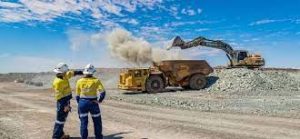
  • Miners calls for security deployment to legal mining sites

    The Chief Executive Officer of the Chamber of Mines has in the wake of the latest invasion of AngloGold Ashanti’s mining site by illegal miners, reiterated his calls for the state to deploy security to legal mining sites in the country.


    Speaking in an interview last week, Sulemanu Koney stated that the deployment of security at the mining sites will prevent any interference from community members mostly engaged in illegal small scale mining.


    “At the end of the day, we want appropriate security deployment at the mining sites so that they [miners] can focus on the core business of mining for the country,” he appealed.


    According to him, these calls have been made in the past, leading to some engagement with the government and the Ghana Police Service at some point.


    Unauthorised persons underground are able to exit on foot – AngloGold Ashanti on trapped illegal miners


    Mr Koney’s calls come against the backdrop of reports that about 300 illegal miners had been trapped in one of the shafts at Anwiam in the Obuasi East District of the Ashanti Region.


    The miners reportedly entered the underground shaft in search of gold deposits but were unable to come out after all exit routes were closed.


    Meanwhile, AngloGold in a statement issued on May 30 clarified that unauthorised individuals who entered the mine are able to exit on foot through the existing ramp and main access points, and no one has been confined underground.


    “Unauthorised persons underground are able to exit on foot, via the existing ramp, through the main access of this mining area. No person underground has been confined in any way, and the main exit ramp from the mine remains open,” portions of the statement read.


    Reacting to the happenings, Sulemanu Koney described it as unfortunate.


    He said the incidence of illegal miners making unauthorised entries into legal mining sites is “becoming a nightmare for us as an industry.”


    He wants the relevant stakeholders to support the industry to “quell such an unfortunate situation.”

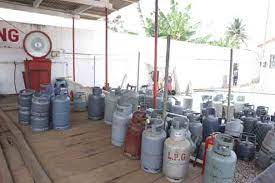
  • Consumers of LPG to enjoy 5% fall in prices

    Adnan Adams Mohammed


    Prices of liquefied petroleum gas (LPG) is expected to fall by 5 percent within the first half of this month, the Institute for Energy Security has projected.


    Within same period prices of petrol and diesel are expected to remain the same.


    The IES puts it down to the Ghana cedi’s strong performance on the domestic forex market in the last two weeks, and the drop in the price of LPG on the international market, even though international prices of the liquid products shot up.


    “The Institute for Energy Security’s review of prices over the past two weeks as monitored by Global Standard & Poor (S&P) platform indicate the prices of Gasoline [petrol] and Gasoil [diesel] have increased at 4.20% and 2.70%, respectively, whereas Liquefied Petroleum Gas (LPG) decreased by 5.80%”.


    “The Ghana cedi also gained 5.42% against the U.S dollar over the two weeks trading period on domestic forex market,” it added.


    On the local market, the IES said the ex-pump prices as it has observed in the second pricing window for May 2023, fell at an average 3% for both petrol and diesel, with most oil marketing companies (OMCs) selling the two products at the same price in the window.


    The IES said its monitoring of various OMCs during the pricing window under review finds the national average price per litre for petrol and diesel at GH¢11.90 and LPG at about ¢13 per kilogramme.


    On the world market, the IES said the price of Brent crude oil continued trading below US$80 per barrel in the last two weeks.


    The average price per barrel over the window traded at about US$75.90 per barrel.


    Meanwhile, some Oil Marketing Companies (OMCs) have started increasing prices of petroleum products at the pumps.


    Goil has taken the lead, selling at litre of diesel and petrol at ¢12.45 from its previous price of ¢12.30 a litre.


    The increase is in line with the biweekly review of prices at the pumps.


    The latest increase, according to some stakeholders is due to the cedi’s performance and the price of crude oil on the international market.


    It is expected that more OMCs will also adjust prices of petroleum products upward later today, June 1, 2023.


    Apparently, the Chamber of Petroleum Consumers Ghana (COPEC) has projected a marginal decline in the prices of fuel in the first pricing window of June 2023.


    COPEC attributes this projection to the relative stability of the forex rates although the international market benchmark prices of crude oil haven’t been that favorable.


    The Chamber is further predicting that the price of Liquefied Petroleum Gas (LPG) is expected to decline by roughly 5% during the same period.


    Duncan Amoah, the Executive Secretary of the Chamber of Petroleum Consumers Ghana (COPEC), said in an interview last week, “the first pricing window for June looks relatively stable although per our figures some OMCs may decline marginally on current pump prices”.


    “This informed by a relative stability of some relative gains the cedi would have made within the period. International market benchmarks have not been good as witnessed in the past window,” he added.


    As of May 29, 2023, the price of gasoline in Ghana stood at 13.2 Ghanaian cedis (GHS) per liter, corresponding to roughly 1.19 U.S. dollar.


    This decreased from the prices in December 2022 but considerably increased compared to most of the previous weeks observed.


    Since January 3, 2022, the price of gasoline in Ghana has increased by over 91 percent.


    At some OMCs both petrol and diesel were selling at GHS 12.30 as at May 29, 2023.