Category: Economy and Finance

  • Using Policy Rate to Control Inflation and Liquidity… MPC faces toughest time

    Adnan Adams Mohammed

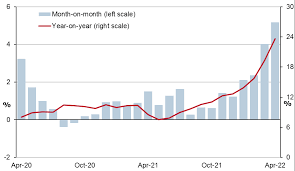
    As the Bank of Ghana Monetary Policy Committee (MPC) is scheduled to announce its next decision on May 23 amidst historical rise in inflation to record high of 23.6 percent in more than 18 years, MPC members have one of the toughest test to pass.

    Some economists have predicted that, the MPC bimonthly review of the economy will ‘sweat’ to arrive at policy recommendations that balance its mandate to tame the unprecedented inflation spike, manage liquidity issues, and growing the economy. 

    Underscoring the dilemma the central bank faces, an economist with Institute of Economic Affairs (IEA) have suggested upwards adjustment in the policy rate by about 200 basis point to help narrow the gap with rising inflation and also ease to some extent the risk of foreign currency outflows. But, Databank research proof otherwise as it predict that, a further tightening of the Monetary Policy Rate (MPR) could stifle economic growth.

    “Any attempt by the central bank to tighten monetary policy further will be an attempt to squeeze water out of stone,” Courage Martey, an economist at Databank Group said in an interview last week. “Inflation hasn’t peaked yet, so the MPC would want to avoid creating a perception of chasing inflation when it should be ahead of the inflation curve.”

    Although, the Databank economist admits that the Committee members of the central bank will have “a nail-biting decision to make.” 

    Annual inflation jumped to 23.6%, the highest since January 2004, from 19.4% in March. As calls increase for an intervention to stem the situation, the IEA has projected a 200 basis points increase in the monetary policy rate to 19 percent. The last MPC meeting in April increased the policy rate by 250 basis points to 17%, but, Director of Research at the IEA, Dr. John Kwakye, believes the rate should see another increase to par with the current inflation rate of 23.6 percent.

    In a paper titled, ‘How should the Bank of Ghana respond to the run-away inflation and the high cost of living in Ghana?’, Dr. Kwakye asserted that, “Taking all of these factors together, it may be surmised that the PR should be raised by another 200 basis points to 19 percent.”

    “This will help narrow the gap with inflation and also ease to some extent the risk of foreign currency outflows. The adjustment will also provide some assurance to the markets that the BoG is committed to addressing the resurging inflation. Anything less than this may be interpreted as a weak response, which may be concerning to the markets.”

    According to the Institute, the factors that should determine the rate adjustment include the wide gap between the current rate of 17% and inflation rate of 23.6%; the policy tightening by major central banks, which increases the risk of foreign currency outflows from developing and emerging market economies and which could put renewed pressure on the cedi; and the increase in the policy rate by as much as 250 basis points two months ago, an increase that may not have fully exerted its impact.

    Apparently, according to the Databank’s Weekly Fixed Income Update, while it maintains an additional 200 basis hike in the policy rate in 2022, it expect the Monetary Policy Committee (MPC) to exercise restraint in May 2022, deferring a potential 100 basis points hike in MPR to July 2022.

    It expatiates that, liquidity levels are already tight on the interbank market. Real returns on fixed-income securities are also depressed with the high inflation profile, continually undermining the Treasury’s financing operations.

    “We note that short-term interest rates are misaligned, resulting in negative real yields, which could prompt the MPC to act in the week ahead”, it however pointed out.

    The first and second-round effects of petroleum and transport price hikes, elevated food prices and the lagged impact of exchange rate pass through are the main drivers of the April 2022 inflation rate. 

    “We believe these cost-push pressures will persist until the third quarter”, the investment bank stressed. Additionally, it noted that the implementation of the Electronic Transaction Levy from May 1st, 2022, and the impending hike in utility tariffs are further upside risks to inflation.

    The MPC’s regular meetings over the next three days will conclude with an announcement of a decision to either maintain, reduce or increase the policy rate today, 23rd May 2022.

    At the last meeting the policy rate which informs the rate at which the central bank lends to commercial banks which ultimately influences final interest rates was increased by 250 basis points to 17 percent to tame inflation which has so far risen by about 10 percentage points from January’s 13.9 percent to April’s 23.6 percent.

  • Chamber of Agribusiness wants Agric Minister to resign over sector woes

    Chamber of Agribusiness wants Agric Minister to resign over sector woes

    The Chamber of Agribusiness is demanding the resignation of the Minister for agriculture, Dr. Owusu Afriyie Akoto for his failure to address key challenges facing the sector.

    The chamber is threatening to embark on a strike followed by a demonstration if the ministry does not the minister does not resign.

    Although many industry players have suggested ways by which the government can help bring some relief to them and Ghanaians in general, their calls have fallen on deaf ears.

    The Chamber of Agribusiness Ghana is blaming the struggles of the industry on the poor performance of the sector minister. Dr. Owusu Afriyie Akoto, and is hence calling for his resignation.

    Anthony Morrison is the Chief Executive Officer of the Chamber.

    “Calling on the minister to step down is not just calculated on his personality. Three weeks ago, he gave permit for the export of soya and maize. What data informed his decision? Why do you bring in a ban when we are now going into the production season? If someone is bringing investment into the sector and there’s a ban, the person is going to think twice.”

    He continued, “Access to fertilizer also remains a challenge. One would have expected that the minister will negotiate with other stakeholders to put in place a credit like that will give fertilizer and feed importers some credit facilities to import these fertilizer easily. But he is not thinking of how to mitigate our food security.”

    “The Chamber is talking to other major players in the industry. We have provided enough information, advice and advocacy for the Ministry to take action. The Chamber and its strategic partners will convene a meeting in the coming week. If that is not adhered to, there’ll be a strike. There’ll be a demonstration in the country for the first time where farmers will come and join hands with processors and other value chain players and demonstrate against this Minister,” Mr. Morrison said.

    Ghana’s agriculture sector has for years now been fraught with many challenges, as there have been shortages of several feed ingredients including maize, wheat bran and soya bean, particularly for the poultry sector, due to exports to neighbouring countries coupled with exorbitant prices slapped on these items.

    The issue of fertilizer shortage, the menace of fertiliser smuggling and delay of payment to fertiliser distributors under the Planting for Food and Jobs programme has also created dire consequences for the over-1.5 million farmers under the programme.

    The recent Russian-Ukraine war has worsened the situation, as the distortion in the global food value chain has led to a high inflation rate with food inflation as a major driver.

    Many players in the agric sector have warned of looming food shortage if the domestic issues especially are not tackled and have suggested ways by which they can be looked at but to no avail.

    Although the government has maintained that it is working hard to check these problems, the Chamber of Agribusiness Ghana is of the stance that the sector Minister is responsible for their woes.

    According to the chamber, the agricultural sector has become worse off under the Minister’s leadership and wants him to step down.

    “We think that the Minister should humbly resign so that we can get someone else who’ll come with ideas as to where we should go as an industry so that we’ll all rally around him and push the growth of the industry,” Anthony Morrison told Citi Business News.

  • Analysts react to ECG/GWCL tariffs adjustment proposal

    Analysts react to ECG/GWCL tariffs adjustment proposal

    Adnan Adams Mohammed

    Some policy analysts have reacted to the proposal from the utility service providers for the Public Utilities Regulatory Committee (PURC) to increase tariffs.

    The Electricity Company of Ghana and Ghana Water Company Limited have proposed an astronomic increase in tariffs for the year 2022.  ECG is demanding a 148% increase in electricity tariff, whilst the Ghana Water Company Limited wants 334%.

    This has ignited a heated debated among Ghanaians including experts. Among the analysts who have reacted to the proposals is, Dr. Steve Manteaw. He has described the demand of increase in electricity and water tariffs as justifiable, saying, there is a strong basis for an upward adjustment, despite the inefficiencies of the utility firms. According to him, factors such as inflation and exchange rate losses justify the upward increment.

    “There is a strong basis for an upward adjustment; if you look at inflation rate, if you look at the cedi depreciation and all that. But what the companies haven’t told us is what component is made up of transmission losses and commercial losses. These are categorised us inefficiency cost”, The Executive Director of ISODEC said in an interview last week.

    “PURC has the mandate to ensure that inefficiency cost are not passed onto consumers. Of course to deal with inefficiencies, you need to make investments, but you don’t make investments from tariffs”, Dr. Manteaw expatiated.

    But, a Political Scientist and lecturer at the University of Ghana, Professor Ransford Gyampo, has questioned the proposal.

    Reacting to the proposed in a Facebook post, last week, he said: “You cannot propose an increment in utility bills across the board like that, at this time when the poor has already been hit hard.”

    He, therefore, wants “only article 71 officeholders, who have, but don’t pay, pay for such hikes,” to be made to pay the proposed increase by the utility service providers and “Leave the poor alone!”

    Apparently, a policy Think tank, Consumer Unity and Trust Society (CUTS) International, has backed the push for a review of utility tariffs by the Electricity Company of Ghana and the Ghana Water Company Limited.

    The think tank, however, maintains that there is the need to speedily address the inefficiencies within the system to make the companies sustainable.

    West Africa Regional Director for CUTS International, Appiah – Kusi Adomako, speaking in an interview explained that; “I support the principle that tariffs need to go up to make ECG able to fulfil its mandate. If ECG is deprived of increment, what it means is that ECG may not be able to invest. And we are told that most of the cables and other things are old and need replacement, or we might go back to the dumsor era. Water is also justifiable because the water company buys chemicals. These chemicals are imported into the country. Freight prices have also gone up, exchange rate has also gone up and even the cost of buying those items have also gone up between the last time tariffs were increased. So, we need to allow these firms to be able to get some increment so that the business will be sustainable. When it is sustainable, people will find them attractive to invest in,” he said.

    Furthering his argument, Dr Manteaw noted that, in normal business practices, shareholders are mandated to inject capital into the business with regard to equipment renewal and all the capital investments needed.

    “The shareholders in this case is the republic (government) and therefore we have to finance these major equipment renewal and maintenance activities from our taxes. They must be budgeted for through the budget and then in terms of the daily operations, you can actually finance through the taxes”, he added.

    He said the package given to Aqua Vitens Rand were far more and better conditioned than those given to Ghanaian entities, adding, “I do recall when we went through ECG privatization, we were prepared to do for PDS what we were not prepared to do for our Ghanaian managers”.

    For instance, he pointed out “when PDS took over, they asked that all the debts ECG had at the time were to be re-fenced. So it were not part of the account because those were legacy debts…they were not responsible. But we are not prepared to re-fenced for the old ECG”.

    “Again, a year before PDS took over, we had denied ECG tariff adjustment (upward adjustment). But when PDS took over, we gladly approved upward adjustment for PDS”, he added.

    Furthermore, Dr. Manteaw said “I tend to look at our utility companies sympathetically, a reason being that they really work under severe stress. And the conditions under which they work are not the type that any foreign multinational company will want to work under.”

    “I recall we brought in Aqua Vitens Rand, we improve water distribution in this country and by the time we abrogated – we actually refused to renew that contract – we had the phenomenon known as the Kufuor gallons. When the facility reverted to the Ghanaian manager, the gallons disappeared”, he stressed.

    In the proposal, ECG also wants 7.6% average adjustments between the periods of 2023 to 2026.

    The GWCL argues that while the average tariff per cubic metre in 2019 was 1.27 USD, it was reduced to USD 1.13 as a result of cedi depreciation.

    For the GWCL, the current domestic tariff of GHS3.29 per cubic metre to consumers within 0-5 cubic metres is less than what the poor in rural areas pay, which is about 10 cedis.

    The water company thus wants a 334% tariff hike.

  • Gov’t plans to restructure domestic debt

    Gov’t plans to restructure domestic debt

    Adnan Adams Mohammed

    The government plans to restructure its domestic debt component of the total public debt of GH¢351.8 billion, which is 80.1 percent of Gross Domestic Product (GDP), at the end of December 2021.

    Figures from the Bank of Ghana indicates that, the domestic debt stood at GH¢181.8 billion as at  December 2021, equivalent to 41.4 of GDP, while the external component of the total public debt shot up to US$28.3 billion or GH¢170.0 billion.

    The Finance Minister speaking to a gathering in Accra, last week, to announce government’s support and programmes for the upcoming 2022 Annual Meetings of the African Development Bank to be held in Accra later this month, posited that, the issue of restructuring Ghana’s debt was a complicated one, especially the Eurobond and the private sector loans.

    “The issue of restructuring debt is a very complicated issue especially with the private sector and the Eurobond etc. We need to decide among ourselves on what type of structure that will be useful to us. We have essentially about 50/50 with regards to domestic and external debt”, Ken Ofori-Atta expressed.

    “The domestic debt of course has interest rates of about three and half times what the foreign debt has. And then we look at the profile and clearly the foreign debt in terms of the impact really begins to hit in 2025 with regards to our Eurobonds etc.”

    To him, solving the domestic debt conundrum should be tackled immediately.

     “So solving the domestic debt conundrum is what we should be looking at and that is where we are putting our minds as to how best to do that”.

    On the rising inflation Mr. Ofori-Atta pointed out that though the situation is a global one, government is committed to building an entrepreneurial society to trade among themselves and reduce imported inflation.

  • Gov’t declares ‘No IMF bailout’..It’s positive with economic development 

    Gov’t declares ‘No IMF bailout’..It’s positive with economic development 

    Adnan Adams Mohammed

    The Akufo Addo/Bawumia administration have resoundingly affirmed their unwillingness to seek any bailout from the  International Monetary Fund (IMF) despite the dire economic conditions of the country.

    According to Finance Minister, although the economy is in difficulties now, he believes the it is heading in the right direction, and therefore government will find alternative ways of refinancing the country’s debt.

    The pronouncement was made when, the minister announced government’s support and programmes for the upcoming 2022 Annual Meetings of the African Development Bank, here in Accra this month. Mr. Ofori-Atta said government is intervening with policies to strengthen the economy.

    “We have committed not to going back to the Fund because in terms of interventions of policy, we are right there and the Fund knows that we are completely in the right direction”, Ken Ofori-Atta reiterated government’s commitment of not seeking assistance from the IMF. “And so the issue is validating the programme that we are putting in place and then in my view supporting us to find an alternative ways to refinance or reprofiling our debt without needing to be with the Fund.”

    “I think is a general acknowledgement that should be the first point of call and we are doing it”, he stressed.

    Mr. Ofori-Atta in March 2022 announced sweeping spending cuts to reduce the fiscal deficit, contain rising inflation and slow the cedi’s slide, with the country facing a looming debt crisis.

    This is coming on the back of rising inflation, the relatively weak cedi and downgrade of the country’s credit worthiness by rating agencies.

  • Inflation to worsen further

    Inflation to worsen further

    By Elorm Desewu

    Year on year inflation is expected to worsen further in the coming months in the wake of the decision by the Public Utility Regulation Commission to hike tariffs of electricity and water as well as increase in transport fares by the transport operators in the country.

    The Electricity Company of Ghana and the Ghana Water Company have proposed a tariff hike for consumers between of 148 and 334 percent respectively while the transport operators have kicked start with their 20 percent increase in transport fares across the country.

    This is expected to impact heavily on the non-food inflation which would trigger a further rise in year on year inflation.

    The current development would pose a headache to the seven member committee of the Monetary Policy Committee (MPC) as they commence their bimonthly review of the economy this week.

    Already, the MPC has revised it medium term inflation target of 8+/-2 to March 2023.

    The Bank of Ghana announced some measures in April this year in relation to universal banks, in attempt to anchor inflation. These include, the Cash Reserve Ratio was increased to 12 percent; the Capital Conservation Buffer was reset to the pre-pandemic level of 3 percent, making the Capital Adequacy Ratio a total of 13 percent; and the provisioning rate for loans in the Other Loans Exceptionally Mentioned (OLEM) category was reset to the pre-pandemic level of 10 percent.

    But recent figures from the Ghana Statistical Service, (GSS) depict that year on year inflation measured by the Consumer Price Index, (CPI) increased significantly to 23.6 percent for the 12-months period ended April, 2022 from 19.4 percent in March, 2022.

    According to the Ghana Statistical Service, “four divisions – transport (33.5%); household equipment and routine maintenance (28.5%); food and non-alcoholic beverages (25.6%), and housing, water, electricity, gas and other fuels (25.0%) recorded inflation rates above the national average of 23.6% with transport recording the highest inflation.”

    National month-on-month inflation from March 2022 to April 2022 was 5.1%.

    It also noted that this is the first time in 29 months that inflation for imported items exceeded domestic inflation. Whilst inflation for locally produced items was 23.0%, inflation for imported items was 24.7%.

    “The inflation for imported goods is higher than the 17.3% recorded for March 2022 while the inflation for locally produced items is 23.0% higher than the 20.0% recorded in March 2022.”

    Whilst Food and Non-Alcoholic Beverages inflation was 26.6%, Non-Food inflation stood at 21.3%.

    April 2022’s food inflation of 26.6% is higher than both food inflation for March 2022 (22.4%) and the average of the previous 12 months (13.5%).

    Food inflation’s contribution to total inflation however, decreased from 51.4% in March 2022 to 50.0% in April 2022.

    All the 15 food subclasses recorded positive month-on-month inflation with Fruit and Vegetable Juices recording the highest of 15.3%.

    Non-food year-on-year inflation on average went up again in April 2022 compared to March 2022, that is from 17.0% to 21.3%. Only one out of the 12 Non-food Divisions had the 12 months rolling average to be higher than the year-on-year inflation for April 2022 for the divisions. Transport is the Division that recorded the highest inflation in April 2022 (33.5%).

    There is a high expectation that the MPC would again hike the policy rate further to stem the rising inflation.

  • NPP exposed on electricity excess capacity lies

    NPP exposed on electricity excess capacity lies

    Press Release

    For Immediate Release

    09/05/2022

    NPP FALSE CLAIMS ON EXCESS CAPACITY DISPLACED AS THE COUNTRY FACES EMINENT DUMSOR.

    The baseless and unfounded allegations by the NPP Government that, Ghana has excess electricity generation capacity, which the country does not need, leading to the payment of about GHC 17 billion in excess capacity bills, has been displaced with available facts as contained in the recently released 2022 electricity supply plan for Ghana.

    Sadly, these contrived and concocted narratives led by no less a person than the Vice President, Dr. Mahamadu Bawumia against the person of former President Mahama was therefore as needless as they are mischievous and propaganda-laden.

    The 2022 publication authored by a technical team known as “The Power Planning Technical Committee (PPTC)” inaugurated in 2020 by the Hon. Minister of Energy to among others examine, plan, and make recommendations for the Ghana Power System as per the requirement in Section-7 of the National Electricity Grid Code and Section 2 (2)(c) of the Energy Commission Act 1997 (ACT 541) makes very interesting conclusions.

    Amongst others, the report makes an astonishing but factual revelation that the Nation’s existing generating capacity will not be adequate to serve the projected demand with the required 18% reserve margin.

    It will be recalled that Dr. Mahamudu Bawumia at a recently held Tescon training and orientation conference at Kasoa made very wild and unsubstantiated claims on a so called GHC 17 billion payment by the state arising from what he described as excess capacity bills.

    The minority has since described this statement as false and baseless and has further challenged the Vice President and the NPP Government to produce the  details on such payments to substantiate this fictitious claim. It will interest Ghanaians to know that till date no such information has been made available.

    The current information as contained in the 2022 Electricity Supply Plan clearly points to a deceptive and dishonest narrative by the current NPP Government on the cause of the current economic hardship that the nation is experiencing.  

    For the avoidance of doubt, the following conclusions are drawn from the 2022 Electricity Supply Plan as captured in pages (vi)-(viii) of the report:

    1. An estimated amount of MMUSD 872.8 will be required to purchase Natural Gas to run the thermal plants (.i.e. a monthly average of MUSD 72.74).

    2. The provision for LCO, diesel and HFO during the gas outage period leads to a total of US$ 988 Million required for fuel purchase in 2022.

    3. Relocation of the 250 MW Ameri Power Plant from Takoradi to Kumasi reduces transmission system losses significantly. It also improves the voltage regulation in Kumasi & its environs and aids export.

    4. The existing generating capacities will not be adequate to serve the projected demand with 18% reserve margin for any of the planning years

    5. The timely completion of the committed projects barely has adequate generation up to 2024.

    5. Additional generation capacity will be needed from 2023, specifically, 184 MW, 187 MW, 114 MW and 337 MW additional generation capacity will be needed in 2023, 2024, 2026, and 2027, respectively.

    -RECOMMENDATIONS-

    Based on the above conclusions, the following are some of the key recommendations made:

    1. Due to the growing electricity demand in Ghana, there is an urgent need to make arrangements to increase gas supply volumes for more Thermal generation. It is also very important to make necessary investments towards an improved gas supply reliability owing to the increasing dependency on natural gas for power generation.

    7. Efforts should be expedited to complete the relocation of the 250 MW Ameri Power Plant to Kumasi by September 2022 to create a new generation enclave in Kumasi, among others.

    It is equally revealing from the report that the claim that Ghana has excess Gas leading to capacity payments are false. Indeed, the report rather recommends that efforts are made to increase available Gas supply. So, the Ameri plant was not bad and needless after all, as the NPP wanted us to believe.

    Thank you.

    Hon.John Abdulai Jinapor (MP)

    Ranking Member

    (Mines and Energy Committee)

  • Aker-GNPC deal: FPSO price inflated by over US$600mn

    Aker-GNPC deal: FPSO price inflated by over US$600mn

    A case of an inflated price has been identified in the botched Ghana National Petroleum Corporation (GNPC) and the Norwegian Petroleum Company, Aker Energy transaction in which GNPC wanted to pay Aker US$1.65 billion to acquire a 37 percent stake in the Deepwater Tano/Cape Three Points (DWT/CTP) and 70 percent interest in SDWT.

    The inflated price has to do with the cost of the Floating Production Storage and Offloading (FPSO).

    FPSO is a marine vessel, used by the offshore oil and gas industry, for the production and processing of crude oil.

    Ghana would have lost a colossal US$565 million, if the deal had gone through in the form and shape it was presented by the GNPC last year.

    The two institutions, had been involved in negotiations to acquire Ghanaian oil blocks, and needed an FPSO for the exploration of the crude oil.

    Interestingly, while the state-owned GNPC is quoting whopping US$600 million, Aker Energy says the FPSO, is rather costing a paltry US$35 million; US$565 million less than what officials of GNPC led by its immediate past Chief Executive Officer (CEO), Dr Kofi Koduah Sarpong, had in presentations told Akufo-Addo’s cabinet, the Ghanaian media and civil society organizations during the heated GNPC-AKER debate last year.

    The deal was suspended after it was discovered that, GNPC did not conduct any due diligence on the wells before expressing interest in them willing to cough up a massive US$1.62 billion.

    Dr Sarpong and Dr Baah-Nuakoh, GNPC’s General Manager, Sustainability and Stakeholder Relations in many power point presentation, said “Aker’s share of cost = US$740 million, comprising FPSO (US$600 million) and cash calls and IGC financing (US$140 million)”.

    But the Norwegian company in its “Fourth quarter and preliminary annual results 2021” mentioned that “Aker Energy and its license partners have secured the FPSO Dhirubhai-1, from Ocean Yield for USD 35 million, for the Pecan field development and are working to firm up cost and schedule and further optimize the concept to mitigate cost inflation”.

    The report said that, “Aker Energy is an E&P company aiming to become an offshore oil and gas operator in Ghana”, adding “Aker Energy and license partners are working to submit a revised Plan of Development for the DWT/CTP block by the end of second quarter 2022”.

    Benjamin Boakye of the African Centre for Energy Policy (ACEP) was the first to identify and raise issues with the inconsistency in the amounts presented by the two institutions i.e. GNPC and AKER-Energy.

    He took to his Twitter handle, saying “in the same accounting year, the cost of the same FPSO is $600m to GNPC and $35m to investors. Activist saved Ghana from the #Aker transaction. I hope the media houses that said CSOs were Anti-Ghana are following the numbers”.

    Dr Sarpong, in his farewell message to GNPC workers had stated that “Aker Energy’s Pecan Field will come on stream in the very near future” meaning the Akufo-Addo government was still interested in the deal.

    Aker-energy in the “Fourth quarter and preliminary annual results 2021” also stated that “during the quarter Aker Energy secured further financing from African Finance Corporation of an additional 100 million dollars in senior secured convertible bonds. Aker Energy is evaluating different strategic options for its ownership in the DWT/CTP block. In August 2021, the Ghanaian Parliament approved a mandate for GNPC to negotiate a transaction with Aker Energy regarding a potential acquisition of a stake in the DWT/CTP block”.

    The Herald is also investigating a report that the Aker deal, has been whittled down to around US$300million from a high of $1.6 billion.

    Sometime last year, many civil society groups and personalities challenged the GNPC-Aker deal.

    One such person was Dr Theo Acheampong, a Petroleum Economist and Political Risk Analyst, who stated that the proposed $1.65bn Aker

    Energy/AGM – GNPC farm-out deal is overpriced.

    He told Accra-based Joy FM on its Super Morning Show, Tuesday, August 10, that “in my view, there’s overpricing of the assets, the assumptions that went into the assets need to be questioned and we shouldn’t be paying for the amounts that are being quoted”

    Dr Acheampong, stressed that the oil price being used i.e $65, $67 per barrel, for the transaction, is questionable.

    According to him, the valuation could have been based on between $50 and $55 dollars per barrel, which will reduce the value of the entire transaction substantially.

    He further stated that after consultations with experts in the oil and gas industry, he arrived at a conclusion that the entire deal should be valued at a cost not more than $500million.

    “I have been running some numbers myself, and from consultations with persons who work in the industry both in Ghana and outside, I don’t think that the two assets are worth more than 500million dollars,” he said.

    He added that, “if you run a number of the scenarios and the numbers based on the production, projections and oil prices, you’re not looking at anything more than half a billion in terms of the value and that’s where I think we have to go back to question a number of the assumptions that are really going into these numbers that are being bandied about.”

    “As far as I know, nobody has certified the reserves, nobody has certified the contingent resources on the South Deep Water block, as far as I know, the commerciality of the Nyankom-1X has a big question mark around that and if all of these are taken into account, the value should be much lower,” he added.

    GNPC had claimed that the approval will allow GNPC to own significant stakes in offshore oil blocks for the first time since it was established in 1983, adding Ghana’s interest in the Aker Energy and AGM blocks will increase to 47% and 85%, respectively.

    GNPC, has argued in its proposal to Parliament, that the new ownership structure will provide it and Ghana a firm ground to face the emerging energy transition in a well-prepared manner and create significant value for the benefit of the Ghanaian people.

    Once finalized, GNPC Explorco, the commercial wing, would also become a joint operator with Aker Energy in both blocks through a new joint operator company, providing an opportunity for GNPC to acquire operatorship capacity to enable it to play a major role as an Exploration and Production company.

    Bright Simons, a global thought leader, also has raised red flags over the planned acquisition of stakes in Aker Energy and AGM Petroleum Ghana oil blocks by the Ghana National Petroleum Corporation (GNPC) saying it’s mind-boggling.

    In an article analyzing the developments, Mr Simons rubbished the GNPC’s reasoning for entering into the deal.

    He said the GNPC’s explanation that it wants to become a major operator in the production of oil within Ghana was “plain nonsense” as it has had past opportunities.

    Mr Simons, further noted that the GNPC, via subsidiaries, had not proven to be capable of bearing fruits in operations at South Deep Water Tano (SDWT) and the Offshore South West Tano Block (OSWT).

    Source: The Herald

  • Ghana determined to avoid ‘Energy Transition curse’ – Dr Amin

    Ghana determined to avoid ‘Energy Transition curse’ – Dr Amin

    Government of Ghana says it is committed striving to canvass coherent arguments in the wake of the global energy transition advocacy to avoid the country’s hydrocarbon assets from being stranded.

    The effects of the transition, ranging from revenue losses, underinvestment in hydrocarbons and the huge cost of adjustment, will only deepen the already existing schism and further ensure that Africa is left behind the rest of the world.

    A Deputy Energy Minister has said even though Africa is the least emitter, it is certainly going to suffer the grave consequences of the transition.This, he described as unfair, inequitable and unjust.

    “Our governments have, therefore, been looking for options to generate oil and gas wealth and to improve on the management of this wealth through good governance to support our development efforts. Oil and gas resources have, therefore, been viewed today as a ‘shot in the arm’ promising prosperity”, Mohammed Amin Adam said when speaking at the “Around the world series” programme on the margins of the 2022 Offshore Technology Conference on the theme, “West Africa’s Oil and Gas in search of investment in the wake of Energy transition” in HoustonTexas, USA.

    “The unfortunate realities in several West African countries, particularly in the resource-rich areas is the fact that the standard of living of the people is normally not commensurate with the wealth of resources extracted, leading to social and political agitation in several instances.”

    In the wake of the above, Dr Amin Adam argued that efforts to push Africa into the transition corner at the same pace as the West, is not just counter-productive but an affront to the concept of global development.

    He said Europe is looking for new gas suppliers due to geopolitics and the desire for energy independence from Russia and indicated that Africa holds significant levels of undeveloped oil and gas reserves, which could prove strategic for European countries compared with US gas, given the proximity to Europe.

    He canvassed, therefore, that investments in Africa could provide answers to Europe’s gas demand of between 150-190 billion cubic metres annually that Russia has usually supplied.

    The deputy minister said Ghana wants to own the process and to transition at its own pace, thus, to this end, the government of Ghana has established a National Energy Transition Committee to develop the energy transition policy and strategy to guide our steps towards a net-zero future.

    “We want to continue oil and gas production, scale-up renewable energy, integrate nuclear energy in our energy mix and in future produce blue and white hydrogen,” he noted.

  • GOIL, Fan Milk others given up to May ending to file Unaudited Financial Statement

    GOIL, Fan Milk others given up to May ending to file Unaudited Financial Statement

    The Ghana Stock Exchange (GSE) has granted some listed companies extension for the submission of their Unaudited Financial Statement for the period ended March 31st, 2022.

    The firms; Fan Milk, GOIL, ESLA PLC and SIC Insurance have between May 13th to June 15th, 2022 for the submissions of their unaudited financial statements.

    GOIL have up till May 13th, 2022 to submit its unaudited financial statement, whilst Fan Milk, SIC Insurance and ESLA have up till May 15th, 2022; June 15th, 2022 and May 9, 2022 to do so.

    Also, the GSE has granted further extension to aluminum smelter, ALUWORKS, for the submission of the Audited Financial Statements for the year ended December 31, 2021.