Category: Economy and Finance

  • Tariffs increment: will PURC consider economic hardship or face reality?

    Tariffs increment: will PURC consider economic hardship or face reality?

    Adnan Adams Mohammed

    The Public Utilities Regulatory Commission (PURC) has said this year’s approved tariffs for utility service providers will be announced on July 1, 2022.

    According to the PURC, the tariffs could be increased or decreased.  The Director of Research at PURC, Dr Eric Kofi Obutey, has said,  the Commission is engaging all the stakeholders to arrive at tariffs that will serve the need of Ghanaians as well as the service providers. The stakeholders as the Parliamentary Select Committee on Mines and Energy; Association of Ghana Industries (AGI), and Ghana Employers Association among others.

    The Electricity Company of Ghana (ECG) and Ghana Water Company Limited have proposed 148 per cent and 334 per cent hikes, respectively, in tariffs. This has triggered the anger of Ghanaians who complains that, the economy is already ‘burning the hell’ out of them, including policy analyst.

    Among the analysts who have reacted to the proposals is, Dr. Steve Manteaw. He has described the demand of increase in electricity and water tariffs as justifiable, saying, there is a strong basis for an upward adjustment, despite the inefficiencies of the utility firms. According to him, factors such as inflation and exchange rate losses justify the upward increment.

    “There is a strong basis for an upward adjustment; if you look at inflation rate, if you look at the cedi depreciation and all that. But what the companies haven’t told us is what component is made up of transmission losses and commercial losses. These are categorised us inefficiency cost”, The Executive Director of ISODEC said in an interview last week.

    “PURC has the mandate to ensure that inefficiency cost are not passed onto consumers. Of course to deal with inefficiencies, you need to make investments, but you don’t make investments from tariffs”, Dr. Manteaw expatiated.

    But, a Political Scientist and lecturer at the University of Ghana, Professor Ransford Gyampo, has questioned the proposal.

    Reacting to the proposed in a Facebook post, last week, he said: “You cannot propose an increment in utility bills across the board like that, at this time when the poor has already been hit hard.”

    He, therefore, wants “only article 71 officeholders, who have, but don’t pay, pay for such hikes,” to be made to pay the proposed increase by the utility service providers and “Leave the poor alone!”

    Apparently, a policy Think tank, Consumer Unity and Trust Society (CUTS) International, has backed the push for a review of utility tariffs by the Electricity Company of Ghana and the Ghana Water Company Limited.

    The think tank, however, maintains that there is the need to speedily address the inefficiencies within the system to make the companies sustainable.

    West Africa Regional Director for CUTS International, Appiah – Kusi Adomako, speaking in an interview explained that; “I support the principle that tariffs need to go up to make ECG able to fulfil its mandate. If ECG is deprived of increment, what it means is that ECG may not be able to invest. And we are told that most of the cables and other things are old and need replacement, or we might go back to the dumsor era. Water is also justifiable because the water company buys chemicals. These chemicals are imported into the country. Freight prices have also gone up, exchange rate has also gone up and even the cost of buying those items have also gone up between the last time tariffs were increased. So, we need to allow these firms to be able to get some increment so that the business will be sustainable. When it is sustainable, people will find them attractive to invest in,” he said.

    Furthering his argument, Dr Manteaw noted that, in normal business practices, shareholders are mandated to inject capital into the business with regard to equipment renewal and all the capital investments needed.

    “The shareholders in this case is the republic (government) and therefore we have to finance these major equipment renewal and maintenance activities from our taxes. They must be budgeted for through the budget and then in terms of the daily operations, you can actually finance through the taxes”, he added.

    He said the package given to Aqua Vitens Rand were far more and better conditioned than those given to Ghanaian entities, adding, “I do recall when we went through ECG privatization, we were prepared to do for PDS what we were not prepared to do for our Ghanaian managers”.

    For instance, he pointed out “when PDS took over, they asked that all the debts ECG had at the time were to be re-fenced. So it were not part of the account because those were legacy debts…they were not responsible. But we are not prepared to re-fenced for the old ECG”.

    “Again, a year before PDS took over, we had denied ECG tariff adjustment (upward adjustment). But when PDS took over, we gladly approved upward adjustment for PDS”, he added.

    Furthermore, Dr. Manteaw said “I tend to look at our utility companies sympathetically, a reason being that they really work under severe stress. And the conditions under which they work are not the type that any foreign multinational company will want to work under.”

    “I recall we brought in Aqua Vitens Rand, we improve water distribution in this country and by the time we abrogated – we actually refused to renew that contract – we had the phenomenon known as the Kufuor gallons. When the facility reverted to the Ghanaian manager, the gallons disappeared”, he stressed.

    Subsequently, the Ghana National Chamber of Commerce and Industry (GNCCI) says any adjustment must favour industries.

    According to the GNCCI, further increases, particularly in energy cost, will be detrimental to the private sector.

    The GNCCI notes that the PURC must consider cushioning the business community with a comparatively lower tariff that is reflected in the production capacity of manufacturing and key service sectors.

    Already, businesses are recovering from the impact of the pandemic in addition to rising cost of doing business.

    A statement issued by the GNCCI states that, “Energy is one of the critical cost components of business. While recognizing improvements in the energy situation over the last few years, energy cost to businesses remains too high (comprising up to 30% of cost of operation in some extreme cases). Businesses pay much higher energy in order to subsidize households. Whereas in many other countries, households pay higher energy cost to subsidize industry.”

    “As we move into the integrated African market zone, power tariff component of products will be a defining factor. Ethiopia and Kenya have better tariffs than Ghana; thus, making their products competitive.”

    In the proposal, ECG also wants 7.6% average adjustments between the periods of 2023 to 2026.

    The GWCL argues that while the average tariff per cubic metre in 2019 was 1.27 USD, it was reduced to USD 1.13 as a result of cedi depreciation.

    For the GWCL, the current domestic tariff of GHS3.29 per cubic metre to consumers within 0-5 cubic metres is less than what the poor in rural areas pay, which is about 10 cedis. The water company thus wants a 334% tariff hike.

    Considering the concerns and facing reality of the economic conditions at the a time inflation at reached all time highest in over 18 years to record 23.67 percent: Will the PURC consider the reality and dishonour or cut down the rate of increase being demanded by the utilities service providers, thus, ECG and GWCL; or it will consider the financial distress of the utility companies and give them what is due them to sustain their smooth operation?

    Ghanaians, ECG and GWCL are all now at the mercy of PURC decision to be announced on July 1.

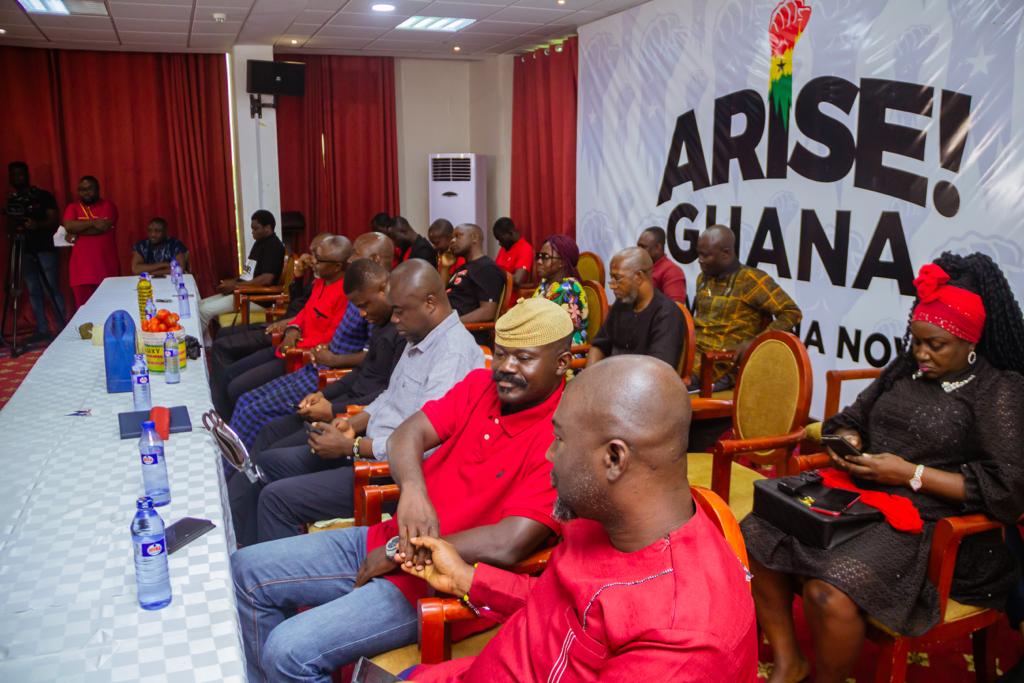
  • Arise Ghana addresses Ghanaian on economy mismanagement and governance of impunity

    Arise Ghana addresses Ghanaian on economy mismanagement and governance of impunity

    Full Press Statement below:

    MAIDEN PRESS CONFERENCE BY “ARISE GHANA” TO ADDRESS CRITICAL ISSUES OF

    POLITICAL AND SOCIO-ECONOMIC IMPORTANCE TO OUR DEAR NATION.

    Wednesday, 25th May, 2022

    Good morning, ladies and Gentlemen of the press.

    We have the honour of welcoming you to this maiden press conference of “Arise Ghana”, a coalition of patriotic,

    conscientious and concerned Ghanaians drawn from various political parties, including the Peoples’ National

    Convention (PNC), the Convention Peoples’ Party (CPP), the Ghana Union Movement (GUM), the Great

    Consolidated Popular Party (GCPP), the All People’s Congress (APC), the New Patriotic Party (NPP), the

    National Democratic Congress (NDC), various Civil Society Organizations, the media, the creative arts industry,

    Driver Unions, Traders and citizens from all walks of life.

    Distinguished friends from the media, “Arise Ghana”, is an amalgamation of activists who through advocacy and

    nationalistic mobilization, will seek to lead a crusade against the continuous misrule, mismanagement and maladministration of our dear nation Ghana by today’s duty bearers.

    We are determined to relentlessly champion the common cause of the Ghanaian people, provide a voice for the voiceless and vigorously seek reforms that will bring about the needed change in the socio-economic, politico-social and general wellbeing of the Ghanaian

    citizenry.

    Ladies and gentlemen, we have come to a point in our nation’s history where to remain silent is not an option.

    This is so because, to be silent is to encourage the continuous triumph of evil. To remain quiet over the present

    state of affairs is to encourage the continuous slide of our country into the abyss. Choosing not to speak about the

    current state of affairs means being complicit in the ongoing state capture and the sacrifice of our collective future

    on the altar of instant gratification. We obviously cannot afford the option of remaining silent.

    Economic hardships.

    Friends from the media, there are hardly enough words to describe the harsh economic realities of Ghanaians

    today. Fuel prices keep rising at the pumps every day, with its concomitant effect on transport fares, prices of food and general goods and services in the country.The price of fuel in Ghana today remains one of the highest in Africa. As a result of this, the distance between Kwame Nkrumah Circle and Kaneshie, costs the ordinary man in a Trotro, Ghc3 as we speak. Today, the distance from Madina to Kasoa requires a transport fare of Ghc12 even in public transport. In fact, one requires a whopping Ghc200 to travel from Accra to Tamale, a distance that used to cost the commuter Ghc100 in the year 2019.

    Inflation rate continues to gallop at an alarming rate and stands today at 23.6%, the highest in 18 years, thereby

    spiraling weekly hikes in prices of foodstuffs. A recent survey by Metro TV which was published on Sunday, 22nd May, 2022 revealed that an Olonka of Maize which sold for GH12.00 only last week, now sells for GH15.00 this week, while a sack of maize which sold for GH450.00 only last week, now sells for GH650.00 this week. In similar vein, a sack of yam which was selling at GH350.00 last week is now selling for GH450.00 this week, while a box of tomatoes which hitherto was sold at GH1000.00 last week is this week going for GH1,200.00.

    From this market survey which was done over a period of just one week, it is clear that cost of living in Ghana today is at an all-time high. With Government’s much-touted Planting for Food and Jobs program remaining a monumental failure, coupled with the ever-increasing cost of agricultural inputs and mechanization services, the threat of food insecurity looms ever larger on us than before.

    In fact, the purchasing power of the ordinary Ghanaian has fast deteriorated due to the unbearable cost of living

    thereby inflicting untold hardships on Ghanaians. Things are continuously getting worse by the day with no end

    in sight.

    WORSENING ECONOMIC CONDITIONS

    Distinguished friends from the media, the economy continues to wallow in the doldrums, with all economic indicators nose-diving while Government looks on helplessly. The Cedi’s free-fall continues unabated as a result of the failure of Government to translate its rhetoric into action. Today, the Cedi trades at about Eight Cedis, fifty pesewas (GHC8.50 = $1) to the US Dollar.

    The continuous depreciation of our national currency against its major trading partners continues to wash away the profit margins and in most cases, the capital of many businesses and traders who

    depend on forex exchange to import vital goods into the country. This situation has further aggravated the alarming rate of inflation the nation is presently experiencing.

    Even more worrying is the alarming rate of joblessness and hopelessness in the country, especially among the youth. Today, the rate of unemployment has risen to an all-time high, having moved from 6% in the year 2017 to a staggering 13.5% as at 2021.

    Indeed, our dear nation is presently in a deep economic mess. The country has lost access to the international capital market due to our unsustainable debt position. Our Public debt has increased to unprecedented and unsustainable levels from GHS120 billion cedis to over GHS391.9 billion cedis only in the last five and half years. This means that at a minimum, this government alone, since 2017, has added a whopping Ghc271.9 billion to the national debt stock, with a chunk of this going into consumption. Debt to GDP ratio has galloped from 56%

    in 2016 to about 80% as we speak, while our debt service burden has moved from about GHS14 billion cedis as at December 2016, to a whopping GHS50 billion cedis.

    This economic situation which is our worst performance in the history of this Fourth Republic has worsened our credit worthiness and dampened investor confidence in our economy leading to our worst ever downgrades by reputable sovereign credit rating Agencies such as Moody’s and Fitch. Simply put, our beloved Ghana is broke and this is a direct product of the bad leadership, insensitivity, misplaced proprieties and gross economic

    mismanagement of the present Akufo-Addo/Bawumia administration.

    DRACONIAN TAXES

    While wages of the Ghanaian worker remain static, with almost all labor unions up in arms over poor wages in the wake of worsening economic hardships, the Akufo-Addo/Bawumia government continues to impose killer and draconian taxes on the already burdened taxpayer.

    The recent passage of the obnoxious E-levy and its subsequent implementation remains yet another slap in the face of the Ghanaian people. Never in the history of our country has a government behaved so obstinately in imposing a draconian tax measure on its citizens, despite

    loud public outcry.

    Government’s subsequent use of judicial shenanigans in an attempt to defend the illegal imposition of this E-levy remains yet another clear demonstration of how desperate and callous they are State capturing and land grabbing.

    THE ATTEMPT TO REINTRODUCE THE FRAUDULENT AGYAPA DEAL

    Distinguished friends from the media, one of the cardinal, yet regrettable legacies of President Akufo-Addo and Alhaji Bawumia remains the unprecedented levels of state capture we are witnessing today. The practice of state capture under this government has assumed such alarming proportions that the God-given resources of this country that are supposed to benefit present and future generations are being utilized by only a few greedy family,

    friends and cronies in government today.

    One of the most bizarre, yet brazen display of state capture has manifested itself in the unpopular decision of this

    Government to Monetize our mineral resources in perpetuity under a fraudulent scheme dubbed “Agyapa” for the

    benefit of a select few.

    It initially gladdened our hearts that the Ghanaian people spoke in unison against this organized heist called “Agyapa” and forced government to suspend same. We are however mortified to note that despite the public outcry over this deal, the NPP/Akufo-Addo government is headstrong and is seeking to reintroduce the “Agyapa” deal as recently announced by the Finance Minister. We wish to serve notice that this latest attempt to reintroduce the unpopular “Agyapa” Mineral Royalties deal shall be defeated, as we shall resist same with everything within us.

    GRABBING OF ACHIMOTA FOREST RESERVE LANDS

    Ladies and gentlemen of the media, we daresay that you, like many Ghanaians, were surprised by recent reports of a certain E.I 144 which seeks to declassify portions of the Achimota Forest as no longer a Forest Reserve.

    Well, as the saying goes, coming events cast their shadows, and indeed recent events have now given out the real

    motive and intent of the Akufo-Addo/Bawumia Government relative to this matter of the Achimota Forest

    Reserve. As we now know, President Akufo-Addo and his land grabbers in government were only hiding behind

    a certain historical claim by one Owoo Family to appropriate the Achimota Forest Reserve, a nature conservation of huge environmental importance to all of us, among themselves.

    It has now emerged through some leaked portions of the Will of the late Kwadwo Owusu Afriyie, aka Sir John, a former CEO of the Forestry Commission, that elements within the Akudo-Addo/Bawumia Government have already shared lands in the Achimota Forest Reserve among themselves. Indeed, portions of the lands are contained in the leaked Will Document making the rounds. This is a tragedy of national proportions and we condemn it in no uncertain terms. To imagine that the Achimota Forest, one of the few surviving nature reserves in Ghana, would become another subject of the state capture of President Akufo-Addo and his cabal of buccaneers in Government breaks our hearts greatly.

    Friends from the media, portions of the late Kwadwo Owusu Afriyie’s Will reveals several prime lands, including those at the Achimota Forest and the Sakumono Ramsar Site that the late CEO of the Forest Commission acquired within a very short stint in Government, which he in turn willed to his relatives prior to his death.

    These revelations are but a microcosm of the scale and magnitude of grabbing and plundering of state lands and other resources by President Akufo-Addo and functionaries in his government in a manner akin to the conduct of pirates on the high sea.

    CORRUPTION AND ABUSE OF THE PUBLIC PURSE.

    Distinguished friends from the media, corruption remains endemic and pervasive under President Akufo-Addo and Alhaji Bawumia who have turned themselves into the greatest enablers and promoters of same.

    Despite being the most resourced government in Ghana’s history, this government has wasted all the

    unprecedented revenues that have accrued to them totaling about GHS500 billion mainly through profligacy and

    corruption.

    At the risk of sounding monotonous, it bears reminding that corruption scandals such as the BOST scandal involving the illegal sale of five million liters of contaminated fuel to dubious entities, the Australian Visa Fraud Scandal, the Galamsey Fraud Scandal, the PPA Contracts for Sale scandal, the PDS scandal, the Missing Excavators scandal and the most recent Sputnik V Scandal remain unresolved instances of daylight heist that President Akufo-Addo has either turned a blind eye to or whitewashed the perpetrators.

    All attempts to demand accountability for the use of Covid-19 funds continues to be suppressed by President Akufo-Addo who has effectively doused the flame of accountability. There is little wonder therefore that corruption is at an all-time high under this current regime.

    Even more bizarre is the fact that at a time when majority of Ghanaians are suffering and experiencing excruciating hardships, President Akufo-Addo continues to travel in ultra-luxurious and hyper-expensive private jets at high expense to the already-impoverished Ghanaian taxpayer just to satisfy his creature comforts.

    CONCLUSION

    Distinguished friends from the media, our dear nation is on the verge of becoming a failed state. The center can no longer hold. Things are falling apart. It goes without saying that the current state of affairs calls for action.

    Every well-meaning Ghanaian is therefore duty-bound not only to speak against the ills of today, but also to act now in order to save the soul of our nation.

    This is why we in Arise Ghana are saying to all conscientious Ghanaians to arise and “Save Ghana Now”!

    DEMANDS

    1. We demand an immediate withdrawal of E.I 144 and an end to the land grabbing of the Achimota Forest Reserve lands. Caution is hereby served to President Akufo-Addo and his land grabbers to stay their hands off the Achimota Forest lands. We urge Parliament who are the representatives of the people to institute a bi-partisan probe into the matters relating to the sale of lands in the Achimota Forest immediately. This probe should be

    transparent and all persons, be they past or present government officials, civil or public servants, and all whose hands are soiled by this shameless grabbing of Achimota Forest lands should be named, shamed and the stolen Lands retrieved for the State.

    2. We demand an immediate and total cancelation of the Agyapa Royalties deal as same is not in national interest.

    We will never sit aloof and allow a few selfish and greedy thieves in government to appropriate our mineral royalties for themselves and their families.

    3. Also, we demand an immediate reduction in fuel prices through the scrapping of crippling fuel taxes such as

    the sanitation levy (“borla tax”) of 10 pesewas on every liter of diesel and petrol. We believe that this if done, will provide some respite to suffering drivers and Ghanaians as a whole.

    4. Additionally, we demand the immediate repeal of the obnoxious E-levy Act, which is nothing but naked thievery of the meager resources of the citizenry by the wicked Akufo-Addo/Bawumia government.

    In the light of the foregoing demands, “Arise Ghana” shall hold a Public Forum in the coming days to further expatiate on these important matters of considerable public interest.

    More importantly, we wish to announce for the information of all Ghanaians, that we shall be embarking on a mammoth demonstration on the 21st of June 2022 in the city of Accra to press home these demands. We therefore call on all Ghanaians who desire to see a change in the affairs of our beloved country to come out in their numbers and join us on the streets of Accra for this historic protest.

    This will be the first of a series of protest actions that we shall relentlessly be holding across the length and breadth

    of the country with the aim of bringing sufficient pressure to bear on the insensitive, corrupt and incompetent

    Akufo-Addo/Bawumia government to act in the best interest of Ghanaians.

    Ladies and gentlemen, Ghana needs to be saved now. And this must be done by you and I. We have had enough of the hardships government keeps inflicting on us; Enough of the broken promises; Enough of the naked thievery of state resources; Enough of the arrogance of power; Enough of the state-capture; Enough of the culture of impunity. We all have a role to play in the struggle to save the soul of our beloved country. The time to act is now!

    May God bless our homeland Ghana and make her great and strong through your collective efforts.

    Thank you for your attention ladies and gentlemen.

    Signed,

    Comrade Mordecai Thiombiano

    General Secretary, APC and leading Member of Arise Ghana

    (contact No.; 0279781055)

    Comrade Duncan Amoah

    Executive Secretary, COPEC Ghana and leading member of Arise Ghana

    (contact no.; 0243246570)

    Comrade Bobie Ansah

    Broadcast Journalist and Leading member of Arise Ghana

    (contact no.; 0243123620)

    Comrade Mensah Thompson

    Convener, ASEPA and leading member of Arise Ghana

    (contact no.; 0542120628)

    Comrade Osei Kofi Acquah

    National Youth Organzier, CPP and leading member of Arise Ghana

    (Contact no.; 0243388633)

    Comrade Ishaq Awudu

    Communications Director, PNC and leading Member of Arise Ghana

    (contact no.; 0244947573)

    Comrade Kojo Gold

    General Secretary, GUM and leading member of Arise Ghana

    (Contact no.; 0244782025)

    Comrade Rex Omar

    Musician and Leading Member of Arise Ghana

    (contact no.; 0556569304)

    Dzramado Selorm Dramani

    President, Unemployed Association and Leading Member of Arise Ghana

    (contact no.; 0241384810)

  • African DFIs tasked to enhance credit rating positions to boost investment

    African DFIs tasked to enhance credit rating positions to boost investment

    Development Finance Institutions across Africa have been tasked to beef up efforts to enhance credit rating positions to attract more global investments.

    According to the Bank of Ghana, access to global debt capital and loan markets continues to remain a problem hence the call for the financial institutions to implement policies that will attract investments on more favourable terms.

    Development Finance Institutions (DFIs) provide risk capital for economic development projects on a non-commercial basis.

    Ghana is currently in the process of setting up such an outfit called the Development Bank Ghana with funding from internal and global partnership sources.

    Among the objectives for setting up the bank is to position certain sectors of the Ghanaian economy to attract the needed global investment.

    Many DFIs across the continent are in the process of positioning their economies for similar investments.

    It is in this regard that the Bank of Ghana is asking these institutions to implement policies that will enhance their ratings in order to attract global investments.

    The Head of Banking Supervision at the Bank of Ghana, Osei Gyasi, was speaking on behalf of the Governor of the Central Bank at the 2022 annual general assembly of the Association of African Development Finance Institutions.

    “African DFIS should work at enhancing credit rating positions. In spite of the large number of African DFIs, access to global debt capital and loan markets continues to be dominated by a few leading multilateral African or regional DFIs largely due to innovations in credit enhancements and structuring. It is imperative, therefore, for DFIS to implement policies that will enhance their ratings in order to attract more global investments on more favourable terms, including longer tenors and lower interest rates.”

    Following the recent increase of the Monetary Policy Rate by 200 basis points to 19 percent due to the high inflation rate, it is expected that the cost of borrowing from financial institutions will go up at least for the next two and half months.

    It is for this reason that banks and other financial institutions will have to review their fees and charges to adjust to the current monetary policy situation.

    Managing Director of the National Investment Bank, Samuel Sarpong spoke to Citi Business News on the sidelines of the meeting.

    He said, “All banks are going through a period o adjusting to the various economic conditions as well as the monetary policy situation. For example, the cost of doing business has gone up significantly with the inflationary rate and all banks are adjusting their rates and fees to make sure that they make profit. So similar to other banks, NIB is looking at its interest rates, fees and cost of doing business and adjusting appropriately just as any other business will do.”

    The 48th Association of African Development Finance Institutions annual general assembly which was hosted by the National Investment Bank was under the theme, ‘Unlocking Innovative Resources for Development Finance Institutions: Agenda for African DFIs’.

  • MoMo transactions records 3% decline in value

    MoMo transactions records 3% decline in value

    The value of mobile money transactions has seen a three percent decrease in a period of one month between March and April 2022.

    According to latest data from the Bank of Ghana, the value of transactions dropped from GHS90.5 billion in March to GHS87.7 billion in April.

    The number of MoMo transactions also dropped from 413 million in March to 403 million in April.

    The Central Bank’s Summary of Economic and Financial Data revealed a minimal decrease in the number of active mobile money accounts from 18.9 million to 18.6 million between March and April this year.

    Although it is observed that on a year-on-year basis, most of these transactions recorded an increase in value and volume between April last year and April this year, the figures decreased on a monthly basis.

    These reductions seem to be a result of reactions to the electronic transfer levy prior to its actual implementation on May 1, as experts had earlier predicted a reduction in the volumes if the tax policy is approved.

    This was indeed confirmed as Mobile Money agents across the country lamented a shortage of cash due to the rush from customers to withdraw their funds from their accounts ahead of the implementation of the levy.

    Amidst all this, Mobile Money Interoperability on the other hand has seen increases in both volume and value over the months.

    The Bank of Ghana data disclosed that the number of MoMo Interoperability transactions saw an 11 percent increase to record 14.2 million in April, while the value saw about 20 percent increase for the same month.

  • 3-year bond rolled-over attracts yield of 25% 

    3-year bond rolled-over attracts yield of 25% 

    Ghana Government will have to pay as high as 25 percent yield or cost for the 3-year bond which was rolled-over, last week Friday, May 20th, 2022.

    The Bank of Ghana’s data indicates, it secured GH¢470.4 million for the debt instrument, about 76% less than the targeted amount.

    Despite the coupon rate within the pricing guidance, the financial market has become really expensive due to the liquidity squeeze and prevailing inflation uncertainty.

    This is manifested in the amount of money raised by the government, which significantly fell short of the target.

    On the secondary market, it appears more investors are considering selling their bonds or debt instruments rather than buying the financial instruments.

    This has made it costly to issue new bonds, hence the high yield-to-maturity, which could impact on government financing.

    Per the terms, government is expected to pay interest on the bonds semi-annually till maturity where it will pay off the principal if it does not rollover.

    The bond had a minimum bid of ¢50,000 and multiples of ¢1,000 thereafter.

    Absa, Black Star, CalBank, Databank, Ecobank, Fidelity, GCB, IC Securities and Stanbic Bank were the book runners.

    Government paid extra interest rate for the 5-year and 2-year bonds issued earlier in the month.

    It paid an interest of 22.30% and 21.50% for the 5-year and 2-year bonds issued on Friday, 6th May, 2022.

    The interest rate, which will probably increase the country’s interest payment will be paid semi-annually, until maturity in 2027 and 2024 respectively.

    Until recently, government was paying between 19% and 20.50% for medium term financial instruments.

  • Domestic debt hits 38% of projected GDP

    Domestic debt hits 38% of projected GDP

    Adnan Adams Mohammed

    Ghana’s domestic debt ballooned from GH¢181.9 billion in January to GH¢189.9 billion in March, which represents about 38% of the projected Gross Domestic Product (GDP) for 2022.

    This shows an increase in domestic debt by an amount of GH¢8 billion in two months.

    The domestic debt is a component of the total debt stock which stood at GH¢391.9 billion (equivalent of US$ 55.1 billion) as of March 2022, data from the Bank of Ghana indicate.

    However, the external component of the debt, increased significantly by about GH¢32 billion in the first 3 months of 2022, from GH¢169.8 billion in January to GH¢201.9 billion in March.

    Even though dropped by $3 billion in the first quarter of 2022 from $58.4 billion in January to $55.1 billion in March, it increased in cedi terms due to

    The depreciation of the currency resulted in increment of the total debt of about GH¢40 billion. Even though the debt value dropped by US$3 billion in the first quarter of 2022 from US$58.4 billion in January to US$55.1 billion in March.

    The total debt stock was GH¢351.7 billion in January 2022.

    The increase in the debt stock in cedis increases Ghana’s debt to Gross Domestic Product (GDP) ratio to 78%.

    Year-on-year, from March 2021 to March 2022, the debt stock rose by about 30% from GH¢304.6 billion to GH¢391.9 billion.

  • Fiscal deficit worsens by 0.3% of GDP

    Fiscal deficit worsens by 0.3% of GDP

    Adnan Adams Mohammed

    The Bank of Ghana’s provisional data for the first quarter of 2022, indicated an overall broad fiscal deficit (cash, excluding energy sector payments, financial sector clean-up costs) of 2.6 percent of Gross Domestic Product (GDP).

    This is against the programmed target of 2.3% of GDP.  The corresponding primary balance for the period was a deficit of GH¢2.3 billion (0.5% of GDP), against a deficit target of GH¢1.4 billion (0.3% of GDP).

    Over the period, total revenue and grants amounted to GH¢16.7 billion (3.3% of GDP), below the projected GH¢19.3 billion (3.8% of GDP).

    Total expenditures amounted to GH¢27.0 billion (5.4% of GDP), below the programmed target of GH¢30.5 billion (6.1% of GDP).

    However, the Monetary Policy Committee (MPC) during its press conference indicated that, it observed that execution of the budget for the first quarter was broadly in line with targets although there was a minor deviation in the deficit target, stemming largely from low revenue receipts.

    It is the expectation of the Committee that fiscal consolidation will take hold gradually and the mid-year budget review will provide further fiscal fine-tuning to ensure that the fiscal consolidation efforts stay on track.

    On the general economic overview, the central bank at a press briefing, last week, said: “In sum, the Committee observed that the global growth recovery is showing signs of a slowdown, on account of heightened risks emanating from lingering supply chain bottlenecks, China’s zero-Covid policy, and the Russia-Ukraine war. Concurrent with the growth slowdown is the sharp rise in inflation across several advanced and emerging market economies, which has posed some challenges to central banks globally. Global price pressures have broadened beyond the volatile items of energy and food.

    “This has prompted some coordinated monetary policy tightening in Advanced Economies and most Emerging Market and Developing Economies and triggered tightened global financing conditions. The spillover effects of these policy responses have impacted economies through the trade and finance channels, with vulnerable developing countries faced with capital flow reversals and currency pressures. Ghana’s economy is already facing some of these headwinds from these spillover effects”.

    It said growth prospects in the domestic economy remain positive and the Bank’s high-frequency indicators point to continued and increased momentum in economic activities with private sector credit showing some improvement in real terms, despite the increased price pressures.

    “All these are resulting in a closure of the negative output gap. The banking sector remains robust, with sustained growth in total assets, investments and deposits. However, business and consumer confidence have dipped, reflecting the sharp depreciation of the currency and the general high inflationary environment, which has resulted in higher input costs for businesses. A quick turnaround, with more confidence-building measures to counter these conditions, would provide further boost to the real economy”, it added.

  • Trade surplus improves as it almost doubles in value

    Trade surplus improves as it almost doubles in value

    Adnan Adams Mohammed

    Provisional data as released by the Bank of Ghana indicates a trade surplus of US$1.3 billion in the first four months of the year, compared with a trade surplus of US$778.00 million in the same period of last year.

    The improvement in export earnings was attributed to crude oil and non-traditional exports. Crude oil export receipts recorded significant growth of 61.0 per cent to US$1.9 billion, due to price effects, while gold exports improved by 3.6 per cent, also supported by price effects.

    Non-traditional export receipts crossed the US$1.0 billion mark in the review period and contributed significantly to the trade surplus. These developments far outweighed the 7.7 per cent growth in total oil imports in the review period, on the back of compressed non-oil imports.

    Accorcing to the Monetary Policy Committee (MPC), the trade surplus was offset by investment income outflows and net services payments, resulting in a current account deficit of US$128.15 million (0.2 per cent of GDP) for the first quarter of the year, representing a marginal improvement from the current account deficit of US$197.0 million (0.2 per cent of GDP) recorded in the first quarter of 2021.

    The capital and financial account, however, recorded some significant outflows from net portfolio reversals and net private capital outflows, which resulted in an overall balance of payments deficit of US$934.46 million for the first quarter of 2022, compared with a deficit of US$429.93 million, same time last year.

    Although, commodity prices have remained volatile due to the ongoing geopolitical tensions. Average crude oil prices gained 42.0 percent on a year-to-date basis to settle at US$106.2 per barrel in April 2022, supported by supply constraints arising from the geopolitical tensions between Russia and Ukraine.

    Gold prices also gained 8.1 per cent to settle at US$1,935.89 per fine ounce, on the back of increased safe-haven demand amid global inflation concerns.

    Similarly, cocoa prices went up by 4.4 percent to settle at US$2,591.06 per tonne in April 2022, compared to the US$2,481.95 per tonne in December 2021, due to unfavourable weather conditions across West Africa.

    The favourable commodities price trends positively impacted the trade account, as export inflows outweighed imports.

  • A bite at BoG’s inflation targeting framework.. is it still effective or a ‘try your luck’?

    Adnan Adams Mohammed

    As inflation rate in the country has leapfrogged within past few months to record highest rate in about 18 years has unveiled the Bank of Ghana’s inflation control framework to criticism. 

    The current inflationary trend, despite the Monetary Policy Committee of the central bank raising the policy rate by about 250 basis points last month, yet, it was that month annual inflation rate jumped from 19.4% in March to 23.6%, the highest since January 2004. Not only is the inflation substantially above the Bank’s target of 8+/-2 %, but it has also markedly outstripped the current policy rate of 17%.

    While inflation is high it is also straining economic growth together with slowing global output and a 2.5 percentage point increase in March in the key interest rate, the biggest hike since at least 2002. The S&P Global Ghana Purchasing Managers’ Index has also been below 50 since February, indicating a deterioration in business conditions. 

    All things being equal an increase in the policy rate is supposed to tame the rate of inflation, but in the current development has disapproved the macroeconomic management theory.  This has therefore lay bare the inflation targeting regime of the central bank, which it uses to control economy in terms of currency exchange rate and rate of economic growth, to criticisms by some economists as to whether it real works the magic or it is a ‘try your luck’ theory.

    Among such economists, is the Director of Research at the Institute of Economic Affairs (IEA), Dr. John Kwakye, who has expressed unhappiness with the current approach being used by the Bank of Ghana in stemming Ghana’s inflation situation.

    According to the Institute, “the inflation targeting framework being used by the Central Bank cannot provide a lasting solution to the country’s inflation problem hence must be avoided.”

    In a paper titled, “How should the bank of Ghana respond to the run-away inflation and the high cost of living in Ghana”, Dr. Kwakye argued that, “in principle, the inflation-targeting framework may be relevant in dealing with second-round inflationary effects of initial supply or cost shocks but the situation isn’t so in the Ghanaian context thereby rendering the framework less effective in stemming the country’s type of inflation.”

    In view of this, he stressed on the need for a comprehensive approach that includes direct targeting of the supply or cost elements to find a lasting solution to the rising inflation rate.

    The IEA opines that going by the principle underlying the inflation targeting, with current inflation and future outlook being so elevated, the immediate response by the BoG should be to tighten monetary policy by increasing it by 200 basis points to help narrow the gap with inflation.

    Arguably, an economist with Databank Group has indicated that, the BoG’s MPC will have tough time to arrive at their decisions in their May bimonthly review meeting. 

    “The monetary policy committee of the central bank will have a nail-biting decision to make,” Courage Martey said in an interview.  “Any attempt by the central bank to tighten monetary policy further will be an attempt to squeeze water out of stone.” 

    Mr Martey cautioned that, “Inflation hasn’t peaked yet, so the MPC would want to avoid creating a perception of chasing inflation when it should be ahead of the inflation curve.”

    However, according to an astatute financial and economic journalist who doubles as the managing editor of Economy Times newspaper, Elorm Desewu, year on year inflation is expected to worsen further in the coming months in the wake of the decision by the Public Utility Regulation Commission (PURC) to hike tariffs of electricity and water as well as increase in transport fares by the transport operators in the country. 

    Fortnight ago, the Electricity Company of Ghana and the Ghana Water Company tabled a tariff hike before the PURC awaiting approval or disapproval for consumers to pay more in access of 148 percent for power and 334 percent for water, while the transport fares have gone up by 20 percent effective last week. 

    “This is expected to impact heavily on the non-food inflation which would trigger a further rise in year on year inflation”, the journalist noted in his analysis. 

    “The current development would pose a headache to the seven member committee of the Monetary Policy Committee (MPC) as they announce their decisions of the bimonthly review of the economy today, May 23, 2022. 

    Already, the MPC has revised it medium term inflation target of 8+/-2 to March 2023.

    Additionally, the Bank of Ghana announced some measures in April this year in relation to universal banks, in attempt to anchor inflation. These include, the Cash Reserve Ratio was increased to 12 percent; the Capital Conservation Buffer was reset to the pre-pandemic level of 3 percent, making the Capital Adequacy Ratio a total of 13 percent; and the provisioning rate for loans in the Other Loans Exceptionally Mentioned (OLEM) category was reset to the pre-pandemic level of 10 percent.

    But recent figures from the Ghana Statistical Service, (GSS) depict that year on year inflation measured by the Consumer Price Index, (CPI) increased significantly to 23.6 percent for the 12-months period ended April, 2022 from 19.4 percent in March, 2022.

    According to the Ghana Statistical Service, “four divisions – transport (33.5%); household equipment and routine maintenance (28.5%); food and non-alcoholic beverages (25.6%), and housing, water, electricity, gas and other fuels (25.0%) recorded inflation rates above the national average of 23.6% with transport recording the highest inflation.”

    National month-on-month inflation from March 2022 to April 2022 was 5.1%.

    It also noted that this is the first time in 29 months that inflation for imported items exceeded domestic inflation. Whilst inflation for locally produced items was 23.0%, inflation for imported items was 24.7%.

    “The inflation for imported goods is higher than the 17.3% recorded for March 2022 while the inflation for locally produced items is 23.0% higher than the 20.0% recorded in March 2022.”

    Whilst Food and Non-Alcoholic Beverages inflation was 26.6%, Non-Food inflation stood at 21.3%.

    April 2022’s food inflation of 26.6% is higher than both food inflation for March 2022 (22.4%) and the average of the previous 12 months (13.5%).

    Food inflation’s contribution to total inflation however, decreased from 51.4% in March 2022 to 50.0% in April 2022.

    All the 15 food subclasses recorded positive month-on-month inflation with Fruit and Vegetable Juices recording the highest of 15.3%.

    Non-food year-on-year inflation on average went up again in April 2022 compared to March 2022, that is from 17.0% to 21.3%. Only one out of the 12 Non-food Divisions had the 12 months rolling average to be higher than the year-on-year inflation for April 2022 for the divisions. Transport is the Division that recorded the highest inflation in April 2022 (33.5%).

    There is a high expectation that the MPC would again hike the policy rate further to stem the rising inflation.

  • BoG shocked at rate of inflation rise…but boast of solid economy

    Adnan Adams Mohammed

    The Bank of Ghana has expressed shock at skyrocketing rise in the rate of inflation in the country.

    The central bank is however confident that the Monetary Policy Committee, which is meeting to review developments in the economy, will take a decision to see the decline of the rate of growth.  

    The MPC need to decide on the current policy rate, which stands at 17%. The policy rate, which influences interest rates for individuals and businesses, is also used as a tool to curb inflation in the country.

    “It’s an issue, which in a sense is baffling for all of us. A year ago inflation in Ghana was 7%% and now we find ourselves with high double-digit inflation. It’s a very complicated environment”, the Governor of the Bank of Ghana, Dr. Ernest Addison, said in an interview, last week.  “The MPC is meeting this week and I do not want to pre-empt what the committee will decide, but I think it’s a very complicated situation. We do need to take a position on what to do with the policy rate, which stands at 17%.”

    Data from the Ghana Statistical Service shows that the continuous surge in transport and food prices among others, across the country, has pushed the national year-on-year inflation for April 2022 to 23.6 %, which is over 13 percentage points higher than the upper band of government’s inflation target for 2022, which is 10 %.

    Under the inflation targeting regime being operated by the Central Bank, policy makers generally prefer that the policy rate stays ahead of headline inflation. But for the first time in a long while, the key rate is trailing headline inflation by about 700 basis points, leaving the Central Bank in a difficult position.

    Meanwhile, Dr. Addison has assured that he was confident the rate of inflation had peaked and should begin declining for the rest of the year.

    “Government and the Central Bank are very much aware of the problem. We’ve had very major decisions on fiscal consolidation. Expenditures have been cut by 20% among other things. We expect that these measures will serve as an anchor to inflation. A lot of the shocks that we are seeing now tend to be supply-side in nature, but we think the worst has gone through the system, and we expect that inflation will be tapering off for the rest of the year.”

    The Governor further noted that, the Ghanaian economy is growing strongly despite the threat of rising inflation and the recent sharp volatility of the cedi. 

    According to him, data secured by his outfit so far indicates that the economy continues to rebound, irrespective of the challenges. He said, the real sector of the economy has been resilient despite the impact of COVID-19 pandemic.

    “The Ghanaian situation in a sense also reflects what happened in 2020 where the government took a very expansionary stance on policy. Therefore there were many interventions that was put into place in order to protect lives and livelihoods.”

    “The impact of that was real sector being more resilient than we see in other places. As I said, we are beginning to see a pick-up in growth in 2021”, Dr. Addison emphasised.”

    Indeed, sectors such as Information, Communications and Technology; Tourism and Hospitality; Manufacturing have bounced back, registering strong growth rates.

    “Some of the data that has come in 2022 does not suggest that we are slowing down”, the Governor noted.

    “I believe, if we were to choose between growth and inflation, the policy priority should be managing the pace at which prices are increasing”, he added.

    Economy expanded by 5.4% in 2021 – GSS

    Ghana’s economy expanded by 5.4% in 2021, far higher than the 0.4% recorded in the year 2020, a period that COVID-19 pandemic had severely hit the global economy.  

    Without oil, the economy recorded a Gross Domestic Product (GDP) growth rate of 6.9%

    According to provisional estimate by the Ghana Statistical Service, only 10 countries in Africa recorded growth rates higher than that of Ghana. They included Cote d’ lvoire and Uganda.

    The strong growth rate was driven by the Services sector, particularly the Information, Communication and Technology (33.1%) and the Agriculture sector, such as Fishing (13.4%).

    The Services sector recorded the highest GDP growth rate of 9.4% in 2021.