
By Adnan Adams Mohammed
In a monumental development for local agriculture and industrialization, the government has announced an ambitious plan to establish one of the largest palm processing factories in the country right within the Akyem Abuakwa Traditional Area.
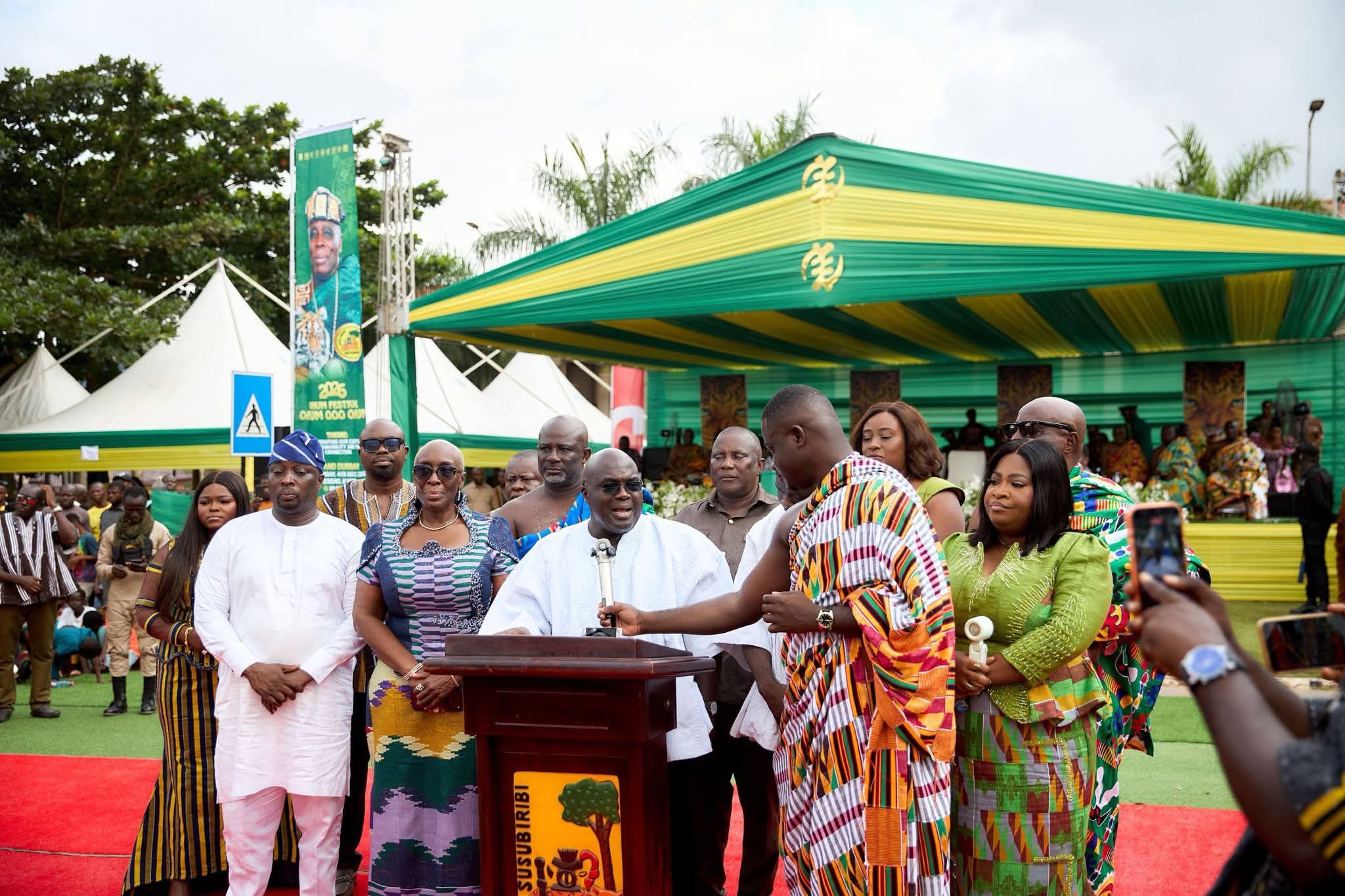
The landmark initiative was unveiled by the Chief of Staff, Dr. Julius Debrah, who spoke on behalf of President John Dramani Mahama at the grand durbar of the 2026 Ohum Festival held at Kyebi.

Delivering the executive address at Eseho, the forecourt of the Ofori Panin Fie, Dr. Julius Debrah made a passionate appeal to the Okyehene, Osagyefuo Amoatia Ofori Panin, and the area’s traditional leaders to support the state by securing the necessary land to kickstart construction.
The announcement has catalyzed a shared vision between state authorities and the Okyeman Traditional Council to aggressively expand the local oil palm value chain.
Harnessing the Potential of “Red Gold”
The Mahama administration’s focus on the oil palm industry stems from a strategic push to diversify Ghana’s agricultural output and maximize rural industrialization.
”President John Dramani Mahama is keen on harnessing the potential of the emerging ‘red gold’ industry and its vast value chain, which is expected to create jobs for young people,” Chief of Staff Julius Debrah told the vibrant gathering of chiefs, queen mothers, and residents.
The proposed processing facility is designed to move the local economy entirely away from the mere cultivation and sale of raw palm fruits. By capturing the full value chain, the factory will process raw materials directly within the Eastern Region into high-value consumer items. Officials at the gathering highlighted that the industrial pipeline will focus heavily on producing household essentials, including high-quality soaps and cooking oil.
A Twin Vision for Youth Employment
The state’s industrialization drive directly complements advanced plans already set in motion by the Okyeman Traditional Council to expand its own signature project, the Okyeman Oil Palm Plantation. The combined weight of a state-backed factory and an expanded plantation is expected to serve as a massive economic engine for the region.
The project aims to tackle two critical socio-economic challenges at once:
Curbing Rural Unemployment: The mega-factory and expanded cultivation are anticipated to create thousands of direct and indirect jobs specifically targeted at the youth.
Mitigating Rural-Urban Migration: By anchoring high-earning manufacturing jobs locally, young people will no longer feel compelled to move to major cities in search of work.
To guarantee these outcomes, Hon. Julius Debrah directly petitioned the traditional leadership. He urged the Okyehene, in close consultation with his sub-chiefs across Akyem Abuakwa, to identify and safely release a contiguous, suitable tract of land dedicated entirely to the factory’s construction and long-term sustainability.
A Unified Call for Development
The 2026 Ohum Festival—celebrated under the timely theme “Rejuvenating our Customs for Sustainability and Nature Connection”—served as a masterclass in cultural heritage and state-traditional collaboration.
Supporting the Chief of Staff’s address, the Minister of Local Government, Chieftaincy and Religious Affairs, Ahmed Ibrahim, reaffirmed the government’s unwavering commitment to the equitable distribution of infrastructure. He assured citizens that the administration would continuously remain accountable to Ghanaians regarding its nationwide developmental stewardship.
In response, the Okyehene, Osagyefuo Amoatia Ofori Panin, welcomed the forward-thinking agricultural blueprints. Standing under the banner of Susubiribi, local leaders and enthusiastic residents expressed an overwhelming wave of support for the project. The traditional council called upon all local stakeholders to display absolute unity and maximum cooperation to translate this massive industrial blueprint into immediate reality on the ground.
