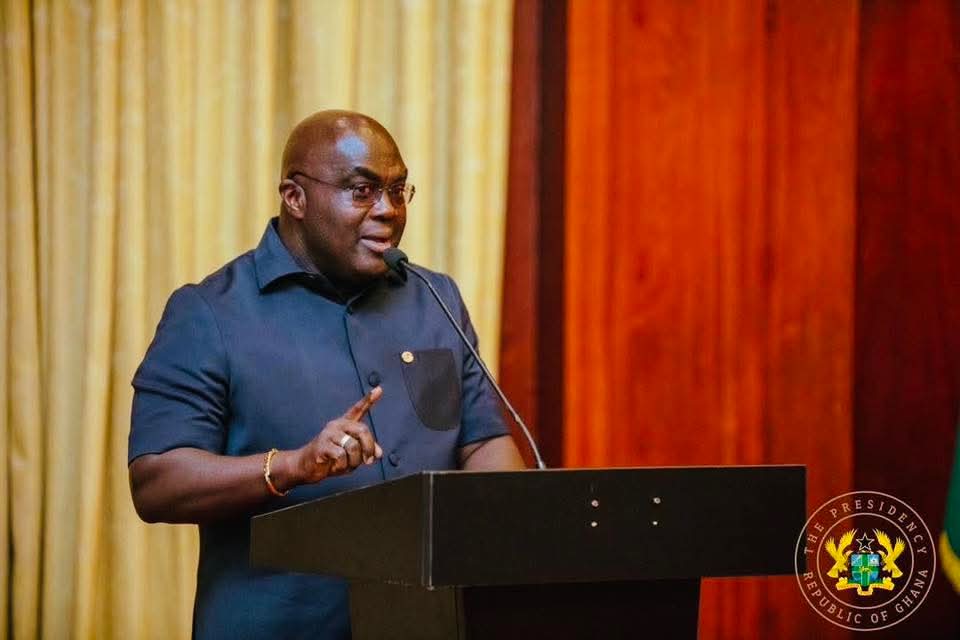
Government has issued a firm call to stakeholders across the mining sector, declaring that historic mining communities like Obuasi must reflect the immense wealth extracted from their soil.
Speaking at the National Mining Dialogue in Accra, Chief of Staff Dr. Julius Debrah, in a speech delivered on his behalf by Deputy Government Spokesperson Shamima Muslim, emphasized that as the world’s sixth-largest gold producer, Ghana bears a heavy responsibility to ensure its wealth is visible in local infrastructure and human development.
“We have heard that Ghana is now the 6th largest gold-producing country in the entire world,” Dr. Debrah noted in his keynote address. “We may applaud, but that also brings us huge responsibility to look like the 6th largest gold-producing nation of the world. Government remains committed to lawful, responsible mining and enforcement; each matter must be handled fairly on evidence and through the proper institution.”
The Chief of Staff’s remarks underscored a growing national consensus that decades of mineral extraction must no longer leave host towns lagging behind in basic infrastructure and industrial growth. Calling for a shift from unsafe practices to structured, transparent systems, Dr. Debrah reiterated that the public will ultimately judge the country’s mining sector by the tangible wealth retained domestically and the strength of national reserves.
“Formalisation must not become a war against vulnerability and security,” he added. “From an opaque market to a fair market and from unsafe practices to responsible livelihoods, the artisanal miner should hear reforms and an invitation to operate safely, lawfully, and profitably.”
Echoing the Chief of Staff’s charge, Chief Executive Officer of the Ghana Gold Board (GoldBod), Sammy Gyamfi, highlighted the stark reality of host communities like Obuasi, drawing a sharp contrast between long-standing local extraction and the actual transformation on the ground.
“We cannot continue to mine gold from the soil of our communities while poverty, lack of access to potable water, poor roads, youth unemployment, and weak local capacity persist,” Gyamfi stated. “Ghana has mined gold commercially for more than a century, yet Obuasi can produce gold for generations and still not compare to Johannesburg in industrial depth, urban development, and economic opportunities. Extraction without intentional policy does not automatically produce transformation.”
Gyamfi argued that host communities should be treated as active development partners and economic shareholders rather than mere land donors. Under the central framework of the Ghana Gold Board, government efforts aim to build value by strengthening local processing, refining, and supply chain logistics.
As state agencies, mining operators, and local leaders assess the road ahead, the consensus remains clear: policy reforms under GoldBod and the Domestic Gold Purchase Programme must deliver visible, lasting progress to communities like Obuasi so that their infrastructure finally mirrors the gold beneath their soil.
Leave a Reply