Category: Technology

  • 3-year bond rolled-over attracts yield of 25% 

    3-year bond rolled-over attracts yield of 25% 

    Ghana Government will have to pay as high as 25 percent yield or cost for the 3-year bond which was rolled-over, last week Friday, May 20th, 2022.

    The Bank of Ghana’s data indicates, it secured GH¢470.4 million for the debt instrument, about 76% less than the targeted amount.

    Despite the coupon rate within the pricing guidance, the financial market has become really expensive due to the liquidity squeeze and prevailing inflation uncertainty.

    This is manifested in the amount of money raised by the government, which significantly fell short of the target.

    On the secondary market, it appears more investors are considering selling their bonds or debt instruments rather than buying the financial instruments.

    This has made it costly to issue new bonds, hence the high yield-to-maturity, which could impact on government financing.

    Per the terms, government is expected to pay interest on the bonds semi-annually till maturity where it will pay off the principal if it does not rollover.

    The bond had a minimum bid of ¢50,000 and multiples of ¢1,000 thereafter.

    Absa, Black Star, CalBank, Databank, Ecobank, Fidelity, GCB, IC Securities and Stanbic Bank were the book runners.

    Government paid extra interest rate for the 5-year and 2-year bonds issued earlier in the month.

    It paid an interest of 22.30% and 21.50% for the 5-year and 2-year bonds issued on Friday, 6th May, 2022.

    The interest rate, which will probably increase the country’s interest payment will be paid semi-annually, until maturity in 2027 and 2024 respectively.

    Until recently, government was paying between 19% and 20.50% for medium term financial instruments.

  • Domestic debt hits 38% of projected GDP

    Domestic debt hits 38% of projected GDP

    Adnan Adams Mohammed

    Ghana’s domestic debt ballooned from GH¢181.9 billion in January to GH¢189.9 billion in March, which represents about 38% of the projected Gross Domestic Product (GDP) for 2022.

    This shows an increase in domestic debt by an amount of GH¢8 billion in two months.

    The domestic debt is a component of the total debt stock which stood at GH¢391.9 billion (equivalent of US$ 55.1 billion) as of March 2022, data from the Bank of Ghana indicate.

    However, the external component of the debt, increased significantly by about GH¢32 billion in the first 3 months of 2022, from GH¢169.8 billion in January to GH¢201.9 billion in March.

    Even though dropped by $3 billion in the first quarter of 2022 from $58.4 billion in January to $55.1 billion in March, it increased in cedi terms due to

    The depreciation of the currency resulted in increment of the total debt of about GH¢40 billion. Even though the debt value dropped by US$3 billion in the first quarter of 2022 from US$58.4 billion in January to US$55.1 billion in March.

    The total debt stock was GH¢351.7 billion in January 2022.

    The increase in the debt stock in cedis increases Ghana’s debt to Gross Domestic Product (GDP) ratio to 78%.

    Year-on-year, from March 2021 to March 2022, the debt stock rose by about 30% from GH¢304.6 billion to GH¢391.9 billion.

  • Fiscal deficit worsens by 0.3% of GDP

    Fiscal deficit worsens by 0.3% of GDP

    Adnan Adams Mohammed

    The Bank of Ghana’s provisional data for the first quarter of 2022, indicated an overall broad fiscal deficit (cash, excluding energy sector payments, financial sector clean-up costs) of 2.6 percent of Gross Domestic Product (GDP).

    This is against the programmed target of 2.3% of GDP.  The corresponding primary balance for the period was a deficit of GH¢2.3 billion (0.5% of GDP), against a deficit target of GH¢1.4 billion (0.3% of GDP).

    Over the period, total revenue and grants amounted to GH¢16.7 billion (3.3% of GDP), below the projected GH¢19.3 billion (3.8% of GDP).

    Total expenditures amounted to GH¢27.0 billion (5.4% of GDP), below the programmed target of GH¢30.5 billion (6.1% of GDP).

    However, the Monetary Policy Committee (MPC) during its press conference indicated that, it observed that execution of the budget for the first quarter was broadly in line with targets although there was a minor deviation in the deficit target, stemming largely from low revenue receipts.

    It is the expectation of the Committee that fiscal consolidation will take hold gradually and the mid-year budget review will provide further fiscal fine-tuning to ensure that the fiscal consolidation efforts stay on track.

    On the general economic overview, the central bank at a press briefing, last week, said: “In sum, the Committee observed that the global growth recovery is showing signs of a slowdown, on account of heightened risks emanating from lingering supply chain bottlenecks, China’s zero-Covid policy, and the Russia-Ukraine war. Concurrent with the growth slowdown is the sharp rise in inflation across several advanced and emerging market economies, which has posed some challenges to central banks globally. Global price pressures have broadened beyond the volatile items of energy and food.

    “This has prompted some coordinated monetary policy tightening in Advanced Economies and most Emerging Market and Developing Economies and triggered tightened global financing conditions. The spillover effects of these policy responses have impacted economies through the trade and finance channels, with vulnerable developing countries faced with capital flow reversals and currency pressures. Ghana’s economy is already facing some of these headwinds from these spillover effects”.

    It said growth prospects in the domestic economy remain positive and the Bank’s high-frequency indicators point to continued and increased momentum in economic activities with private sector credit showing some improvement in real terms, despite the increased price pressures.

    “All these are resulting in a closure of the negative output gap. The banking sector remains robust, with sustained growth in total assets, investments and deposits. However, business and consumer confidence have dipped, reflecting the sharp depreciation of the currency and the general high inflationary environment, which has resulted in higher input costs for businesses. A quick turnaround, with more confidence-building measures to counter these conditions, would provide further boost to the real economy”, it added.

  • Trade surplus improves as it almost doubles in value

    Trade surplus improves as it almost doubles in value

    Adnan Adams Mohammed

    Provisional data as released by the Bank of Ghana indicates a trade surplus of US$1.3 billion in the first four months of the year, compared with a trade surplus of US$778.00 million in the same period of last year.

    The improvement in export earnings was attributed to crude oil and non-traditional exports. Crude oil export receipts recorded significant growth of 61.0 per cent to US$1.9 billion, due to price effects, while gold exports improved by 3.6 per cent, also supported by price effects.

    Non-traditional export receipts crossed the US$1.0 billion mark in the review period and contributed significantly to the trade surplus. These developments far outweighed the 7.7 per cent growth in total oil imports in the review period, on the back of compressed non-oil imports.

    Accorcing to the Monetary Policy Committee (MPC), the trade surplus was offset by investment income outflows and net services payments, resulting in a current account deficit of US$128.15 million (0.2 per cent of GDP) for the first quarter of the year, representing a marginal improvement from the current account deficit of US$197.0 million (0.2 per cent of GDP) recorded in the first quarter of 2021.

    The capital and financial account, however, recorded some significant outflows from net portfolio reversals and net private capital outflows, which resulted in an overall balance of payments deficit of US$934.46 million for the first quarter of 2022, compared with a deficit of US$429.93 million, same time last year.

    Although, commodity prices have remained volatile due to the ongoing geopolitical tensions. Average crude oil prices gained 42.0 percent on a year-to-date basis to settle at US$106.2 per barrel in April 2022, supported by supply constraints arising from the geopolitical tensions between Russia and Ukraine.

    Gold prices also gained 8.1 per cent to settle at US$1,935.89 per fine ounce, on the back of increased safe-haven demand amid global inflation concerns.

    Similarly, cocoa prices went up by 4.4 percent to settle at US$2,591.06 per tonne in April 2022, compared to the US$2,481.95 per tonne in December 2021, due to unfavourable weather conditions across West Africa.

    The favourable commodities price trends positively impacted the trade account, as export inflows outweighed imports.

  • A bite at BoG’s inflation targeting framework.. is it still effective or a ‘try your luck’?

    Adnan Adams Mohammed

    As inflation rate in the country has leapfrogged within past few months to record highest rate in about 18 years has unveiled the Bank of Ghana’s inflation control framework to criticism. 

    The current inflationary trend, despite the Monetary Policy Committee of the central bank raising the policy rate by about 250 basis points last month, yet, it was that month annual inflation rate jumped from 19.4% in March to 23.6%, the highest since January 2004. Not only is the inflation substantially above the Bank’s target of 8+/-2 %, but it has also markedly outstripped the current policy rate of 17%.

    While inflation is high it is also straining economic growth together with slowing global output and a 2.5 percentage point increase in March in the key interest rate, the biggest hike since at least 2002. The S&P Global Ghana Purchasing Managers’ Index has also been below 50 since February, indicating a deterioration in business conditions. 

    All things being equal an increase in the policy rate is supposed to tame the rate of inflation, but in the current development has disapproved the macroeconomic management theory.  This has therefore lay bare the inflation targeting regime of the central bank, which it uses to control economy in terms of currency exchange rate and rate of economic growth, to criticisms by some economists as to whether it real works the magic or it is a ‘try your luck’ theory.

    Among such economists, is the Director of Research at the Institute of Economic Affairs (IEA), Dr. John Kwakye, who has expressed unhappiness with the current approach being used by the Bank of Ghana in stemming Ghana’s inflation situation.

    According to the Institute, “the inflation targeting framework being used by the Central Bank cannot provide a lasting solution to the country’s inflation problem hence must be avoided.”

    In a paper titled, “How should the bank of Ghana respond to the run-away inflation and the high cost of living in Ghana”, Dr. Kwakye argued that, “in principle, the inflation-targeting framework may be relevant in dealing with second-round inflationary effects of initial supply or cost shocks but the situation isn’t so in the Ghanaian context thereby rendering the framework less effective in stemming the country’s type of inflation.”

    In view of this, he stressed on the need for a comprehensive approach that includes direct targeting of the supply or cost elements to find a lasting solution to the rising inflation rate.

    The IEA opines that going by the principle underlying the inflation targeting, with current inflation and future outlook being so elevated, the immediate response by the BoG should be to tighten monetary policy by increasing it by 200 basis points to help narrow the gap with inflation.

    Arguably, an economist with Databank Group has indicated that, the BoG’s MPC will have tough time to arrive at their decisions in their May bimonthly review meeting. 

    “The monetary policy committee of the central bank will have a nail-biting decision to make,” Courage Martey said in an interview.  “Any attempt by the central bank to tighten monetary policy further will be an attempt to squeeze water out of stone.” 

    Mr Martey cautioned that, “Inflation hasn’t peaked yet, so the MPC would want to avoid creating a perception of chasing inflation when it should be ahead of the inflation curve.”

    However, according to an astatute financial and economic journalist who doubles as the managing editor of Economy Times newspaper, Elorm Desewu, year on year inflation is expected to worsen further in the coming months in the wake of the decision by the Public Utility Regulation Commission (PURC) to hike tariffs of electricity and water as well as increase in transport fares by the transport operators in the country. 

    Fortnight ago, the Electricity Company of Ghana and the Ghana Water Company tabled a tariff hike before the PURC awaiting approval or disapproval for consumers to pay more in access of 148 percent for power and 334 percent for water, while the transport fares have gone up by 20 percent effective last week. 

    “This is expected to impact heavily on the non-food inflation which would trigger a further rise in year on year inflation”, the journalist noted in his analysis. 

    “The current development would pose a headache to the seven member committee of the Monetary Policy Committee (MPC) as they announce their decisions of the bimonthly review of the economy today, May 23, 2022. 

    Already, the MPC has revised it medium term inflation target of 8+/-2 to March 2023.

    Additionally, the Bank of Ghana announced some measures in April this year in relation to universal banks, in attempt to anchor inflation. These include, the Cash Reserve Ratio was increased to 12 percent; the Capital Conservation Buffer was reset to the pre-pandemic level of 3 percent, making the Capital Adequacy Ratio a total of 13 percent; and the provisioning rate for loans in the Other Loans Exceptionally Mentioned (OLEM) category was reset to the pre-pandemic level of 10 percent.

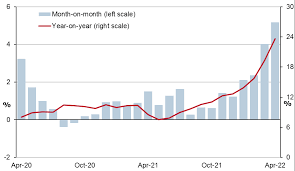
    But recent figures from the Ghana Statistical Service, (GSS) depict that year on year inflation measured by the Consumer Price Index, (CPI) increased significantly to 23.6 percent for the 12-months period ended April, 2022 from 19.4 percent in March, 2022.

    According to the Ghana Statistical Service, “four divisions – transport (33.5%); household equipment and routine maintenance (28.5%); food and non-alcoholic beverages (25.6%), and housing, water, electricity, gas and other fuels (25.0%) recorded inflation rates above the national average of 23.6% with transport recording the highest inflation.”

    National month-on-month inflation from March 2022 to April 2022 was 5.1%.

    It also noted that this is the first time in 29 months that inflation for imported items exceeded domestic inflation. Whilst inflation for locally produced items was 23.0%, inflation for imported items was 24.7%.

    “The inflation for imported goods is higher than the 17.3% recorded for March 2022 while the inflation for locally produced items is 23.0% higher than the 20.0% recorded in March 2022.”

    Whilst Food and Non-Alcoholic Beverages inflation was 26.6%, Non-Food inflation stood at 21.3%.

    April 2022’s food inflation of 26.6% is higher than both food inflation for March 2022 (22.4%) and the average of the previous 12 months (13.5%).

    Food inflation’s contribution to total inflation however, decreased from 51.4% in March 2022 to 50.0% in April 2022.

    All the 15 food subclasses recorded positive month-on-month inflation with Fruit and Vegetable Juices recording the highest of 15.3%.

    Non-food year-on-year inflation on average went up again in April 2022 compared to March 2022, that is from 17.0% to 21.3%. Only one out of the 12 Non-food Divisions had the 12 months rolling average to be higher than the year-on-year inflation for April 2022 for the divisions. Transport is the Division that recorded the highest inflation in April 2022 (33.5%).

    There is a high expectation that the MPC would again hike the policy rate further to stem the rising inflation.

  • BoG shocked at rate of inflation rise…but boast of solid economy

    Adnan Adams Mohammed

    The Bank of Ghana has expressed shock at skyrocketing rise in the rate of inflation in the country.

    The central bank is however confident that the Monetary Policy Committee, which is meeting to review developments in the economy, will take a decision to see the decline of the rate of growth.  

    The MPC need to decide on the current policy rate, which stands at 17%. The policy rate, which influences interest rates for individuals and businesses, is also used as a tool to curb inflation in the country.

    “It’s an issue, which in a sense is baffling for all of us. A year ago inflation in Ghana was 7%% and now we find ourselves with high double-digit inflation. It’s a very complicated environment”, the Governor of the Bank of Ghana, Dr. Ernest Addison, said in an interview, last week.  “The MPC is meeting this week and I do not want to pre-empt what the committee will decide, but I think it’s a very complicated situation. We do need to take a position on what to do with the policy rate, which stands at 17%.”

    Data from the Ghana Statistical Service shows that the continuous surge in transport and food prices among others, across the country, has pushed the national year-on-year inflation for April 2022 to 23.6 %, which is over 13 percentage points higher than the upper band of government’s inflation target for 2022, which is 10 %.

    Under the inflation targeting regime being operated by the Central Bank, policy makers generally prefer that the policy rate stays ahead of headline inflation. But for the first time in a long while, the key rate is trailing headline inflation by about 700 basis points, leaving the Central Bank in a difficult position.

    Meanwhile, Dr. Addison has assured that he was confident the rate of inflation had peaked and should begin declining for the rest of the year.

    “Government and the Central Bank are very much aware of the problem. We’ve had very major decisions on fiscal consolidation. Expenditures have been cut by 20% among other things. We expect that these measures will serve as an anchor to inflation. A lot of the shocks that we are seeing now tend to be supply-side in nature, but we think the worst has gone through the system, and we expect that inflation will be tapering off for the rest of the year.”

    The Governor further noted that, the Ghanaian economy is growing strongly despite the threat of rising inflation and the recent sharp volatility of the cedi. 

    According to him, data secured by his outfit so far indicates that the economy continues to rebound, irrespective of the challenges. He said, the real sector of the economy has been resilient despite the impact of COVID-19 pandemic.

    “The Ghanaian situation in a sense also reflects what happened in 2020 where the government took a very expansionary stance on policy. Therefore there were many interventions that was put into place in order to protect lives and livelihoods.”

    “The impact of that was real sector being more resilient than we see in other places. As I said, we are beginning to see a pick-up in growth in 2021”, Dr. Addison emphasised.”

    Indeed, sectors such as Information, Communications and Technology; Tourism and Hospitality; Manufacturing have bounced back, registering strong growth rates.

    “Some of the data that has come in 2022 does not suggest that we are slowing down”, the Governor noted.

    “I believe, if we were to choose between growth and inflation, the policy priority should be managing the pace at which prices are increasing”, he added.

    Economy expanded by 5.4% in 2021 – GSS

    Ghana’s economy expanded by 5.4% in 2021, far higher than the 0.4% recorded in the year 2020, a period that COVID-19 pandemic had severely hit the global economy.  

    Without oil, the economy recorded a Gross Domestic Product (GDP) growth rate of 6.9%

    According to provisional estimate by the Ghana Statistical Service, only 10 countries in Africa recorded growth rates higher than that of Ghana. They included Cote d’ lvoire and Uganda.

    The strong growth rate was driven by the Services sector, particularly the Information, Communication and Technology (33.1%) and the Agriculture sector, such as Fishing (13.4%).

    The Services sector recorded the highest GDP growth rate of 9.4% in 2021.

  • Using Policy Rate to Control Inflation and Liquidity… MPC faces toughest time

    Adnan Adams Mohammed

    As the Bank of Ghana Monetary Policy Committee (MPC) is scheduled to announce its next decision on May 23 amidst historical rise in inflation to record high of 23.6 percent in more than 18 years, MPC members have one of the toughest test to pass.

    Some economists have predicted that, the MPC bimonthly review of the economy will ‘sweat’ to arrive at policy recommendations that balance its mandate to tame the unprecedented inflation spike, manage liquidity issues, and growing the economy. 

    Underscoring the dilemma the central bank faces, an economist with Institute of Economic Affairs (IEA) have suggested upwards adjustment in the policy rate by about 200 basis point to help narrow the gap with rising inflation and also ease to some extent the risk of foreign currency outflows. But, Databank research proof otherwise as it predict that, a further tightening of the Monetary Policy Rate (MPR) could stifle economic growth.

    “Any attempt by the central bank to tighten monetary policy further will be an attempt to squeeze water out of stone,” Courage Martey, an economist at Databank Group said in an interview last week. “Inflation hasn’t peaked yet, so the MPC would want to avoid creating a perception of chasing inflation when it should be ahead of the inflation curve.”

    Although, the Databank economist admits that the Committee members of the central bank will have “a nail-biting decision to make.” 

    Annual inflation jumped to 23.6%, the highest since January 2004, from 19.4% in March. As calls increase for an intervention to stem the situation, the IEA has projected a 200 basis points increase in the monetary policy rate to 19 percent. The last MPC meeting in April increased the policy rate by 250 basis points to 17%, but, Director of Research at the IEA, Dr. John Kwakye, believes the rate should see another increase to par with the current inflation rate of 23.6 percent.

    In a paper titled, ‘How should the Bank of Ghana respond to the run-away inflation and the high cost of living in Ghana?’, Dr. Kwakye asserted that, “Taking all of these factors together, it may be surmised that the PR should be raised by another 200 basis points to 19 percent.”

    “This will help narrow the gap with inflation and also ease to some extent the risk of foreign currency outflows. The adjustment will also provide some assurance to the markets that the BoG is committed to addressing the resurging inflation. Anything less than this may be interpreted as a weak response, which may be concerning to the markets.”

    According to the Institute, the factors that should determine the rate adjustment include the wide gap between the current rate of 17% and inflation rate of 23.6%; the policy tightening by major central banks, which increases the risk of foreign currency outflows from developing and emerging market economies and which could put renewed pressure on the cedi; and the increase in the policy rate by as much as 250 basis points two months ago, an increase that may not have fully exerted its impact.

    Apparently, according to the Databank’s Weekly Fixed Income Update, while it maintains an additional 200 basis hike in the policy rate in 2022, it expect the Monetary Policy Committee (MPC) to exercise restraint in May 2022, deferring a potential 100 basis points hike in MPR to July 2022.

    It expatiates that, liquidity levels are already tight on the interbank market. Real returns on fixed-income securities are also depressed with the high inflation profile, continually undermining the Treasury’s financing operations.

    “We note that short-term interest rates are misaligned, resulting in negative real yields, which could prompt the MPC to act in the week ahead”, it however pointed out.

    The first and second-round effects of petroleum and transport price hikes, elevated food prices and the lagged impact of exchange rate pass through are the main drivers of the April 2022 inflation rate. 

    “We believe these cost-push pressures will persist until the third quarter”, the investment bank stressed. Additionally, it noted that the implementation of the Electronic Transaction Levy from May 1st, 2022, and the impending hike in utility tariffs are further upside risks to inflation.

    The MPC’s regular meetings over the next three days will conclude with an announcement of a decision to either maintain, reduce or increase the policy rate today, 23rd May 2022.

    At the last meeting the policy rate which informs the rate at which the central bank lends to commercial banks which ultimately influences final interest rates was increased by 250 basis points to 17 percent to tame inflation which has so far risen by about 10 percentage points from January’s 13.9 percent to April’s 23.6 percent.

  • Gov’t plans to restructure domestic debt

    Gov’t plans to restructure domestic debt

    Adnan Adams Mohammed

    The government plans to restructure its domestic debt component of the total public debt of GH¢351.8 billion, which is 80.1 percent of Gross Domestic Product (GDP), at the end of December 2021.

    Figures from the Bank of Ghana indicates that, the domestic debt stood at GH¢181.8 billion as at  December 2021, equivalent to 41.4 of GDP, while the external component of the total public debt shot up to US$28.3 billion or GH¢170.0 billion.

    The Finance Minister speaking to a gathering in Accra, last week, to announce government’s support and programmes for the upcoming 2022 Annual Meetings of the African Development Bank to be held in Accra later this month, posited that, the issue of restructuring Ghana’s debt was a complicated one, especially the Eurobond and the private sector loans.

    “The issue of restructuring debt is a very complicated issue especially with the private sector and the Eurobond etc. We need to decide among ourselves on what type of structure that will be useful to us. We have essentially about 50/50 with regards to domestic and external debt”, Ken Ofori-Atta expressed.

    “The domestic debt of course has interest rates of about three and half times what the foreign debt has. And then we look at the profile and clearly the foreign debt in terms of the impact really begins to hit in 2025 with regards to our Eurobonds etc.”

    To him, solving the domestic debt conundrum should be tackled immediately.

     “So solving the domestic debt conundrum is what we should be looking at and that is where we are putting our minds as to how best to do that”.

    On the rising inflation Mr. Ofori-Atta pointed out that though the situation is a global one, government is committed to building an entrepreneurial society to trade among themselves and reduce imported inflation.

  • Gov’t declares ‘No IMF bailout’..It’s positive with economic development 

    Gov’t declares ‘No IMF bailout’..It’s positive with economic development 

    Adnan Adams Mohammed

    The Akufo Addo/Bawumia administration have resoundingly affirmed their unwillingness to seek any bailout from the  International Monetary Fund (IMF) despite the dire economic conditions of the country.

    According to Finance Minister, although the economy is in difficulties now, he believes the it is heading in the right direction, and therefore government will find alternative ways of refinancing the country’s debt.

    The pronouncement was made when, the minister announced government’s support and programmes for the upcoming 2022 Annual Meetings of the African Development Bank, here in Accra this month. Mr. Ofori-Atta said government is intervening with policies to strengthen the economy.

    “We have committed not to going back to the Fund because in terms of interventions of policy, we are right there and the Fund knows that we are completely in the right direction”, Ken Ofori-Atta reiterated government’s commitment of not seeking assistance from the IMF. “And so the issue is validating the programme that we are putting in place and then in my view supporting us to find an alternative ways to refinance or reprofiling our debt without needing to be with the Fund.”

    “I think is a general acknowledgement that should be the first point of call and we are doing it”, he stressed.

    Mr. Ofori-Atta in March 2022 announced sweeping spending cuts to reduce the fiscal deficit, contain rising inflation and slow the cedi’s slide, with the country facing a looming debt crisis.

    This is coming on the back of rising inflation, the relatively weak cedi and downgrade of the country’s credit worthiness by rating agencies.

  • Inflation to worsen further

    Inflation to worsen further

    By Elorm Desewu

    Year on year inflation is expected to worsen further in the coming months in the wake of the decision by the Public Utility Regulation Commission to hike tariffs of electricity and water as well as increase in transport fares by the transport operators in the country.

    The Electricity Company of Ghana and the Ghana Water Company have proposed a tariff hike for consumers between of 148 and 334 percent respectively while the transport operators have kicked start with their 20 percent increase in transport fares across the country.

    This is expected to impact heavily on the non-food inflation which would trigger a further rise in year on year inflation.

    The current development would pose a headache to the seven member committee of the Monetary Policy Committee (MPC) as they commence their bimonthly review of the economy this week.

    Already, the MPC has revised it medium term inflation target of 8+/-2 to March 2023.

    The Bank of Ghana announced some measures in April this year in relation to universal banks, in attempt to anchor inflation. These include, the Cash Reserve Ratio was increased to 12 percent; the Capital Conservation Buffer was reset to the pre-pandemic level of 3 percent, making the Capital Adequacy Ratio a total of 13 percent; and the provisioning rate for loans in the Other Loans Exceptionally Mentioned (OLEM) category was reset to the pre-pandemic level of 10 percent.

    But recent figures from the Ghana Statistical Service, (GSS) depict that year on year inflation measured by the Consumer Price Index, (CPI) increased significantly to 23.6 percent for the 12-months period ended April, 2022 from 19.4 percent in March, 2022.

    According to the Ghana Statistical Service, “four divisions – transport (33.5%); household equipment and routine maintenance (28.5%); food and non-alcoholic beverages (25.6%), and housing, water, electricity, gas and other fuels (25.0%) recorded inflation rates above the national average of 23.6% with transport recording the highest inflation.”

    National month-on-month inflation from March 2022 to April 2022 was 5.1%.

    It also noted that this is the first time in 29 months that inflation for imported items exceeded domestic inflation. Whilst inflation for locally produced items was 23.0%, inflation for imported items was 24.7%.

    “The inflation for imported goods is higher than the 17.3% recorded for March 2022 while the inflation for locally produced items is 23.0% higher than the 20.0% recorded in March 2022.”

    Whilst Food and Non-Alcoholic Beverages inflation was 26.6%, Non-Food inflation stood at 21.3%.

    April 2022’s food inflation of 26.6% is higher than both food inflation for March 2022 (22.4%) and the average of the previous 12 months (13.5%).

    Food inflation’s contribution to total inflation however, decreased from 51.4% in March 2022 to 50.0% in April 2022.

    All the 15 food subclasses recorded positive month-on-month inflation with Fruit and Vegetable Juices recording the highest of 15.3%.

    Non-food year-on-year inflation on average went up again in April 2022 compared to March 2022, that is from 17.0% to 21.3%. Only one out of the 12 Non-food Divisions had the 12 months rolling average to be higher than the year-on-year inflation for April 2022 for the divisions. Transport is the Division that recorded the highest inflation in April 2022 (33.5%).

    There is a high expectation that the MPC would again hike the policy rate further to stem the rising inflation.