Category: News

  • NDC Observes Muslim Prayers for Party and Country 

    NDC Observes Muslim Prayers for Party and Country 

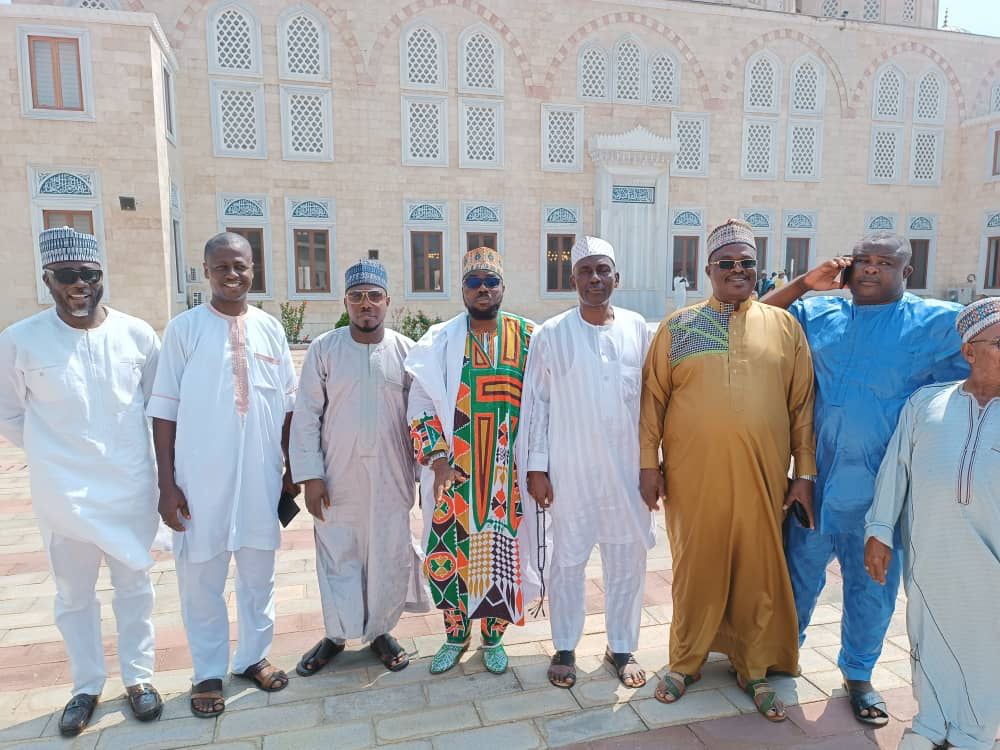
    As part of activities to commemorate the 10th anniversary of the late President John Evans Atta Mills, the National Democratic Congress and the Board of the Atta Mills Memorial Heritage today friday organized Muslim prayers in some mosques for our *Country Ghana*; that Allah will continue to grant us peace and stability.

    The occasion was also to say a prayer for the NDC Party as it marked its 30th anniversary in June last month.

    Alhaji Hudu Yahaya led a delegation to the National Mosque whiles the delegation to the Shia mosque was led by Imam Umar Sanda Ahmed, a former Ambassador to Egypt. Hon Mohammed Bawah Braimah- MP for Ejura also led the delegation to the Sunna Mosque at Nima. All the speakers admonished the youth to emulate the lifestyle of Prez Atta Mills as he stood for peace, unity and tolerance.

    Joining the teams at various mosques for the Jumma prayers were Hon Limuna Mohammed Muniru, Hon Rashid Pelpuo, Hon Alex Segbefia, board chairman of the Atta Mills Memorial Heritage, Alhaji Cole Younger of Zongo Caucus, Hon Latif Dan, Hon Nasser Toure, Hon Adamu Ramadan, Hon Yusif Jajah, Alhaji Mustapha Abubakar, Alhaji Yahaya Kundo, Naziru Mohammed, Thomas Ashong, Alhaji Ashka, Horoya Ali and some constituency executives of Nima, Maamobi, Ablekuma central and Madina.

    The various Imams prayed and asked Allah to continue to grant us peace, bless our home land Ghana and grant the NDC Party victory in 2024. Ameen.

  • Ghana’s Reserves: Finance Committee and BoG data conflicting

    Ghana’s Reserves: Finance Committee and BoG data conflicting

    Adnan Adams Mohammed

    In the wake of International Monetary Fund (IMF) engagement, as data credibility is key to ascertain true state of the economy, the Bank of Ghana and the Finance Committee of Parliament have released conflicting data on the country’s international gross reserves.

    The Finance Committee and the Central Bank have released different figures purporting to be the current level the country’s reserves as US$3.0 billion and US$7.6 billion respectively.  

    This is a disturbing development which might affected all data credibility that government will be submitting to the IMF team during the data reconciliation stage of the engagement for a possible ‘balance of payment support’. Aside, data credibility acceptance fear by the IMF, the reserve levels have great influence on the forex exchange rate as a low reserve level promote rush for the US dollar which results in hoarding and black-market control. A report of the Finance Committee on a Loan Facility Agreement between government of Ghana and the AfreximBank for a loan of up to US$750 million released, last week, indicated that, the country would have gone bankrupt without approval of the loan amount.

    “These challenges are further exacerbated by the rapidly dwindling reserves of the Bank of Ghana which has declined from $9 billion to about $3 billion”, the report of revealed. “With a monthly demand of over $600 million, the reserves of the central bank may be exhausted in a few months if urgent steps are not taken to shore up the countries reserves.” 

    Contrary, a Bank of Ghana document as published by Joy Business shows that, Ghana’s reserves has declined from $8.1 billion in May 2022 to $7.6 billion in June 2022, a 3.4 months of import cover.

    This has necessitated the Chairman of Parliament’s Finance Committee, Kweku Kwarteng, expected to make a statement on the floor of parliament about the committee’s report on the AfreximBank Loan Agreement and Ghana’s International Reserves.

    The committee report further revealed that, the Finance Minister, Ken Ofori-Atta, explained to parliamentarians that, the country needed this loan amount to shore up the reserve position of the Central Bank.

    “The Minister further indicated that, there is an urgent need for the government to secure the $750 million facility to help shore up the reserve position of the Bank of Ghana to avoid the country defaulting on its international commitments and also to avoid the country moving into insolvency.”

    The Minister said despite the facility seeming expensive in its face, it’s a reflection of the overall market conditions.

    The report mentions 11 projects the loan amount will be used to finance including the Ofankor – Nsawam road, the Suame Interchange and local road network project as well as the completion of the flower pot interchange.

    Parliament has since approved the loan agreement between the government of Ghana and the African Export-Import Bank (AfreximBank).

    Ghana’s Gross International Reserves dipped to $8.34 billion in April 2022, from $9.70 billion recorded in December 2021, data from the Bank of Ghana has revealed.

    This was equivalent to 3.7 months of import cover.

    In January 2022, the country’s Gross International Reserves stood at $9.76 billion, about 4.4 months of import cover.

    It further dropped to $9.54 billion (4.2 months of import cover) in February 2022 and $8.81 billion (3.9 months of import cover) in March 2022.

    According to the figures on External Sector Developments, the Heritage and Stabilisation Funds in April 2022 stood at $939 million. This is compared with  $971.4 million in December 2021.

    Ghana records $1.33bn trade surplus in April 2022

    Ghana recorded a trade surplus of $1.33 billion in the first four months of 2022, higher than the $1.107 billion recorded in the entire 2021.

    This is approximately 1.9% of Gross Domestic Product (GDP).

    According to the Bank of Ghana Summary of Economic and Financial Data, total exports in the 4-months of 2021 was $6.10 billion. This is against total imports of $4.77 billion.

  • SIM card registration: No extension of July 31 deadline as 12 million SIMs registered

    SIM card registration: No extension of July 31 deadline as 12 million SIMs registered

    Adnan Adams Mohammed

    The Minister for Communications and Digitalization has warned that the deadline for the registration of SIM cards in Ghana will not be extended for a second time.

    The exercise which began on 1st October, 2021, and originally scheduled to end on 31st March, 2022, was extended by the sector Ministry to 31st July, 2022, due to the fact that, over 7.5 million citizens and residents at the time, were yet to obtain their Ghana Card, to enable them register their SIM cards.

    According to the Minister over, 12 million Ghanaians have so far linked their Ghana Cards to their SIM Cards, against almost 16 million Ghanaians who have received their Ghana card as reported by the National Identification Authority.

    “I therefore take this opportunity to urge all those who’ve not registered their SIM cards to do so as the deadline of 31st July, 2022 will not be extended,”  Ursula Owusu-Ekuful stressed when speaking at a forum by the National Communications Authority (NCA) in Kumasi.

    She indicated that, the exercise will ultimately help build a credible and safe SIM Card database in Ghana.

    “Most people access their internet through their mobile devices. We must make sure that they do so safely. We must make it difficult for the criminals who hack our systems and defraud us through multiple online channels to operate, and this SIM registration exercise is one of the steps the government is taking in that regard. Essentially this stresses the point that this exercise will enable the establishment of a subscriber database with integrity to keep the consumers safe from scams and fraud.”

    The Ghana Card, which is the only source of Identification for the SIM registration, has been a hot cake in past months since the registration exercise begun.

    The issuing body of the Ghana Card, National Identification Authority (NIA), has indicated that, over 15.7 million Ghanaians current have received their Ghana cards.

    According to the Executive Secretary of , Prof. Kenneth Agyemang Attafuah, data available to him reveals that 16,969,034 persons have registered for the Ghana Card, with about 16,535,623 cards printed as of last week.

    However, he gave multiple reasons why some people who have registered have not been issued with their cards.

    “There are people who have double-registered. That is potentially a criminal offence. Those ones are being individually investigated. There are those whose cards have gone into adjudication, not because of double registration but because they have sought to change their vital data in the custody of the authority, such as bio-data. For such people, the system arrests their application, and it joins a queue.”

    “For such people, until the outstanding issues are rectified, they can’t receive their cards,” he added.

  • BoG hopeful of cedi rebound

    BoG hopeful of cedi rebound

    By Elorm Desewu

    The Ghana cedi would soon rebound after it has experienced some level of depreciation during the first half of this year due to government’s decision not to issue Eurobonds this year.

    The Bank of Ghana has banked it hopes on the recent US$750million loan from African Export-Import Bank (Afreximbank) as well as this year’s cocoa loan syndication to build it reserves  which currently stands at US$7.6 billion representing 3.4months import cover according to BoG’s latest economic and financial data report released last week and also stabilize the currency.

    The local currency has depreciated by about 18.89% to the dollar on the interbank market and 26% on the retail market.

     Senior Economic and Currency Analyst, Courage Martey explained that market participants are not confident of the market outlook.

    He is therefore calling for new ways to cushion the country’s foreign reserves.

    “The cedi’s problem is idiosyncratic because of the fixation of regular Eurobond inflow’s which is now missing today. And the kind of the withdrawal symptom from the Eurobond market is really squeezing the cedi hard and the market is really not comfortable with the level of reserves [Ghana’s foreign reserves] they are seeing.”

    Furthermore, he said “in recent weeks or so, you’d also agree that there has been negative noise around the level of reserves that we have. And that also plays into the psychology of the market in a negative way and the cedi is really under serious selling pressure”

    Mr. Martey continued, saying, despite the approval of the $750 million syndicated loan by Parliament yesterday, the outlook of the foreign exchange market is not encouraging.

    “The good news is that yesterday parliament approved some $750 million, out of the $1.0 billion. However, the understanding is that it doesn’t fully resolve our total external financing means for the year [2022] and so the market doesn’t have that full confidence that the supply side or the gap between demand and supply is fully met with this approval”.

    So that limited supply without options to beef up the reserve right now is really playing  

  • US$731.9m recorded from crude oil receipts in half-year of 2022

    US$731.9m recorded from crude oil receipts in half-year of 2022

    The Ghana Petroleum Funds Report has revealed that, a total of $731.9 million have been accounted for as crude oil receipts in the first half of this year. 

    The component of the total receipts are; $544.61 million realised from crude oil liftings in the first five months of 2022.

    US$186.3 million was however secured from corporate tax paid by the oil producing companies including Tullow, Kosmos and Petro Sa and US$992.3 million was obtained from surface rental and interest from the Petroleum Holding Fund.

    For the crude oil liftings, $108.8 million and $104.1 million which were the biggest earnings were secured from liftings on March 6th, 2022 (Ninth SGN) and March 26th, 2022 (sixty fith Jubilee) respectively.

    With regard to surface rental, AGM Petroleum Gh paid the highest tax of $174,100, followed by Aker with $150,750.

    Meanwhile, the country earned $1.2 billion at the end of June 2022 as investments from oil revenue, since the beginning of commercial oil production in 2011.

    The Heritage Fund invested with the New York Reserve Bank accrued $377 million, while the Stabilisation Fund recorded $846 million.

  • NDC press conference on Ghana Judicial System

    NDC press conference on Ghana Judicial System

    The NDC remains committed to Ghana’s democracy and the promotion of the Rule of Law. Accordingly, we shall endeavor at all times, in line with our social democratic ethos, to ensure that the justice system performs the role assigned to it by the 1992 Constitution by serving the interest of all Ghanaians devoid of any political or partisan considerations.
    Read full statement:

    PRESS STATEMENT BY THE NATIONAL DEMOCRATIC CONGRESS ON CERTAIN DEVELOPMENTS WITHIN GHANA’S JUDICIARY

    A. INTRODUCTION

    1. The National Democratic Congress (NDC) has carefully considered certain recent developments within Ghana’s judiciary and is gravely concerned that if immediate steps are not taken to nib these negative developments in the bud they will fester with serious harmful effects on our democracy and the public’s confidence in the judiciary.

    2. Our decision to publicly address these concerns has not been taken lightly. We are aware of the auspicious role our judiciary plays in our democracy, the sometimes lonely and solitary lives of our judges, their traditional reserve and no comment policy on certain matters of national importance. These attributes of our judges require that we exercise great restraint in our public comments on the judiciary. We are however convinced that constructive criticisms of our judiciary, particularly the apex court, is a national duty, and as the largest opposition party in Ghana, we will be remiss in our duties to the nation and the people of Ghana if we remain silent about these developments. Accordingly, our duty to our national constitution and obedience to our national motto of “Freedom and Justice” compel us to speak.

    3. The NDC observes that our democracy cannot operate efficiently and deliver the values of freedom, justice, development and equality of opportunity for all citizens, regardless of political affiliation, if our judiciary, particularly, elements within the Supreme Court, become or are perceived to be the rented agents or the political wing of a political party. In recent times, certain happenings at the apex court, in particular, have dampened our faith in the court and it was this loss of faith that had provoked our petition to the Secretary-General of the Commonwealth of Nations regarding various acts of human rights violations, criminal persecutions and harassment of the members and supporters the NDC by the Government of Ghana headed by His Excellency, President Nana Addo Danquah Akufo.

    4. The NDC wishes to outline and share with the good people of Ghana some of the negative developments within our judiciary, particularly, the Supreme Court with the view to seeking remedial action promptly and effectively.

    *B. NO REASONS ASSIGNED FOR JUDGMENTS AND RULINGS*

    5. One disappointing, if not scandalous development, that is likely to make our justice system the butt of jokes among other democracies in Africa and the world at large is the phenomenon of court judgments without reasons. In recent times, our Supreme Court has handed down some judgments and rulings that do not make any legal or factual sense because the court failed to assign any reasons for these judgments. Two examples will suffice. It is instructive to note that in the recent case of *Abdul Malik Kweku Baako vrs Attorney General, *(Suit No. J1/225/2018)*, which had raised certain important constitutional questions about the impeachment proceedings of Mrs. Charlotte Osei the then Chairperson of the Electoral Commission, the apex court simply declared that:

    “After listening to counsel in the matter on the question whether the instant action is a proper invocation of our original jurisdiction and also having regard to the processes filed in this matter, we are of the view that the action does not raise any issue of interpretation or enforcement. Accordingly, we strike out the action which in our view is unmeritorious”.

    6. This cryptic judgment fails in many respects to meet the basic standards of a reasoned judgment. It is devoid of an analysis of the facts of the case, the case and arguments presented by the parties, the legal principles upon which the judgment is based, and how those legal principles apply or do not apply to the facts of the case. As to be expected, this. judgment cannot form the basis of any legal precedent, suggesting that it was a judgment of convenience fashioned out solely to deny justice to Mrs. Charlotte Osei, and once its immediate intended purpose has been achieved the judgment ceases to have any legal relevance in subsequent cases.

    7. True to form, the apex court again applied this scandalous technique in the case of the *Republic vrs High Court, (Criminal Division) Accra; Ex parte: Stephen Kwabena Opuni & Anor (Civil Motion J5/15/22).* The justice hearing the criminal case involving Dr. Stephen Kwabena Opuni, Mr. Justice Clemence Jackson Honyenuga, had in a recent ruling on an application to recuse himself on ground of real likelihood of bias accused Dr. Stephen Kwabena Opuni of “hallucinating”, “malicious lies”, “engineered to court public support”. In its ruling on this matter, the apex court stated that: “It is our considered opinion that the record does not reflect a personal interest by the trial judge in the matters in issue and the making of discriminatory orders to warrant the grant of an order of certiorari to quash the proceedings and orders of the trial court dated 16th December 2021. Regarding the application for prohibition we have thoroughly examined the processes filed by the parties and do not find the existence of a real likelihood of bias on the part of the trial judge such as would prevent the conduct of a fair trial by the judge. Accordingly, we dismiss the application in its entirety.”

    8. This ruling is also devoid of the factual matrix of the case, the case and arguments presented by the parties, the legal principles upon which the judgment is based, and how those legal principles apply or do not apply to the facts of the case.

    9. The NDC notes that the phenomenon of unreasoned court judgments has become so commonplace especially in cases with high political stakes. The NDC wonders how the apex court could engender public confidence in the administration of justice and remain accountable to the people when it assumes a calculated posture of rendering unreasoned judgments. The NDC believes that unreasoned judgments violate fundamental principles of justice and fair trial, and we wonder whether this phenomenon of unreasoned judgments is a clear manifestation of dereliction of judicial duties.

    *C. TRESPASSING INTO DOMAINS RESERVED FOR THE LEGISLATURE*

    10. The NDC is also greatly concerned by the unholy haste of the apex court in trespassing into domains reserved for the legislature by the 1992 Constitution. We note that one entrenched principle of our legal governance since 1993 has been the recognition by our courts that it is not their business to get into certain matters that by law have been assigned to other branches of government. Contrary to this principle, we have observed a creeping tendency of the apex court to trespass into domains reserved for parliament. In the process, the court has demonstrated legal or institutional hubris and thrown overboard the restraints the court has exercised in the past over matters that fall within the domain of Parliament.

    *E. ADMINISTRATIVE ABUSES BY THE CHIEF JUSTICE*

    11. Quite apart from the above, the Honourable Chief Justice, Justice Kwasi Anim Yeboah, is likely to go down in history as the worst Chief Justice of Ghana since the Inception of the 4th Republic. His reign as Chief Justice has been characterized by unimaginable administrative abuses. These abuses are thrown into sharp relief when the conduct of the current Chief Justice is measured against the professionalism and  conduct of former Chief Justices. We recall in particular the words of Chief Justice Kwasi Apaloo at his send-off ceremony that: “The one great quality I would wish to see in my colleagues is courage that is to say they should be in a position to defend to the death positions they believe to be right….I charge you to keep or help keep the flag of the judiciary flying and may the profession as a whole provide leadership and best counsel on these professional matters which we have all held in trust for the benefit of generations yet unborn”.

    12. It would appear that this wise counsel of Chief Justice Apaloo has no resonance with our current Chief Justice, who has failed to show leadership and to “keep the flag of the judiciary flying” by abusing his power to empanel the courts. It has been our understanding that the setting up of divisions of the High Court in Accra such as the Criminal Division, Land Division, the Human Rights Division, and the Commercial Division were all meant to ensure that these specialized courts deal with matters that directly fall within their competence and jurisdictions. In fact, these courts started very beautifully and many were those who hailed the establishment of the court. Incidentally, in recent times these beautiful arrangements appear to have been thrown into a state of utter confusion where we could now witness even land cases being sent to commercial courts, clear-cut commercial court cases being sent to the human rights court and criminal cases sent to the judges at the Land Division. Sometimes the assignment of cases to particular judges is done in a manner that makes one wonder what is the motivation for the case assignment. Recently, the case involving Dr. Cassiel Ato Forson was originally assigned to Justice Solomon Oppong Twumasi only for the judge to announce in open court that the Chief Justice had reassigned the case to another judge in another division of the High Court. This development is quite mind-boggling and we wonder why for us in Ghana, we start everything with so much aplomb and funfair only for us to ruin it along the way.

    13. Another worrying phenomenon is the appointment of Court of Appeal Judges to preside over High Court Cases, For us these appointments are a damper and go a long way to demotivate our judges at the High Courts. By these appointments, is the Chief Justice saying that the said cases could not have any competent Justice of the High Court as currently constituted to deal with them or it is more the case that the Chief Justice has a cadet of justices who are specially deployed to do the bidding of his political masters? Without mincing words, we state that we see the appointments of Court of Appeal justices to preside over these cases as worrying.

    D. CONCLUSION

    14. The NDC is saddened by and gravely concerned about the phenomenon of unreasoned judgments, lack of fidelity to the record of cases, unpardonable factual errors that have become commonplace in judgments of the apex court as well as glaring administrative abuses by the Chief Justice. We were particularly shocked by the palpable blunders committed by the apex court in the election petition judgment. In a case of such magnitude, we expected excellence, professionalism, attention-to-detail and meticulousness from our Supreme Court. Instead, what the people of Ghana obtained from the court were these unpardonable blunders, which have the potential to affect people’s confidence in the administration of justice.

    15. We therefore call on the Judicial Council to institute an internal inquiry to ascertain the reasons for these blunders and appropriate recommendations made to the Chief Justice to forestall their recurrence until appropriate legislation, such as a Judicial Proceedings Bill, is passed by Parliament to regulate the writing of judgments by our courts. The NDC will also petition Parliament for the Judiciary Committee of the House to conduct a public inquiry into the reasons for the blunders committed by the Supreme Court in the 2020 Presidential Election Petition and other cases with the view to proposing appropriate remedial legislation.

    16. The NDC remains committed to Ghana’s democracy and the promotion of the Rule of Law. Accordingly, we shall endeavor at all times, in line with our social democratic ethos, to ensure that the justice system performs the role assigned to it by the 1992 Constitution by serving the interest of all Ghanaians devoid of any political or partisan considerations.

  • GSE, NIC and NPRA to lead local credit rating agency agenda

    The Ministry of Finance has accepted the business plan for the first domestic credit rating agency to be established with key market regulators as shareholders.

    The institutions have already accepted the proposal and working to get the agency established.

    The entities are the National Insurance Commission, the National Pensions Regulatory Authority and the Ghana Stock Exchange (the majority shareholder).

    The move which is backed by the World Bank will improve credibility of corporate bond issuers as well as businesses that participate on the GSE.

    Head of Fixed Income Market at the Ghana Stock Exchange, Augustine Simons, explained to selected Journalists that this is very critical to the promotion of investments on the capital market.

    Early this year, the GSE announced that it will establish a domestic credit rating agency for the capital market in Ghana by the middle of the year.

    The agency is expected to rank bonds according to their value in order to bring some confidence and comfort to investors.

    Giving an update of the work done so far, the Head of the Fixed Income Market said the three market regulators have accepted proposal to hold stake in the agency.

    “Work is progressing steadily and I must say that the three agencies nominated as initial shareholders for the agency, thus, NIC and the GSE have all accepted and made commitments to the establishment”.

    “The business plan developed by accounting and auditing Firm, KPMG, has been accepted by the ministry and they’re supporting it fully to ensure that it becomes successful” he said.

    He added that the requirement by the Securities and Exchange Commission is what could delay the process since it may request a foreign assistance.

    Meanwhile, the Deputy Managing Director of the GSE, Abena Amoah, says the GSE will be using financial literacy programmes to increase the appetite for investments, among citizens.

  • Govt to miss 2022 revenue target by GH¢11.5bn – Fitch Solutions

    Govt to miss 2022 revenue target by GH¢11.5bn – Fitch Solutions

    The country’s total revenue will end 2022 at ¢89.0 billion, far below the target of ¢100.5 billion, the July 2022 Africa Monitor Report by Fitch Solutions has revealed.

    This will keep the fiscal deficit high [8.5% of Gross Domestic Product, excluding bailout costs] as revenue was below 13.6% of its target in the first quarter of this year.

    Revenue growth, the report said, will remain above trend, but will miss the official target.

    “We at Fitch Solutions expect Ghana’s fiscal deficit to narrow to 8.5% of GDP in 2022, from 9.3% in 2021, facilitated by a widening tax base and higher oil receipts. We have revised our 2021 deficit from 11.3% previously on the back of full-year data published by the Ministry of Finance, which shows higher-than-expected revenues of ¢70.1bn, while total public expenditure rose to ¢109.3 billion”.

    However, public revenue will expand by 27.0%, above the 10-year pre-pandemic average of 23.4%.

    Fitch Solutions pointed out that the recent implementation of the Electronic Transaction Levy (e-levy) will further support revenue growth over the year. However, it will fall short of the 5 billion cedis revised projected targeted, for two reasons.

    This is based on two reasons.

    “First, the government had initially proposed a 1.75% tax on electronic financial transactions, but lowered it to 1.5% following pushback from the opposition. Second, authorities had planned for the tax to come into force on January 1 2022. However, the e-levy only took effect on May 1, five months after the start of Ghana’s fiscal year”.

    The report added that despite some fiscal consolidation efforts, public expenditure will remain elevated, preventing a more substantial narrowing of the deficit.

    In the 2022 budget, the government stated it will commit to ‘expenditure rationalisation and reforms’ in order to improve its fiscal position and maintain debt sustainability.

    However, Fitch Solutions projects that due to the rigid nature of Ghana’s expenditures, there will be limited room to significantly restructure spending over the short term.

    “We believe that due to the rigid nature of Ghana’s expenditures, there will be limited room to significantly restructure spending over the short term. Indeed, Ghana’s public wage bill and debt servicing costs accounted for 67.4% of total spending over quarter 1, 2022.”

  • IMF’s Country rep defends mixed assessment of Ghana economy in July 2021

    IMF’s Country rep defends mixed assessment of Ghana economy in July 2021

    The International Monetary Fund’s Resident Representative to Ghana, Dr. Albert Touna-Mama, defended his outfit’s mixed assessment of Ghana’s economy during the July 2021 Article IV consultations, which said Ghana’s economic outlook was improving.

    Speaking on the Citi Breakfast Show,

    Dr. Touna-Mama, explained that the assessment that preceded the dire economic downturn in Ghana was based on projections.

    Ghana has now turned to the IMF for support.

    Such assessments are “made on a forward-looking basis, and we take into consideration the plans and policies that the authorities want to put in place to address whatever vulnerability,” he said.

    The IMF had noted, among others, that Ghana’s monetary policy stance was “broadly appropriate.”

    The IMF also welcomed the fiscal adjustments envisaged in the 2021 budget, while stressing that fiscal consolidation was needed to address debt sustainability and rollover risks.

    Dr. Touna-Mama conceded that there had been drastic changes on the global scene.

    “Last year there was still a debate globally on whether the amount of fiscal stimulus push by bigger economies, the US specifically, would generate inflation.”

    Since then, he said that “it has become clear, inflation is a factor and will remain with us for a long time.”

    He also noted red flags started to appear after the 2022 budget was revealed by the government.

    “That budget was really scrutinized given the direction and whether Ghana would be able to address those vulnerabilities.”

    After the 2022 budget statement, he recalled that Ghana’s Euro bond spread widened and “investors started requesting a higher premium in order to lend to Ghana.”

    “This was a signal that the direction they were seeing in the budget was unfortunately not convincing for them,” Dr. Touna-Mama added.

    This notwithstanding, he said the government was given a more blunt warning about the pitfalls ahead for Ghana’s economy last year.

    While the Article IV consultation features diplomatic wording, Dr. Touna-Mama said, “the report that we [the IMF] leave with the top policymakers is very candid and very direct.”

    Ghana’s economy has faced turbulent times in 2022, with inflation reaching a 19-year high of 29.8 percent.

    The cedi has also been regarded as the worst performing currency against the dollar after depreciating over 20 percent in 2022.

  • 91% Ghanaians lack confident in judicious use of E-Levy funds – report

    91% Ghanaians lack confident in judicious use of E-Levy funds – report

    Adnan Adams Mohammed

    Ghanaians have registered their lack of trust in the government and fears the 1.5 per cent currently being charged on Electronic transactions (E-levy) will be used to fund development projects across the country an Afrobarometer Report has revealed.

    The survey report released by CDD-Ghana shows, out of the total sample size, only 9 percent of Ghanaians are confident that the government will use revenue from the E-levy to fund development. This means, about 91% Ghanaians have no confident in the government when it comes to judicious utilisation of tax monies.

    Amidst the high lack of no confident and on the issue of transparency, key stakeholders in the telecommunication space have advocated the rollout of measures and strategies that will inform people of how their taxes are being used.

    “I think it is fair to ask that if we’ve decided that we are taking this tax for a particular purpose, we are able to go back and see if it is being used for that particular purpose. For me, as a corporate governance student, I think that transparency and providing information, by the people who are in positions of responsibility is important”, Chief Executive Officer of the Ghana Chamber of Telecommunications, Dr. Ing. Kenneth Ashigbey, noted in a radio discussion last week.

    “And I don’t think we do enough of that. It is something we need to do constantly if we want to take out all the clouds and perceptions of suspicion. If we could even have a website that customers can go to find out with regards to how much is coming in and what the funds are being used for, it will be helpful,” he added.

    According to the Afrobarometer report, 51% of Ghanaians do not think government will invest the proceeds generated from the E-levy into development projects.  The report indicates that 24% of Ghanaians are not very confident that the revenue generated from the E-levy will be used for its intended purpose, while 15 per cent are somewhat confident that government will indeed use the accrued revenue for its purpose.

    Also, 47% of Ghanaians despite the charges on electronic transactions say they will continue to use electronic financial transactions.

    However, the report further indicated that, 49% of Ghanaians have disclosed that the E-levy will make them avoid or stop using electronic financial transactions.