The local currency (Cedi) has appreciated in value against international trading currencies, especially the US dollar, starting last week.
The cedi appreciated by 0.09% against the US dollar over the week, closing at a mid-rate of GH¢16.19 per DOLLAR. It also saw a 0.35% gain against the pound and a 0.28% rise against the euro.
This is attributed to successes in the country’s ability to secure restructuring of US$13 billion of Eurobond debt as well as reaching International Monetary Fund (IMF) Staff Level Agreement on the Extended Credit Facility programme.
Ghana is set to receive $360 million in financing this week, if IMF Board approves the Staff-level agreement. This could improves the country’s foreign exchange reserves and strengthen supply-side interventions.
This, some analysts have predicted that, marginal appreciation of the Cedi is expected to continue in the short term. As it currently trading at GH¢16.22 to the US dollar on the retail market.
Meanwhile, the year-to-date depreciation against the US dollar remains significant at around 22%.
A renowned peacebuilding and conflict resolution expert, Idris Mohammed, has called for a critical need for dialogue and mediation in resolving conflicts in Nigeria’s multi-cultural and ethno-religious regions.
He gave the advise while speaking as a panelist at a high-profile panel discussion hosted by the United States Institute of Peace (USIP) in partnership with Mercy Corps in Washington D.C. in United States.
The discussion, which centered on Mercy Corps’ Randomized Controlled Trial (RCT) findings from their Community Initiatives to Promote Peace (CIPP) program, highlighted the role of localized peace strategies in mitigating violence. Drawing from his extensive experience in Northern Nigeria, Mr. Mohammed argued that conventional security responses alone are insufficient in addressing the deeply rooted grievances fueling conflicts. Instead, he advocated for a sustained, dialogue-driven approach that incorporates cultural and religious sensitivities.
Dialogue as a Path to Sustainable Peace
“In a complex setting like Nigeria’s North-Central region, where ethno-religious differences intersect with resource-based disputes, dialogue and mediation remain the most effective tools for peacebuilding,” Mr. Mohammed stated during the panel. “We cannot simply rely on military interventions. Sustainable peace comes from fostering trust among conflicting parties and ensuring their grievances are heard and addressed.”
He cited his previous engagements in peace dialogues between farmers and herders in Nigeria’s volatile regions. Over the years, he has facilitated numerous high-level mediations, bringing together communities often pitted against one another due to resource scarcity and land disputes.
“In my work with USIP’s Network of Nigerian Facilitators, we saw firsthand how structured dialogue sessions between farmers and herders in Kaduna and Plateau states helped de-escalate hostilities. When communities recognize that their interests are intertwined, they become more willing to compromise,” he explained.
Engaging Armed Groups: A Case for Negotiation
Beyond community mediation, Mr.Mohammed has played a crucial role in engaging non-state armed groups, including bandits in Zamfara, Katsina, and Sokoto states. His leadership in peace talks with these groups has been instrumental in brokering temporary ceasefires, facilitating humanitarian access, and encouraging local reconciliation efforts.
He recounted a pivotal moment in Zamfara, where he led a dialogue session between community leaders and bandit commanders. “The turning point was when the bandit leaders acknowledged their fears and distrust of the government. By creating an open space for conversation, we were able to agree on a temporary cessation of attacks, which later paved the way for community-led reconciliation efforts,” he noted.
However, he also cautioned that such negotiations require careful structuring to ensure they do not inadvertently legitimize criminality. “Dialogue is not about conceding to criminal demands but about understanding the root causes of violence and identifying pathways to de-escalation,” he clarified.
Kabara Local Justice: A Model for Reintegration
Another highlight of his contributions was his involvement in transitional justice initiatives in Northeast Nigeria. As a transitional justice expert, Mr. Mohammed played a key role in institutionalizing the Kabara Local Justice system, a community-based mechanism designed to reintegrate ex-Boko Haram combatants while ensuring justice for victims.
“The success of Kabara was its ability to strike a balance between justice and reconciliation. We worked closely with communities to ensure that ex-combatants who showed genuine remorse were reintegrated, while victims received support for their losses,” he explained. The initiative, he added, has been instrumental in reducing recidivism and fostering long-term stability in communities affected by insurgency.
USIP’s Recognition of His Work
USIP’s invitation to Idris Mohammed as a panelist underscores his reputation as a leading figure in peacebuilding research and implementation. His deep understanding of local dynamics, combined with his ability to engage both state and non-state actors, has made him a sought-after expert in conflict resolution efforts across Nigeria and beyond.
“As someone who has worked in research, policy implementation, and direct engagement with communities, I understand that peace is not a one-size-fits-all solution,” he said during the discussion. “Each conflict has its unique context, and our responses must be tailored accordingly.”
His work aligns closely with USIP and Mercy Corps’ broader objectives of promoting locally driven peace initiatives that complement governmental efforts. The findings from Mercy Corps’ CIPP program, which demonstrate the effectiveness of localized interventions, reinforce the need for continued investment in grassroots peacebuilding strategies.
Moving Forward: A Call for Policy Support
While acknowledging the successes of dialogue-based interventions, Mr. Mohammed also highlighted the challenges that remain. Political will, he argued, is crucial in scaling up these initiatives. “We need stronger government buy-in to institutionalize community-led mediation processes. Without policy support, these efforts risk remaining short-lived,” he warned.
He further emphasized the importance of integrating peace education into local governance structures and enhancing the capacity of traditional leaders to mediate disputes. “Traditional and religious leaders play a crucial role in shaping narratives. If they are equipped with the right skills, they can serve as powerful agents of peace,” he added.
As the panel discussion concluded, Idris Mohammed reiterated his commitment to fostering peace through dialogue, mediation, and community-led justice mechanisms. His insights, drawn from years of hands-on experience, resonated with policymakers, researchers, and practitioners in attendance.
“In the end, sustainable peace is not achieved through force alone. It requires a deliberate effort to bridge divides, address historical grievances, and build trust among communities. Dialogue and mediation are not just alternatives; they are necessities,” he concluded.
His participation in the USIP-Mercy Corps discussion reaffirmed his standing as a leading voice in peacebuilding, whose expertise continues to shape conflict resolution strategies across Nigeria and beyond.
AngloGold Ashanti says it is working to strengthen the climate resilience of its business and value chain partners, host communities and the environment in which it operates.
In a statement, the miner said: “Our Climate Change Strategy aims to deliver measurable progress, focus our actions, and demonstrate our commitment to proactive, holistic, sustained and transparent action on climate change.”
To achieve this, AngloGold Ashanti said its Climate Change Strategy adheres to five key Principles that include, “Seeking to ensure that our core values are upheld through actions arising from the Climate Change Strategy, maintaining external commitments where we are a signatory, including the ICMM’s Mining Principles, the ICMM’s Position Statement, the WGC’s Responsible Gold Mining Principles and the UNGC; taking a holistic, long-term, life-of-mine and systemic approach to managing climate risks that include aspects beyond the fence line, supply chains, communities and ecosystems; using the latest science-based data, information and knowledge to support decision-making and disclosing in line with the recommendations of the Task Force on Climate-related Financial Disclosures (TCFD).”
AngloGold Ashanti noted that its roadmap to Net Zero by 2050 is embedded within its strategy and comprises three stages:
1. Target 100% clean electricity (>70% green) including wind, solar, hydrogen, and battery, combined with new storage technologies.
2. Eliminate the use of fossil fuels and adopt 100% electrification. This will include the adoption of electric material movement technology (conveyors, railveyors, trolley assist, battery technology), and energy efficiency initiatives and will be supported by innovative approaches (such as in situ leaching).
3. Use carbon offsets if necessary and as a last resort, particularly where this could support local communities.
Decarbonisation journey
AngloGold Ashanti noted that it has set an interim target of cutting Scope 1 and 2 greenhouse gas emissions by 30% by 2030 through a combination of renewable energy projects and initiatives which improve efficiency or use lower-emission power sources.
“We have taken significant steps towards this target with the start of our renewable energy project at Tropicana in Australia and switching to the national power grid at Geita in Tanzania.”
In Australia, the miner noted that subsidiary AngloGold Ashanti Australia entered into an agreement with Pacific Energy to build one of the largest renewable energy projects in Australia’s natural resource sector.
It added that the construction of this hybrid wind, solar and battery storage facility will be the first of its kind to be implemented by the company and will reduce our average carbon emissions by more than 65,000 tonnes per annum over the 10-year life of the Power Purchase Agreement.
At the Geita Gold Mine in Tanzania, AngloGold Ashanti mentioned that a switch diesel generation is being replaced with grid power sourced with a more environmentally friendly combination of energies, including hydropower and natural gas.
The mine is drawing power from a new on-mine substation linked to Tanzania’s national power grid. The switch will result in an estimated 80% reduction in fuel consumption.
The Cocoa & Forests Initiative (CFI), the largest and first sector-wide public-private partnership in the cocoa industry, has released its latest annual report.
The report said in 2023, CFI made significant strides in traceability systems, forest conservation and climate adaptation.
The report noted that despite it being a challenging year marked by erratic weather patterns, an increase in pests and diseases and illegal mining clearing cocoa farms, “the commitment of companies and governments to CFI has remained steadfast.”
It said given the current challenges facing the cocoa sector, this commitment and collaboration are more crucial now than ever.
Key highlights:
Traceability
In 2023, 83% of directly sourced cocoa from participating companies in Ghana and 82% in Côte d’Ivoire was traceable to the plot level.
Despite supply challenges that required sourcing cocoa from a larger number of producers, these traceability figures have remained relatively stable.
Significant efforts over the past year have been dedicated to enhancing traceability systems in preparation for the 2025 European Union Deforestation-Free Regulation (EUDR).
These efforts are expected to yield higher traceability figures by 2025. Establishing accurate traceability systems is crucial ahead of the EUDR.
Pilots for these systems have been conducted by the Conseil du Café-Cacao and COCOBOD with full implementation planned for the 2024-25 cocoa season.
Additionally, Ghana has published national guidelines for the Sustainable Cocoa Standard (ARS-1000) and Côte d’Ivoire has developed a 2020 reference land use map.
Priority Landscapes and Forests
CFI fosters collaboration between public and private sectors through clear land-use planning and incentives for farmers and their partners.
However, greater collaboration at the landscape level beyond single supply chains is needed.
Hence, the CFI strategy focuses on landscape-level programming in areas prioritised, as a result of high levels of historic deforestation, which are also critical for cocoa production in both countries.
• Côte d’Ivoire: The Classified Forest of Cavally, one of six CFI priority landscapes, has been upgraded to a nature reserve, enhancing its conservation status. Collaboration in this landscape has expanded with new partners, including Touton and CocoaSource, joining Nestlé and Earthworm. In the Yapo-Abbé and Bossématié landscapes work has begun on comprehensive land-use assessments, stakeholder engagement and baseline studies. These will lead to investment plans that will be finalised by the end of 2024.
• Ghana: In the Asunafo-Asutifi landscape, progress has been made and stakeholders have jointly defined and agreed on a comprehensive landscape management plan. Efforts are underway to secure additional investments to scale and accelerate implementation.
Climate Adaptation and Mitigation
Progress continues in achieving positive carbon impact and climate adaptation through private-sector engagement. Côte d’Ivoire is actively developing carbon policies aligned with the UNFCCC National Determined Contributions. Ghana received its first result-based payment of nearly $ 5 million for reducing 972,456 tons of carbon emissions from the World Bank’s Emission Reduction Programme, with the largest share going to CREMAs (Community Resource Management Area) and farmer groups.
This ensures that farmers and farming communities are leading and owning key interventions, which is essential for ongoing sustainability.
These developments align closely with CFI’s progress on community engagement and social inclusion, through which in Ghana and Côte d’Ivoire a total of 12,361 Village Savings and Loans Associations (VSLA) were supported.
In both countries, CFI signatories distributed 10 million multi-purpose tree seedlings to cocoa producers to support increased carbon stocks and biodiversity through agroforestry. Laurent Tchagba, Minister of Water and Forests, Côte d’Ivoire, said: “Two of CFI’s initial major challenges are now effectively addressed. One is the operationalisation of the national unified cocoa traceability system, and the other is the operationalisation of the national spatial forest monitoring and deforestation early warning system. These two instruments are necessary to meet the requirements of the EUDR.”
Mr Samuel A. Jinapor, Minister of Lands and Natural Resources, Ghana, commented: “Deforestation and climate change are common enemies that must be fought through a collaborative approach. The Government of Ghana remains fully committed to the CFI process, and we are happy that the private sector is equally committed to advancing the objectives of this noble Initiative.”
Chris Vincent, WCF President noted: “These achievements underscore the power of collaboration in driving sustainable change. The progress made in forest conservation and climate adaptation is a testament to the commitment of all stakeholders involved in the Cocoa & Forests Initiative.”
Daan Wensing, CEO of IDH, said: “As IDH we will further support CFI to intensify efforts to increase transparency and accountability within the initiative. Based on solid data, partners can foster innovation and adaptability in transforming the cocoa sector” he concluded.
Economies do better at enacting regulations to improve the national business climate than they do in providing the public services needed to secure actual progress, according to the World Bank Group’s new Business Ready report.
The inaugural 2024 report, which assesses the business climate in 50 economies, provides an extensive dataset – 1200 indicators per economy – to identify specific areas where there is room for improvement and motivate reforms. Coverage will increase over the next three years to reach about 180 economies in 2026, providing a full global benchmark.
Nearly all 50 economies assessed this year perform better on their regulatory framework than they do on the public services they provide to ease compliance by businesses. Such implementation gaps keep businesses, workers, and society as a whole from reaping the full benefits of a healthy business climate.
On a scale of 0 to 100, economies score an average of 65.5 for the quality of their regulatory framework—meaning, on average, economies are nearly two-thirds of the way to being business-ready in this category. But they score just 49.7 for their public services, indicating they are only half as ready as they ought to be. This gap exists across all income levels and all regions, although it’s smallest in high-income economies and greatest in Sub-Saharan Africa and the Middle East and Northern Africa.
“With economic growth being slowed by demography, debt, and discord, progress will come only through the ingenuity of private enterprise,” said Indermit Gill, the World Bank Group’s Chief Economist and Senior Vice President for Development Economics. “That depends on conducive conditions—an investment climate that facilitates the economic miracles that entrepreneurs make when they are given half a chance, miracles that are badly needed today. Business Ready gives governments the intelligence they need to create conditions that allow businesses to build prosperity for their shareholders, consumers and workers while treading lightly on the planet.”
Business Ready, the successor of the Doing Business project, reflects a more balanced and transparent approach toward evaluating a country’s business and investment climate. This approach has been shaped by recommendations from experts from within and outside the World Bank Group, including governments, the private sector, civil-society organizations, and academic researchers.
Across the world, the private sector is a powerful force for economic growth—but it needs the right environment to thrive. Business Ready assesses not only the regulatory burden that firms face in the course of entering the market, innovating, and expanding their operations—how long it takes to start a business, for example—but also the quality of regulations. Do labor regulations, for example, include requirements for workplace safety? Do start-up regulations require that the identity of entrepreneurs be verified? Beyond accounting for business regulations, Business Ready evaluates the public services needed to implement them. Do governments make it easy for businesses to pay taxes by setting up online and interconnected facilities? Do they provide public databases that support transparency and make it easy for good businesses to obtain credit?
Business Ready also measures the actual conditions that businesses face in practice. These conditions vary greatly among the 50 economies assessed this year. It takes anywhere from three days to 80 days for a domestic firm to be registered—and up to 106 days for a foreign firm. Firms face an average of four electrical outages per month, although the number can be as high as 22. On average, it takes slightly more than two years for a business dispute to be resolved in court, although the duration can be as long as 5 years or as little as 105 days.
Comparable data of this breadth and quality allows businesses to make key decisions on how and where to operate. It enables governments to better calibrate the exact policy settings needed for the type of private sector development that enables businesses, workers, and society to thrive.
“Richer economies do tend to be more business-ready, but economies need not be rich to have a good business environment,” said Norman Loayza, Director of the World Bank’s Indicators Group, which leads the Business Ready project. “Our analysis finds that low- and middle-income economies can also achieve a strong business-enabling climate. Rwanda, Georgia, Colombia, Viet Nam, and Nepal, for example, do well in various areas such as the quality of regulations, strength of public services, and overall efficiency of the system.”
Transparency is a key feature of Business Ready’s safeguards for data integrity. All information collected by the project—raw granular data, scores, as well as the calculations used to obtain the scores—is now publicly available on the project’s website. Moreover, all results presented in the reports are replicable using straightforward toolkits available on the website
Investing in African Energy, the continent’s premier energy event, is charting a new course, announcing its move to Accra, Ghana, for its 2025 edition.
This strategic shift, revealed during the opening session of the 2024 even, reflects a commitment to amplifying AOW’s impact across the African energy landscape.
Ghana’s Minister of Energy, Herbert Krapa, expressed his nation’s enthusiasm for hosting AOW, stating, “Not any country matches up to ours in terms of being a safe haven for investment. We have a very robust democracy. We have a stable, peaceful atmosphere that continues to be a beacon of hope for several other countries.” He emphasised the vast opportunities within Ghana’s energy sector, inviting attendees to “explore and take advantage of the opportunities that exist in our country in terms of oil and gas, in terms of exploration and production, in terms of the services, in terms of gas infrastructure, and in terms of all the other ancillary services that such an opportunity comes with.”
This decision follows extensive consultations with industry stakeholders who expressed a desire for AOW to embrace a fresh direction and benefit a wider range of African nations. Paul Sinclair, CEO of Sankofa Events, organisers of AOW, highlighted the collaborative spirit driving this change. “We listened intently to our stakeholders who expressed a desire to see AOW chart a new and exciting course. Moving to Ghana allows us to expand our reach, foster new partnerships, and create even greater value for the African energy sector,” he said.
Ghana’s stable political environment, flourishing energy sector, and strategic location make it an ideal setting for AOW’s next chapter. The Ghanaian government has pledged its full support, recognising the event’s potential to drive investment and growth across the African energy landscape. The Minister reinforced this commitment, stating, “The Ghanaian government, I assure you, is fully committed to ensuring that Africa Oil Week maintains its Pan-African focus by inviting governments, national oil companies, regulators from across the continent and private sector players to share their experiences.”
The move to Accra signifies a shared vision for a brighter energy future for Africa – one that is sustainable, inclusive, and empowers future generations. As AOW prepares for its 2025 debut in Ghana, the focus is clear: to facilitate partnerships, drive investment, and ensure Africa takes a leading role in shaping its own energy destiny.
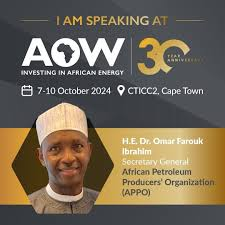
8 October 2024, Cape Town, South Africa – Dr. Omar Farouk Ibrahim, Secretary General of the African Petroleum Producers Organisation (APPO), delivered a powerful message at the AOW – Investing in African Energy conference, calling for a unified African front in the global energy landscape and warning against the detrimental effects of the European Union’s planned carbon border adjustment mechanism (CBAM).
Ibrahim provided an update on the organisation’s efforts to establish the African Energy Bank, a crucial initiative to counter the withdrawal of traditional financiers from African oil and gas projects due to climate change concerns. He announced significant progress, with the establishment agreement signed and ratification underway in several member countries. Nigeria has been selected to host the bank’s headquarters, further solidifying the commitment of APPO members to taking control of their energy destinies.
Addressing the proliferation of energy conferences on the continent, Ibrahim reiterated APPO’s commitment to creating a single, impactful annual event that showcases Africa’s achievements in the energy sector. He hinted at progress made in consolidating these events, thanking stakeholders like the Africa Energy Chamber and the organisers of AOW for their cooperation, and welcomed the conferences move to its new home in Accra, Ghana as of 2025.
However, the crux of Ibrahim’s message was a stark warning about the potential impact of the EU’s CBAM on African nations. He urged African representatives attending the upcoming energy conference in Baku to take a strong stance against the planned tax on carbon-intensive imports. “This is the time to sound the alarm,” Ibrahim declared, arguing that the CBAM would stifle Africa’s industrial and economic development.
He emphasised that developed nations, historically responsible for the bulk of global emissions, should focus on addressing their legacy emissions rather than imposing trade barriers on developing countries. Ibrahim called for a moratorium on the CBAM, urging a more equitable approach to the energy transition that recognises Africa’s right to utilise its resources for economic growth. He concluded with a powerful message: “Africa cannot develop without fossil fuels. Africa deserves better.”
The Bank of Ghana Forex Forward Auction Calendar has indicated plans to sell $40 million each month throughout the fourth quarter to Bulk Oil Distribution Companies (BDCs).
This is in effort to reduce pressure on the foreign exchange market to help stabilise the local currency.
In total, about US$120 million will be made available to BDCs, major forex trading partner in Ghana.
According to the calendar, the Central Bank will auction $20 million to the BDCs twice in October.
The same approach will be taken in November, with two auctions set for November 13 and November 27.
Also, in December, $20 million will be auctioned on December 12 and December 27.
The Bank of Ghana said in a notice that each auction will take place between 9:30 am and 10:30 am, with results to be announced by 3:00 pm on the auction day.
The auctions will follow the guidelines outlined on the Bank of Ghana’s website.
The purpose of the dollar sales is to ensure that oil importers have adequate foreign exchange liquidity to purchase refined petroleum products for local consumption.
It is also expected to help improve overall dollar liquidity in the foreign exchange market.
After a month of Ghana’s Eurobond debt restructuring campaign, about 98.6 percent of bondholders agreed to either a Par or Disco offer, Ministry of Finance has indicated.
These shows an impressive interest from bondholders to accept the restructuring arrangements. The overwhelming backing from bondholders highlights confidence in the country’s financial recovery efforts.
Ending the campaign on October 3, 2024 with series of solicitation meetings to conclude the process.
Eligible holders were invited to swap their old bonds for new ones under two options: Par and Disco.
“Holders of the 2013, 2014, and 2015 World Bank-Guaranteed Notes passed extraordinary resolutions with over 90 percent representation, ensuring a seamless restructuring process”, the Ministry noted last week.
“For the Aggregated CAC Notes, consents exceeded 98.7 per cent, surpassing the required thresholds for the exchange.”
The majority of bondholders, approximately 91 percent of the principal amount, opted for the Disco menu of new notes, while 7.6 percent chose the Par menu, which remained under its cap of USD1.6 billion, leaving a balance of USD605 million for future allocations.
Additionally, USD126 million in consent fees will be distributed to eligible bondholders who submitted their instructions by the early consent deadline.
The issuance of the new bonds is expected around Wednesday, 9 October 2024, with full settlement following shortly thereafter.
This successful exchange is a significant milestone in Ghana’s broader debt restructuring strategy under its International Monetary Fund (IMF) programme, reinforcing the country’s commitment to achieving debt sustainability and rebuilding relationships with international capital markets.
The Government of Ghana expressed its gratitude to bondholders for their participation, emphasising that this outcome reflects a collective commitment to restoring the nation’s economic stability.
To facilitate a smooth final settlement, all existing Eurobonds, including those for which no consent or exchange instructions were provided, will be blocked from trading in preparation for the issue date.
CAPE TOWN, 7 October 2024 – Ministers and senior energy officials from more than 20 African countries convened today for a closed-door session to address the continent’s pressing energy needs and shape a collective vision for a sustainable energy future.
The high-level meeting, held as part of the AOW: Investing in African Energy event, provided a confidential platform for frank discussions and strategic alignment. The AOW event, a leading platform for dialogue and dealmaking in the African energy sector, aims to drive investment, foster partnerships, and showcase the continent’s vast energy potential.
This year’s focus on “Investing in African Energy” underscores the urgency of addressing energy poverty while navigating the complexities of the global energy transition.
A central theme of the closed-door discussions was the need to leverage Africa’s abundant oil and gas resources to directly benefit the African people, the majority of whom still lack access to reliable, affordable energy. Ministers explored pathways to ensure that energy development translates into tangible improvements in living standards, including increased electrification, job creation, and economic growth.
“Our primary responsibility is to liberate the people of Africa from the shackles of extreme poverty, high unemployment, and persistent inequality,” stated South African Minister of Mineral and Petroleum Resources, Gwede Mantashe, echoing the sentiment of the closed session. “Energy is the flywheel for any nation’s economic growth.”
Ghana’s Minister of Energy, Herbert Krapa, emphasised the importance of regional cooperation in achieving these goals, stating, “Regional co-operation has a huge role to play in Ghana’s energy vision in that our plans include exporting energy to other parts of the continent.” He highlighted the need for removing trade barriers and developing shared infrastructure, such as pipelines and refineries, to maximise the benefits of energy resources for all Africans.
A panel discussion featuring prominent voices from the private sector highlighted the importance of collaboration and trust between governments and investors. Panellists emphasised the need for stable regulatory environments, consistent policies, and innovative financing mechanisms to unlock the significant capital required for large-scale energy projects in Africa. There was a strong consensus that “African solutions” are needed to address African challenges, with a focus on local content development and regional energy cooperation.
While acknowledging the global shift towards cleaner energy sources, ministers emphasised that Africa’s energy transition must be pragmatic and consider the continent’s unique circumstances. This should include maximising the use of its natural resources to address the need for regional energy security while simultaneously pursuing sustainable and equitable development models.
A sense of urgency permeated the discussions, with a clear call to move beyond dialogue and implement concrete actions. Ministers acknowledged the need for stable regulatory frameworks and consistent policies to attract long-term investment, recognising that building trust between governments and investors is paramount.
The AOW: Investing in African Energy event will continue over the next three days, featuring keynote presentations from industry experts, and government representatives, as well as panel discussions, and networking opportunities.
The outcomes of the closed-door ministerial session are expected to shape the tone and direction of these public discussions, fostering a spirit of collaboration and shared purpose as Africa strives towards a more sustainable, more just, energy future.