Category: News

  • First Sky Group boss confident Ghana can own its renewable energy

    First sky group

    Executive Chairman of the First Sky Group, a wholly owned Ghanaian group of companies, Eric Seddy Kutortse has challenged local expertise to take charge of the future energy ecosystem of the country since the nation boasts of the required local capacity to deliver present and future energy projects to accelerate economic development.


    Mr. Kutortse noted this was the only way the country’s energy sector could be guaranteed by harnessing the power of our natural resources—sun, wind, and water—to drive our economic growth and reduce our reliance on imported energy.


    The bold call by Mr Kutortse was made during a working visit to inspect the ongoing construction of a 50MW Solar PV generating power station in the Yendi District of the Northern Region on September 30, 2024, by a high-powered delegation from the members of the Parliamentary Committee on Energy led by its Chair Hon. Owuraku Aidoo.


    The inspection delegation also included theDeputy Chief of Staff, Mr. Emmanuel Adumua-Bossman, Board Chair of Bui Power Authority (BPA), Mr. Kwesi Ameyaw-Cheremeh, members of the Board of BPA, Chief Executive Officer of BPA, Hon. Kofi Dzamesi, Senior Management of BPA, Chief Executive Officer and Management of GRIDCo, MP for Yendi Constituency, Hon Umar Farouk Aliu Mahama, the District Chief Executive of Yendi Municipal Assembly among other dignitaries.


    The inspection visit was to offer a first-hand update on the progress of work on the first and largest wholly-owned Ghanaian initiative, which started a year ago, executed by First Sky Limited, a member of the First Sky Group and first-class road and civil engineering firm, on behalf of Bui Power Authority, the nation’s renewable energy leader.


    Sharing a brief on the progress of work, executed on behalf of BPA, Mr. Kutortse disclosed that the Solar PV Project in Yendi sits on about 140 acres of land filled with solar panels to harvest 50 megawatt of renewal power in Ghana and stands as the first of its kind—a fully Ghanaian-owned renewable energy initiative, adding that it is also the second largest solar project in the country with the 55MW Solar PV Project at Bui, the first largest, undertaken by the Bui Power Authority.


    “This project, a landmark milestone, is more than an investment; it is a statement. It says that Ghana will not be left behind in the global march toward renewable energy. It says that we are ready to lead, to innovate, and to create an energy system that is not only sustainable but owned, operated, and driven by Ghanaians”.


    “This is because, across the globe, the energy landscape is shifting. Nations are moving away from fossil fuels, and the world is looking to renewable energy. Ghana cannot afford to lag behind. And today, with this project, we take a bold step towards that vision.”


    “As the largest solar farm being undertaken by an indigenous company, it is important to note that all the experts on the project are Ghanaians, from First Sky Limited and there is no foreigner working on this project” Mr. Kutortse affirmed.


    Commenting on the initiative, the Chief Executive Officer of BPA, the owner of the project, Mr. Samuel Kofi Dzamesi applauded First Sky Group for being the first Ghanaian company to build a solar plant in the country.


    “I want to commend the Executive Chairman of First Sky Group because all the solar plants that have been built in the country were built by foreigners, either Chinese, Swiss or others but this is the first indigenous company that is building a solar plant” he remarked.


    He further explained that First Sky had done the engineering works, the procurement and the financing of the project and when completed, Bui Power would generate and sell the power whilst it repaid the financing over an eight-year period, adding that the solar panels had a warranty of twenty-five years.


    Chair of the Parliamentary Select Committee on Energy, Hon. Owuraku Aidoo, indicated that as Bui Power had the mandate to increase solar power penetration in the country, the Yendi project was in line with the Government’s agenda of getting about 10 percent of a total mix of energy coming from renewables and therefore his committee was keenly watching the progress of the project.


    The Deputy Chief of Staff, Emmanuel Adumua-Bossman, delighted with the progress of work, explained the most impressive part of the Yendi Solar Project was that if any of the panels within the twenty-five-year period, there was a process to change the deteriorated to ensure the facility maintained the 50-megawatt capacity until a major replenishment was undertaken.


    Board Chair of Bui Power Authority, Hon. Kwesi Ameyaw-Cheremeh impressed about the outcome of the project, noted “This is the first time I am seeing what has been done by the First Sky Groups of companies. I am truly pleased that a wholly Indigenous Ghanaian company could do this, it means that we should continue to have faith in ourselves and if we do that, we will build ourselves and we will do things for ourselves and Ghana will be a better place us” he said


    As the contractor, First Sky Limited with the approval of Bui Power Authority, the employer, has proposed to execute the project in two phases; completion of 20MWp by the end of October 2024 in Phase One and execution of 30MWp by end of 2024 in Phase Two.


    The project, engineering, procurement and construction with financing for a 50MW Solar Photovoltaic Power Plant and Ancillary works includes the construction of a solar farm, 5km of the access road and two-unit, two-storey, two-bedroom staff accommodation. The project when completed will contribute to the Government’s efforts at ensuring energy security and reliability for the country and a step towards achieving the outcomes of Ghana’s Energy Transition Agenda.


    The delegation had earlier called on the Galgul Laana, NAA Kassim Norgah, who led the team to pay a courtesy visit to the Yaa Naa, King of the Dagbon Kingdom, His Royal Majesty NAA Gbewah Yaa-Naa Abukari Mahama II, for his blessing



  • Only GSA can lead small-scale mining exploration to combat galamsey


    Geological survey authority

    The Minerals Commission has stressed that addressing the menace of illegal mining, known as galamsey, will remain a significant challenge unless the Geological Survey Authority(GAS) is empowered to conduct exploration for small-scale miners.


    Speaking before the Government Assurances Committee of Parliament, the Chief Executive Officer of the Minerals Commission, Mr Martin Ayisi, highlighted that for over 30 years, successive governments have failed to allocate designated areas for small-scale miners.


    As a result, an estimated 3 million small-scale miners across the country have resorted to unregulated mining practices, leading to the destruction of forest reserves and water bodies.


    Mr Ayisi outlined measures the Commission is proposing to tackle the menace of galamsey.


    One key solution, he emphasized, is to mandate the Geological Survey Authority to identify suitable areas for small-scale mining operations, which would prevent miners from venturing into ecologically sensitive areas.


    This would ensure a more sustainable and regulated approach to small-scale mining, reducing environmental harm and protecting Ghana’s natural resources.


    The Commission’s proposal is seen as a crucial step in the fight against illegal mining, as it seeks to strike a balance between promoting responsible mining and safeguarding the environment.


  • Deloitte Survey: Emissions Levy to impact investment decisions in oil & gas sector


    Deloitte


    A recent survey by Deloitte has revealed that businesses in Ghana’s upstream oil and gas industry expect their investment decisions, particularly in waste management, to be influenced by the introduction of the emissions levy.


    The levy, which was introduced in the 2024 National Budget under the Emissions Act 1112, imposes a tax on carbon dioxide equivalent emissions across several sectors, including oil and gas, construction, manufacturing, mining, and electricity generation.


    According to the survey, 40% of respondents indicated that the emissions levy would drive their investments towards cleaner technologies.


    Awareness of the Ghana Revenue Authority’s levy is also high, with 65% of businesses indicating they are familiar with the policy.


    When asked about the importance of environmental issues, respondents gave an average rating of 4.18.


    Waste management was identified as a top priority, with 65% of companies focusing on it, while 42% are prioritising renewable energy use.


    Although 56% of respondents are aware of the benefits of reducing their carbon footprint to claim emissions credits, only 36% reported familiarity with their own company’s specific carbon footprint.


    The survey also revealed that nearly all respondents (98%) believe it is crucial for companies to publicly disclose their environmental, social, and governance (ESG) practices.


    This emphasis on transparency is highlighted by an average rating of 4.22, underscoring the importance businesses place on revealing their environmental and social impacts.


  • EBID approves €61m, $100m to spur trade, sustainable development in West Africa

    ECOWAS bank for investment and development


    The Board of Directors of the ECOWAS Bank for Investment and Development (EBID), at its 89th Ordinary Session, approved investments totalling EUR 61 million and USD 100 million to stimulate the infrastructure, trade, and sustainable development sectors in West Africa.


    The session was held on fortnight ago, at the Bank’s headquarters in Lomé, Togo, under the chairmanship of Dr George Agyekum Donkor, President and Chairman of the Board of Directors.


    A press statement said Dr Donkor emphasised that the approved investments are in line with the Bank’s mission to promote sustainable development and regional integration for the ECOWAS sub-region while driving growth in economic activity.


    For the private sector, a USD 100 million line of credit was granted to Access Bank Plc in the Federal Republic of Nigeria to support SMEs to expand operations in the various sectors while for the public sector, three projects totalling EUR 61 million were approved in the Federal Republic of Nigeria to support infrastructure, transport, health and sustainable development.


    The approved projects aligned with the United Nations Sustainable Development Goals (SDGs) as well as the Bank’s Strategic Plan for 2021-2025.


    These approvals bring EBID’s total commitments in the ECOWAS region to USD 4.2 billion, of which total commitments in the Federal Republic of Nigeria amounts to USD 408 million.


  • Bond market sees trade volumes fall by 15.56% to ¢609m for 2nd week

    Bond markets

    Trade volumes on Ghana’s secondary bond market have fallen for the second consecutive week, dropping 15.56% to GH¢609 million, down from GH¢722 million.


    Market activity remained largely focused on the shorter end of the yield curve, with the February 2027 bond accounting for 47.2% of all trades.


    This marks the third consecutive week where this bond has dominated trading, with its average yield to maturity (YTM) decreasing to 23.72%, down from the previous week’s 24.13%.


    In total, the shorter and mid-segments of the yield curve represented 79.44% and 20.56% of trades, respectively, with average yields of 23.32% and 24.91%.


    However, there was no trading activity at the longer end of the curve.


    Following the acceptance of over 90% of the government’s Eurobond exchange offer, analysts believe that Ghana’s debt relief has reached a more sustainable level, which could help restore market confidence in the near future.


    Despite this, trading is expected to remain concentrated on the shorter end of the yield curve as investors proceed cautiously until there are clearer signs of a broader market recovery.


  • NPA assures Ghanaians of enough LPG to meet national deman amidst price hikes

    National Petroleum Authority

    The National Petroleum Authority (NPA) has assured the public that there is sufficient Liquefied Petroleum Gas (LPG) available to meet the country’s needs, dismissing fears of any imminent shortage.


    In a statement issued by the NPA, the authority emphasised that there is no cause for concern or panic, as current LPG stocks are enough to meet national demand.


    “As of October 9, 2024, the opening stock of LPG is sufficient to last nearly two weeks of national consumption.


    In addition to this, the Sentuo Oil Refinery continues daily production to supply the market,” the statement said.


    The NPA further revealed that over 20,000 metric tonnes of LPG are scheduled to arrive between October 21 and 27, 2024, under the LPG Tender programme, ensuring continued availability of the product.


    The Authority also addressed the reasons behind recent supply disruptions, particularly in the Western and parts of the Central Region.


    According to the NPA, these regions, which are supplied by the Ghana National Gas Processing Plant in Atuabo, experienced challenges due to a power issue that affected the processing of natural gas, from which LPG is derived.


    To mitigate the impact, the NPA directed LPG Marketing Companies (LPGMCs) to load supplies from Tema to serve retail outlets in the affected areas.


    “Checks with the Ghana National Gas Company (GNGC) on October 8, 2024, confirmed that the power issue has been resolved, though the Gas Processing Plant has not yet returned to full production.


    Regular production is expected to resume from October 15, 2024,” the statement added.


    The NPA also noted that a boycott by some LPGMCs of the Quantum LPG Terminal and Tema Multi-Product Terminal has increased pressure on the remaining depots in Tema, limiting the daily volume of LPG that can be loaded from these facilities.


    Despite these challenges, the NPA reassured the public that there is no threat to the overall supply of LPG in the country.


    The Authority is working with all relevant stakeholders to prioritize loading for the Western Region and address supply issues in the area.


    “The NPA remains committed to ensuring the continued availability of LPG across the country and urges the public to remain calm, as there is no imminent shortage,” the statement concluded.


    Meanwhile, the Liquefied Petroleum Gas (LPG) Marketers Association of Ghana has warned of an imminent gas shortage, likely to begin next week, due to dwindling LPG reserves and complications with new import regulations introduced by the National Petroleum Authority (NPA).

    Vice President of the association, Gabriel Kumi, expressed concern over the current stock of LPG, stating it would not last beyond the week.


    He revealed that the 10,000 metric tonnes recently delivered will be exhausted soon. “If measures are not taken to bring in another vessel of gas by next week, we shall be in a very serious shortage situation,” he said.


    Mr Kumi attributed the situation to fluctuations in global LPG prices and domestic supply challenges.


    The Atuabo Gas Plant, which typically supplies up to 50% of the country’s LPG needs, has been underperforming, leaving marketers reliant on imports. “Atuabo hasn’t been performing well for the past month. We are solely depending on imports,” he noted in an interview with Joy News.


    The LPG association has urged the NPA to act swiftly by instructing Bulk Oil Distributors (BDCs) to expedite product imports, warning that failure to do so would lead to severe shortages.


    Meanwhile, the Tema Oil Refinery (TOR) has assured the public that previous challenges with the BDCs have been addressed.


  • High tax rates impeding growth in Ghana’s petroleum industry – Deloitte Report

     Petroleum Industry


    Ghana’s petroleum industry faces significant hurdles that threaten its growth, according to Deloitte’s October 2024 Oil and Gas Industry Survey.


    The report reveals that a substantial 46 per cent of industry stakeholders identify “high tax rates” as the most pressing concern for the sector, impacting both profitability and overall competitiveness.


    In light of these challenges, around 42 per cent of industry players are advocating for tax amnesty, arguing that it could create a more conducive environment for businesses to flourish.


    The survey also uncovers a critical issue regarding access to foreign currency, with approximately 80 per cent of respondents needing foreign currency to meet their payment obligations.


    However, they struggle to obtain it due to high exchange rates. Stakeholders are urging the central bank to address the shortage of foreign exchange to alleviate these financial constraints.


    On a brighter note, the report indicates that about 91 per cent of industry players believe local content regulations are either sufficient or somewhat sufficient in promoting and protecting Ghanaian participation in the industry.


    Notably, only a small percentage think these regulations hinder foreign investment.


    Additionally, most top management officials emphasise the importance of public disclosure regarding Environmental, Social, and Governance (ESG) practices.


    This perspective is reinforced by a strong rating of 4.22, highlighting the significance of transparency in companies’ environmental and social impacts.


  • About 800k jobs to be created upon completion of Petroleum Hub project

    Petroleum Hub Project


    Adnan Adams Mohammed


    It is estimated that Petroleum Hub Project, when completed, will created about 780,000 direct and indirect jobs.


    The project, being sited at Jomoro, in the Western Region of Ghana, is set to promote value addition in agriculture and energy security, while empowering local enterprises and creating new pathways for economic growth.


    It is expected to play a critical role in the sustainable development of Ghana’s energy and petrochemical industry, attracting investment, driving economic growth, and positioning the country as a leader in the regional gas market.


    “We are not just constructing a Petroleum Hub, we are creating opportunities for local businesses, and ensuring the benefits of our resources reach our communities”, Charles Owusu, Chief Executive Officer of the Petroleum Hub said while speaking at the 2024 Local Content Conference and Exhibition, organized by the Petroleum Commission in Takoradi, last week.


    During a panel discussion on “Developing a Regional Gas Market for a Sustainable Energy and Petrochemical Industry in Ghana,” Mr. Owusu discussed the corporation’s efforts to attract exploration and production investments to bolster local content in the industry.


    He highlighted the project’s significant impact on Ghana’s energy sector and local communities.


    Stressing that, the development of the Petroleum Hub goes beyond building infrastructure—it is about creating opportunities for local businesses and ensuring that Ghana’s natural resources benefit its people.


    The conference brought together key stakeholders from the petroleum sector, with discussions focusing on advancing local content, boosting investment, and fostering a sustainable energy industry in Ghana.


  • Ghanaian pensioner Eurobond holders plead for exemption amid debt restructuring hardship


    Ghana’s Eurobond Debt


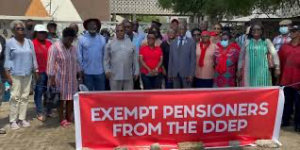
    A group of pensioner Eurobond holders in Ghana has expressed profound disappointment and frustration over government’s Eurobond debt restructuring plan, following recent remarks by the Finance Minister.


    The pensioners, feeling excluded from key negotiations, voiced their concerns after the Minister announced that Eurobond investors had forgiven USD5 billion of Ghana’s debt.


    The pensioners argue that while negotiations have focused on international and commercial bondholders, they have been left out of discussions, despite being significantly impacted by the restructuring.


    They contend that unlike larger institutional investors, they cannot bear the severe financial losses imposed by the government’s current debt restructuring plan.


    The restructuring involves a 37 per cent haircut, reduced interest rates, and extended maturity dates that stretch up to a decade. For the pensioners, these measures are devastating.


    The bonds, which they had relied upon for financial security during their retirement, are now at risk, particularly affecting their ability to cover essential expenses such as medical care.


    “We, the affected pensioners, write to express our deep disappointment and frustration with this turn of events,” the group said in a statement.


    It continued that: “At our age, and being on retirement, the 37 per cent haircut, reduced interest rates, and longer tenor will affect us adversely, resulting in significant financial losses which we can hardly afford.”


    For the past two years, these pensioners have endured zero interest payments on their bonds, exacerbating their financial hardship.


    Despite multiple letters and appeals to the Finance Ministry, they have yet to receive a response. Now, they are pleading for an exemption from the Eurobond restructuring plan, citing their vulnerability as retirees.


    Among their key requests are an exemption from the Eurobond restructuring for pensioners and other vulnerable groups and exploration of alternative solutions that protect their financial stability.


    The pensioners, though a small group, stress that their plea is reasonable given their limited resources and the harsh terms of the restructuring.


    They are urging the government to reconsider its stance and adopt a fairer approach that does not further compromise their financial wellbeing.


  • Eurobond restructuring signals confidence in economy – Akufo-Addo touts

    Ghana’s Eurobond Debt


    Adnan Adams Mohammed


    Ghana’s President, Nana Akufo-Addo, has touted recent agreement with Eurobond holders as a clear indication of renewed investor confidence in the country’s economy.


    The government, fortnight ago, announced success in securing almost 100% participation in the Eurobond Debt Exchange Programme, which concluded on 30th September 2024.


    The debt restructuring exercise, a key requirement under the International Monetary Fund (IMF) programme, was part of efforts to address Ghana’s growing debt burden and secure a US$3 billion bailout over three years.


    “The restructuring will be completed by next week, with bondholders exchanging their old bonds for new ones under revised terms. The new terms would allow Ghana more flexibility in repaying its debt”, President Akufo-Addo indicated during an interview with France 24, last week.


    He expressed optimism that the high level of participation, with 98.6% of bondholders agreeing to the deal, reflects growing confidence in Ghana’s economic recovery, particularly following the financial strain caused by the COVID-19 pandemic.


    He added that the agreement involves different interest rates and will significantly ease the financial burden on the country. “Thirteen billion dollars of our debt has been restructured, with $5 billion written off. In total, we’re talking about savings of around $10 billion, which is a major boost for the economy,” Akufo-Addo noted.


    He expressed optimism that improving macroeconomic indicators would soon lead to tangible economic development and better living standards for Ghanaians.


    As part of the restructuring deal, a significant number of bondholders opted for what is known as the “disco menu,” which involves a 37% reduction in the face value of their bonds and interest payments of 5% from 2024 to July 2028, rising to 6% thereafter. These investors will receive three new bond instruments in return.


    Others chose the “par menu,” which preserves the nominal value of their bonds but offers a lower interest rate of 1.5%, with the new bonds maturing in January 2037.


    According to a statement from the bondholders, this Eurobond Debt Exchange Programme is a crucial part of Ghana’s broader debt restructuring efforts under the IMF deal.


    The swap of old securities for new ones is expected to take place around 9 October 2024 with the entire settlement process finalised shortly afterwards.