Category: News

  • Ghana to receive $360m from IMF

    International Monetary Fund

    By Elorm Desewu

    Ghana will in December receive a total of US$360 million from the International Monetary Fund (IMF) as the board is set to meet and approve the disbursement which is in line with Ghana passing the third review under the fund programme.

    This amount would support the country’s balance of payment as well as stem the speed depreciation of the Ghana Cedi.

    “Once the review is completed by the IMF’s executive board, Ghana would have access to about $360 million in terms of disbursement”, the Director of Communications at the IMF Julie Kozack disclosed at news conference in Washington DC USA.

    “We are working, our staff are working toward a board meeting in early December and will provide additional details on the precise date when we have them”, she added.

    Describing the programme performance as encouraging, Ms. Kozack said Ghana has followed the requirements needed for the country’s debt restructuring.

    “What I can say in addition is that the programme performance has been good. There has been in particular remarkable progress on debt restructuring”.

    She pointed out that some macroeconomic projections have been achieved under the programme, indicating some level of recovery.

    “Economic growth in the first half of 2024 exceeded our expectations, exceeded our projections. Inflation has declined and the fiscal and external positions have shown marked improvement”, she said.

    She cautioned against decisions that may cause slippages in the future.

    “Looking ahead, what will be important for Ghana will be continued implementation of the policy and reform agendas, especially given the difficult situation that many countries in the region and globally face. And it remains essential to fully restore macroeconomic stability and debt sustainability”.

    “We will, of course, have further updates on Ghana when we release the staff report, when we publish the staff report after the board meeting”, she added.

    On October 4th, the IMF staff and government reached a staff level agreement on economic policies and reforms for the third review of the ECF arrangement.

    The disbursement by the IMF Board in December 2024 will bring the total funds received since Ghana signed up for the IMF programme to $1.92 billion.

    The board meeting in December is coming after Ghana passed most of the benchmarks set under the third review by the IMF programme.

    The IMF staff at the end of the third review assessment indicated that all the end-June 2024 quantitative targets were met, and progress on key structural reforms has continued notwithstanding delays in a few areas

    “The economic growth in the first half of 2024 was much higher than initially envisaged primarily fueled by mining, construction, and information and communication activity, with a broadening of the sources of growth across sectors during the second quarter as inflation continued to decline” The IMF Staff said.

  • Mahama builds maternity facility for Atebubu to fulfill chiefs request 

    John Dramani Mahama inspecting the equipments in the wards


    President John Dramani Mahama inaugurated a newly built maternity ward for the Atebubu Hospital in the Bono East Region.


    The maternity ward, fully funded by the leader and presidential candidate of the National Democratic Congress (NDC), is equipped with incubators, ultrasound scan machines, surgical and delivery beds, and other advanced equipment to improve maternal health and delivery for women in the area.

    President Mahama stated that the construction of the Nana Owusu Akyeaw Brempong II Maternity Ward is a direct response to a request made by the chief of Atebubu. He further emphasised that the new facility will guarantee accessible healthcare services to mothers and newborns in the area.


    The new facility is equipped to provide maternal and neonatal services, deliveries, and postnatal support. The former president is confident that the new facility will significantly decrease maternal and infant mortality in the Atebubu area, ensuring safer deliveries and postnatal care.

    He thanked the individuals and organisations that sponsored the construction. He acknowledged his wife, Lordina, for her support to ensure the speedy completion of the project.

  • Cashew farmers demand fair price from gov’t


    Cashew farmers

    The National Cashew Farmers Association is calling on the government to impress on the Tree Crops Development Authority to come out with a realistic minimum price per kilo this year.


    Addressing their grievances in a press conference held at Wenchi in the Bono Region, the association also wants the government to consider the high rate of the dollar coupled with the high production cost of cashew.


    The association Secretary Yahaya Bellu, further appealed to the government to allow foreign buyers to purchase from the farm gate if local buyers fail to buy at the announced minimum price.


    He further reiterated that if the government fails to meet their demands, they (cashew farmers) would advise themselves in the coming elections.


    They also want the government to come out with a policy document to ensure government commitment for making sure that cashew becomes a major cash crop like cocoa.


    On his part the National Chairman of cashew farmers association who doubles as the Adumhene of Wenchi Traditional Area, Nana Adu Boamponsem VI, commended Nana Akufo-Addo, Bawumia government for the establishment of the Tree Crops Development Authority.


    “We can boldly say that the only promise fulfilled by the president Akufo-Addo’s government to cashew farmers is the Tree Crops Development Authority” he said.


    Nana Adu Boamponsem VI therefore urged the government to resource cashew farmers by giving them financial support.


  • AAC pledges sustainable agriculture practices and investments across Africa


    Asian African Consortium


    The Northern Sector Coordinator of Asean African Consortium (AAC), a subsidiary of the Jospong Group of Companies, Peter Dawuni, has reaffirmed the company’s commitment to its rice revolution agenda in Ghana.


    He assured potential investors that sufficient land acquisition was in place to support the project.


    “We have legally secured 200,000 acres of land to sustain our rice revolution project, making it an attractive opportunity for investors, and we possess all necessary documents covering this transaction,” Mr Dawuni disclosed.


    He stressed that any investor partnering with AAC will not face land-related challenges, assuring further that “we’re confident our partnership will drive growth, improve food security, and contribute to Ghana’s economic development.”


    Mr. Dawuni delivered these assurances during a presentation on Sustainable Practices In Food, Agriculture, & Water Management at the UN Climate Change Conference in Baku, Azerbaijan, last week.


    He emphasised the importance of collaborative efforts between the public and private sectors.


    The 200,000-land acquisition, he said, was a crucial step in AAC’s long-term strategy to reduce rice importation in Ghana, aiming to produce 720,000 metric tonnes of rice within five years.


    Additionally, AAC plans to expand investments across Africa, prioritising food security continent-wide, he noted.


    “We must collectively ensure food security for Ghana and our neighbouring countries,” mr. Dawuni urged.


    “Our focus isn’t solely on profitability but making a tangible impact through sustainable food security,” he affirmed.


    To this end, the northern coordinator of AAA recounted that his outfit conducted extensive research domestically and internationally, studying best practices from Thailand, Japan, China, and France.


    He highlighted their adoption of sustainable agricultural practices including Alternative Wetting and Drying (AWD), compost application and agroforestry.


    According to him, AWD was particularly effective for rice production, stressing that the company’s increased compost use significantly reduces carbon emissions in Ghana.


    To achieve sustainable rice production and related agricultural development, he indicated that AAC was exploring equity and debt financing options, adopting climate-resilient agricultural practices, leveraging on appropriate climate-smart technologies, and fostering collaborative private-public partnerships.


    He maintained that by adopting these strategies, AAC has clearly demonstrated its commitment to environmentally friendly and sustainable rice production, supporting Ghana’s food security and economic growth.


    Mr. Awuni announced that Jospong Group and its partners intend to venture into large-scale commercial agriculture, initially focusing on the cultivation and production of onions, soya beans, maize, rice and poultry


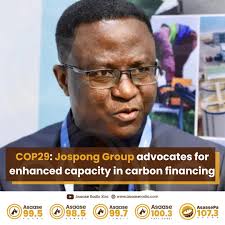
  • Jospong Group’s Chief Investment Officer advocates capacity building in carbon financing at COP29

    Jospong group


    The Chief Investment Officer of Jospong Group of Companies (JGC), Mr. Noah Gyimah, has emphasised the need for capacity building in carbon financing.


    At a 29th Conference of Parties (COP29) of the United Nations Framework Convention on Climate (UNFCCC) side event panel discussion on November 14, 2024, he highlighted capacity building’s crucial role in carbon financing for developmental projects, during the session “New World of Carbon Markets: The Potential of Existing Infrastructure and Impact of Investments in the Green Economy.”


    “Developing capacities in both the private and public sectors is essential for understanding which projects attract carbon financing,” he noted.


    He cautioned that “if that is not done, it becomes a matter of just talking about climate change without knowing what it takes to commercialise these activities to attract capital.”


    The COP29 opened in Baku, Azerbaijan, on Monday, November 11, 2024, with a pressing call for world leaders to agree on an ambitious new global climate finance goal.


    The two-week COP29 conference (11-22 November, 2024,) will focus on several key thematic areas, including the World Leaders Climate Action Summit, finance, investment and trade, energy and peace, relief and recovery, and science, technology and innovation.


    Mr. Gyimah used the opportunity to share Jospong Group’s success story, securing $20 million from the Swiss Government through the support of the Ghanaian Government.


    “This was made possible through a combination of technical expertise from scientists together with sustainable finance experts to do the calculation from carbon emission sums and then to convert it into a financial model to say that if I am able to remediate this number of CO2, it corresponds to this sum of dollars,” he explained.


    He also highlighted the importance of capacity building in project finance, data collection, and technology integration.


    “These capacities are yet to be built, so for Ghana to really reach that apex to attract capital, it is very important that we build the capacities of people to understand project finance, actual documentation, and the data houses that we need to build to have data sources to prove this work we are doing is very important,” he said.


    Mr. Gyimah underscored the role of technology, such as AI, in simulating data and optimising waste management.


    “All of these are data-driven; if you mention that you are going to remediate 1.5 metric tons of CO2 and this amount of tons of waste, I need to have data to prove it.”


    On waste segregation, he noted, “Waste segregation starts at the source, and there is a need for separate bins.”


    He suggested policy initiatives, such as subsidised bins or buyback programmes, to encourage proper segregation.


    Jospong’s innovative approaches, he said, included waste segregation, recycling, organic fertiliser production, and transfer loading stations.


    “Those investments that we made closer to the people help us to be able to aggregate the waste and with that, we are able to have a first line of treatment which helps in the type of waste that goes to the recovery plant for recycling.”


    Mr. Gyimah concluded, “Individuals, governments, and private sectors must work together to reduce carbon emissions. By building capacities and leveraging technology, we can unlock capital and create a sustainable future.”


  • BoG remains committed to delivering on its mandate – Addison


    The bank Square


    Governor of the Bank of Ghana (BoG) Dr Ernest Addison has said that he is filled with optimism that the new headquarters of the BoG, The Bank Square will remain a significant investment in the collective future as a nation.


    He said this would also push the Bank towards new frontiers in central banking and demonstrate what we as a nation are capable of achieving.


    “We remain committed to delivering on our mandate, and this new facility should enable us to do so effectively,” Dr Addison said during the commissioning of the new facility in Accra last week.


    He further explained that The Bank Square, was designed with the future in mind and stands as one of the most important modern civic landmarks in the city of Accra and for that matter, our nation.


    This building, he said, will play a pivotal role in shaping Ghana’s identity as leading force in Africa’s financial ecosystem, symbolizing Ghana’s growing influence as an economic powerhouse on the world stage.


    By commissioning this product of the imagination of an internationally celebrated architect, Sir David Adjaye, a proud son of Ghana, “we are boldly affirming our commitment to investing in the nation’s future. His architectural firm, Adjaye Associates, has created this enduring masterpiece—one designed to withstand the test of time and serve as a beacon of Ghana’s revitalization for generations to come,” Dr Addison said.


    Architecturally, he added, The Bank Square is a bold statement of Bank of Ghana’s enduring presence and authority in the financial landscape. Clad in durable stone, the building symbolizes permanence and resilience, much like ancient monuments that have withstood the test of time.


    “This material not only conveys the Bank’s stature but also requires minimal maintenance and supports the building’s sustainability goals. This architectural form

    reflects the Bank’s role as a regulatory authority and affirms its importance within the nation’s economic framework.


    “Standing at 100 meters, it is not only the tallest building in Ghana, but also the most sustainable EDGE Advanced structure of its size in the country and in the sub-region. This landmark complex is entirely powered by its own harvested solar energy, setting a new standard for environmentally conscious civic and public buildings across Africa. Together,

    the four buildings will accommodate over 2,500 staff and alongside offices and public banking facilities, there is a currency museum, conference and press amenities, 1,500 seat auditorium and rooftop terraces. Despite all the innovative features of the building, by acquiring the services of local partners, the Management of Bank of Ghana has ensured that the value for money assessment of this project can boast of a lower cost per square meter than comparable projects in Accra.


    “In addition, the construction of THE BANK SQUARE has provided an invaluable opportunity for hundreds of local workers to upskill their trades and crafts. It has equipped them with expertise to create buildings that set new standards in sustainability and craftsmanship, positioning them at the forefront of modern construction in Africa.


    16. Your Excellency, this is a civic building in the heart of Accra, that is designed to honour, shape and celebrate the future of Ghana. This state-of-the-art facility will foster creativity, collaboration, and efficiency, and undoubtedly it will enhance productivity in the Bank and further drive our success. We envision this building as a hub for innovation, where

    more groundbreaking ideas will be born and nurtured. It will be a place where our new generation of officials will thrive and achieve new heights in modern central banking.”


  • Ghana’s economy is firmly on the path of recovery – Akufo-Addo says attributing it to BoG data


    The President of Ghana


    President Nana Addo Dankwa Akufo-Addo has called on Ghanaians to continue working with the government to build an economy that is stable, inclusive, and prosperous.


    He said this last week,  when he commissioned The Bank Square, the magnificent new headquarters of the Bank of Ghana, located in the heart of Accra.


    He notes that this architectural masterpiece is more than just a building; it represents a beacon of Ghana’s financial strength, resilience, and aspirations for a sustainable future.


    Designed with eco-friendly technologies and cutting-edge innovations, it stands as a symbol of modern Ghana, prepared to meet the demands of a dynamic global economy, Mr Akufo-Addo said.


    President Akufo-Addo said “The Bank Square reflects the remarkable progress of our nation. Recent data from the Bank of Ghana shows that Ghana’s economy is firmly on the path of recovery. Provisional GDP growth of 6.9% in the second quarter of 2024, with a robust non-oil growth of 7.0%, highlights the strength of our agriculture, industry, and services sectors.


    “Inflation has been sharply reduced from 54.1% in 2022 to 22.1% as of October 2024, bringing relief to households and businesses alike. These achievements are further bolstered by a trade surplus of $2.78 billion and international reserves of $7.5 billion, which provide a strong buffer against external shocks.”


    He added “This milestone is a testament to the Bank of Ghana’s commitment to sound monetary policies under the leadership of Governor Ernest Addison and his dedicated team. I applaud their efforts, as well as the creativity and expertise of the architects, engineers, and contractors—especially GoldKey Properties, a wholly Ghanaian entity—that brought this vision to life. Together, we are building a foundation for a resilient economy, inclusive growth, and a brighter future for all Ghanaians.”


    “As we celebrate this achievement, I call on all of us to continue working together to build an economy that is stable, inclusive, and prosperous.


    “The Bank Square is not just a symbol of what we have accomplished; it is an inspiration for what lies ahead. Let us remain united in our efforts to make Ghana great and strong!” he said.


  • Jospong rice to hit markets soon

    M        Jospong rice

    The Asian African Consortium (AAC), a subsidiary of the Jospong Group, has launched the Jospong Rice, the newest addition to Ghana’s agricultural scene.

    Launching the AAC-branded rice product at the Agrifest 2024 in Accra on the theme; “Building Climate-Resilient Agriculture for Sustainable Food Security, the Minister of Food and Agriculture, Bryan Acheampong, endorsed it as “Authentic Ghanaian rice”.

    This high-quality rice is grown and processed in Ghana, meeting international standards to ensure a delicious and nutritious product for consumers.


    The initiative supports local farmers and the economy, demonstrating AAC’s dedication to strengthening Ghana’s agricultural sector.


    By promoting local production, Jospong Rice aims to reduce Ghana’s reliance on imported rice, which has seen the country spend over GHC6.8 billion (equivalent to $560 million) annually.


    This initiative aligns with the government’s objective of boosting the economy through import substitution.


    “With Jospong Rice, AAC is taking a significant step towards ensuring Ghana’s food future. By supporting local agriculture and promoting sustainable practices, AAC is helping to build a more resilient and food-secure Ghana, noted Mrs. Adelaide Agyepong, the CEO of AAC.


    At the Agrifest 2024 event, the Asian African Consortium showcased its innovative solutions for sustainable food security.


    Their impressive display of modern agricultural equipment and mechanization services drew significant interest from attendees.


    Throughout the event, AAC engaged with key stakeholders, including agrochemical suppliers, financial institutions, and government agencies, to foster strategic partnerships aimed at strengthening Ghana’s agricultural sector.


    With its leadership in agricultural transformation, AAC is driving mechanization and market competitiveness to secure Ghana’s food future.


    The Asian African Consortium is scaling up Ghana’s rice industry by investing in high-quality seeds, modern production technologies, and training for smallholder farmers.


    The goal is to replace the increasing quantities of imported rice.


    Rice consumption in Ghana has nearly tripled in the past decade, with individuals consuming approximately 45 kilograms per year.


    The country has an urgent need to produce rice locally to reduce the financial strain caused by rising imports and foreign exchange demand.


    In 2023, the Asian African Consortium partnered with major players in the rice industry in Thailand and Ghana to develop an integrated rice farming project.


    This initiative aligns with the government’s objective of boosting the economy through import substitution.


  • ACEP Boss questions govt’s current approach to local content in energy projects


    Africa centre energy policy


    Executive Director of the Africa Centre for Energy Policy (ACEP), Benjamin Boakye, has questioned the government’s current approach to local content in energy projects.


    He describes the government’s current approach as superficial.


    “Local content should not mean just putting a Ghanaian face on a business. It should involve building production capacity within the country,” he said during NorvanReports and Natural Resource Governance Institute (NRGI) X Space discussion on “Powering Ghana’s Future: Political Promises vs CSO Demands – Are We Ready for the Green Shift?”,


    He added that policies should focus on skills transfer, local innovation, and long-term economic growth.


    To position Ghana as a leader in renewable energy, Mr Boakye called for investment in research and development, support for student-led innovations, and the creation of local prototypes.


    He referenced Brazil’s ethanol success story as an example of how targeted investments can yield significant economic benefits.


    “We should think about producing energy locally, not just importing solutions,” he urged.


  • Ghana to face electricity loadshedding as 3 IPPs risks shutting down


    Electricity company of Ghana 


    Adnan Adams Mohammed


    Three major Independent Power Producers (IPPs) are likely to shut down due to unpaid debt of $259 million owed by the Electricity Company of Ghana (ECG), if government fails to act swiftly, the Executive Director of the Institute for Energy Security (IES) has disclosed.


    Nana Amoasi VII, has therefore advised government to immediately take steps to avert a return to the power supply challenges experienced in the past.


    The shutdown of three key plants may result in a combined loss of over 1,418 megawatts from the country’s installed capacity.


    “We have already lost 550 megawatts from Asogli, 200 megawatts from Amandi, and another 200 megawatts from Enipower,” Nana Amoasi VII explained. “When you add Karpower, which is currently operating at less than 53 megawatts, we are left with less than 4,000 megawatts of available capacity, far below the peak demand of 3,700 megawatts.”


    This deficit, he warned, will result in prolonged power outages, commonly known as “Dumsor,” potentially destabilizing the national grid and discouraging investor confidence.


    The IPPs operations are severely affected by growing government’s indebtedness to the IPPs.


    “I can confirm that all is not well. If there is no intervention before Friday, I can tell you that by Monday three key power plants will be off the grids. It is a serious matter; it is not fun. We have received these assurances severally so this can’t sway us. We are resolute,” CEO of Chamber of IPPs, Dr. Elikplim Apetorgbor said in an interview last week.


    To this, while commenting on the challenge, Nana Amoasi VII urged government to act on the matter with some urgency.


    “The bird whispered to us at the IES that they intend to take such a step. There is a fear that if they don’t act now, they won’t have the leverage or that audacity to convince the next government to pay them, and so they are venting out their frustration.


    “I believe that they will make do their word judging from where Asogli took us from. We never believed that any IPP would shut down for the second time. Asogli did as of the 8th of October.


    “…We believe strongly that they will make do their word and that government must take them seriously and act now to avert any [power shutdown],” he urged.


    The government has touted the Bridge Power Project as a solution to the country’s power challenges, with President Nana Akufo-Addo recently commissioning the project.


    Apparently, Nana Amoasi VII cast doubt on these assurances, noting that the project had already been operational earlier this year and was not a new addition to Ghana’s power gener ation infrastructure.


    “What we witnessed yesterday was a political commissioning. Bridge Power has already been included in our power generation capacity for months. It’s not new, and it hasn’t solved the ongoing crisis,” he said.


    Despite public claims by Finance Minister Ken Ofori-Atta during the IMF annual meetings that funding was secured to resolve the Asogli Power Plant’s issues, Nana Amoasi VII revealed that no payments had been made, leaving the plant offline.


    “Asogli is still offline because the financial arrangements promised by the government have not materialized,” he said.


    Nana Amoasi VII emphasized the dire state of Karpower operations, which he described as producing far below its potential, with output dipping to just 53 megawatts over the past two weeks.


    “Karpower’s reduced output has been a long-standing issue, and the signals have been clear for some time. This is the final nail in the coffin if urgent action isn’t taken,” he warned.


    With peak electricity demand exceeding available supply, the energy sector is bracing for disruptions that could ripple through households and industries.


    Stakeholders are urging the government to expedite financial settlements and adopt sustainable strategies to stabilize the energy landscape.