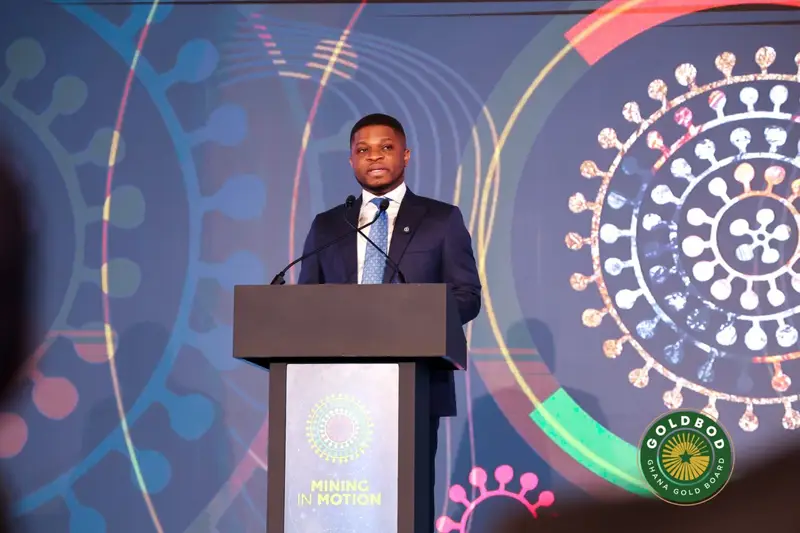
In a major policy address targeting international investors, mining executives, and local leaders at the National Mining Dialogue in Accra, the Chief Executive Officer of the Ghana Gold Board (GoldBod) unveiled a structural strategy designed to transform Ghana’s mining sector from purely extractive operations into a value-retention and community-integrated investment ecosystem.
Addressing stakeholders on the theme “Rethinking the Social Licence to Operate,” Sammy Gyamfi emphasized that long-term asset security and investor returns in Ghana are directly tied to local equity, value addition, and environmental stewardship.
“A social license cannot survive where the youth believe mining has no place for them except as casual laborers… Mining communities must no longer be treated as land donors. They are custodians of the resource hence must be treated as development partners and economic shareholders,” the CEO declared.
The “IPE” Investment Framework
To modernize the sector and mitigate social operational risks, GoldBod proposed the IPE model Involve, Protect, Expand calling on institutional capital and private operators to align with national development goals:
● Involve: Higher, decentralized local royalty retention, structured Corporate Social Responsibility (CSR) contracts, and clear local procurement pathways across production services.
● Protect: Strict enforcement of environmental standards, mandatory land reclamation, and a zero-tolerance policy for water pollution to safeguard social stability.
● Expand: Government-backed support for indigenous capital in exploration, local refining, jewelry fabrication, and down-stream value creation.
“Production without ownership is limited. Production without value addition is leakage. Production without community transformation is a broken social contract,” the GoldBod Chief remarked.
Macroeconomic Impact & Operational Milestones
The address highlighted gold’s dominant role in Ghana’s current economic performance, backed by strong production and trade figures:
Metric / Indicator Output / Value Macroeconomic & Sector Impact
Total Export Earnings (2025) ~$32.0 Billion Gold accounted for $20.2 Billion (63.1%), anchoring trade surpluses and foreign reserves.
National Gold Output (2025) ~5.94 Million oz Artisanal & Small-Scale Mining (ASM) produced 3.11 million oz (52.4%), surpassing large-scale producers.
GoldBod Formal ASM Exports ~170 Tonnes Generated over $17.0 Billion USD in foreign exchange since 2025, bolstering currency stability.
Domestic Refining (2026 YTD) ~9 Tonnes Aggregated by GoldBod for local processing to capture refining fees and downstream benefits.
Large-Scale Local Offtake 30% Local Acquisition Shifted from 20% offshore to 30% local acquisition to feed domestic refineries targeting LBMA certification.
De-Risking Capital and Future Initiatives
To overcome high entry barriers and de-risk exploration for new investors, GoldBod is partnering with the Ghana Geological Survey Authority on targeted geological studies in regions such as Funsi (Upper West) and Bensere (Ashanti). The initiative aims to build investment-grade portfolios while securing strategic state equity in future model mines.
Key upcoming infrastructure projects designed to build an end-to-end ecosystem include:
● ISO-Certified National Assay Laboratory: Groundbreaking in November 2026 at the Aviance Cargo Village, Accra Airport, to establish Fire Assay as the mandatory standard for all ASM and large-scale gold exports.
● Traceability System: Awarding a technology-driven contract by late 2026 to ensure OECD-compliant, transparent supply chains.
● ASM Formalisation & Financing (2027): Launching equipment-financing programs tied to GoldBod aggregation models.
● Gold Tokenization Program (2027): Enabling fractional investment in gold-backed assets for domestic and regional investors.
● Ghana Gold Village: A dedicated industrial zone managed by subsidiary GoldBod Jewelry Limited to anchor commercial jewelry fabrication.
Closing the address, the GoldBod CEO reassured the international and local business community that regulatory firmness and local equity go hand-in-hand with commercial profitability:
“If we get this right, Ghana will not only produce gold. Ghana will produce prosperous mining towns, strategic industries around its minerals, and deeper community trust.”
Leave a Reply