By Adnan Adams Mohammed
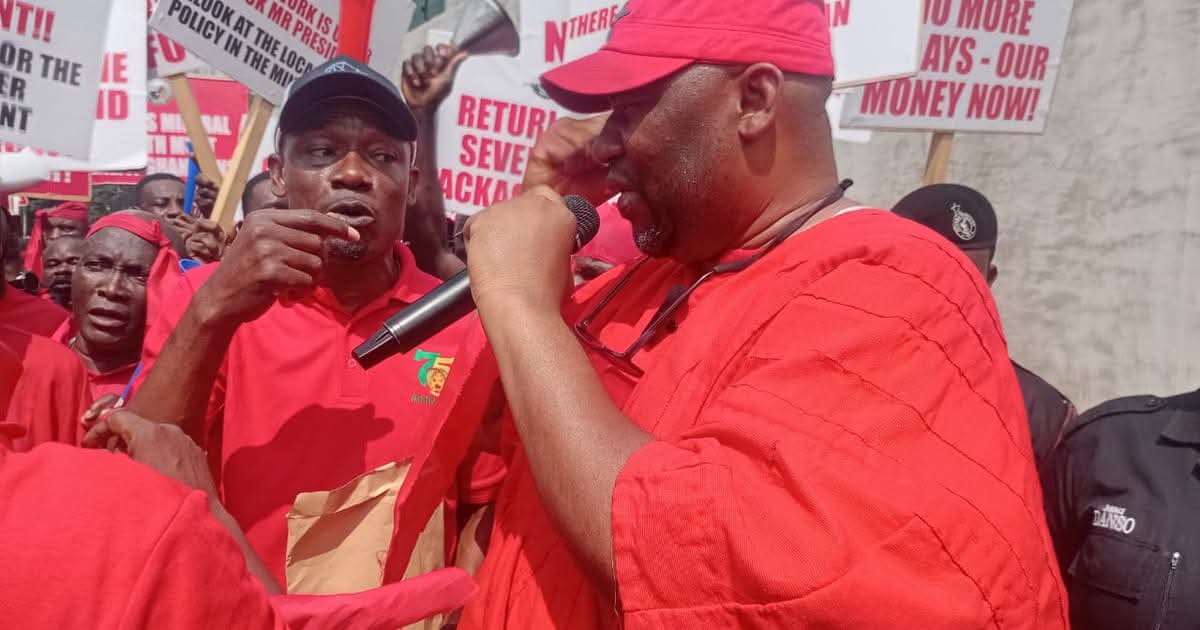
Tensions in Ghana’s gold-rich mining enclaves have reached a critical tipping point. The Ghana Mineworkers’ Union (GMWU) of the TUC has launched a coordinated regulatory offensive against the Bank of Ghana and the Ministry of Lands and Natural Resources.
They issued an ultimatum over locked-up retirement savings and the rapid spread of precarious contract work across major sites.
In two comprehensive petitions signed by GMWU General Secretary Abdul-Moomin Gbana, the union detailed how administrative delays, unkept regulatory promises, and predatory corporate practices are pushing thousands of mineworkers into severe financial distress.
Millions in Worker Savings Trapped in Regulatory Limbo
In a petition addressed to the Governor of the Bank of Ghana, the GMWU disclosed that over GH¢380 million belonging to more than 19,000 workers remains locked in distressed Specialised Deposit-taking Institutions (SDIs), including The Seed Funds Savings & Loans Limited (TSF) and Jislah Financial Services Limited.
These funds, which encompass Provident Fund contributions, severance packages, leave savings, and personal investments managed by IGS Financial Services Limited, have been inaccessible following the central bank’s financial sector clean-up.
Despite central bank commitments dating back to 2021 and explicit mentions in multiple IMF Country Reports, no resolution has been delivered. The union emphasized that retirees, redundant workers, and widows are currently unable to fund critical healthcare, housing, or educational needs.
“Denying these workers access to their legitimate life savings undermines industrial harmony and social stability across mining communities in Ghana,” Gbana stated in the petition to the central bank. “If urgent interventions are not undertaken, there is a real risk of widespread demonstrations and strikes across the mining sector, which could adversely affect industrial relations, mineral production, government revenue, investor confidence, and the broader economy.”
Recalling previous wildcat strikes at Ghana Manganese Company, Future Global Resources, and Golden Star Wassa Mine, the GMWU demanded an immediate full refund of all trapped deposits and an urgent joint conference with the Bank of Ghana and the Ministry of Finance.
Local Content Mandates Fueling ‘Commoditised’ Labor
Simultaneously, the GMWU dispatched a petition to the Minister of Lands and Natural Resources, challenging the Minerals Commission and foreign operators over deteriorating employment conditions. The union accused Chinese-owned operations and third-party “labour brokers” of commodifying Ghanaian professionals including geologists, mining engineers, and metallurgists by placing them on short-term, low-paying contract arrangements.
The union voiced firm opposition to the Minerals Commission’s directive requiring major leaseholders including Zijin, Newmont, and AngloGold to transition their core owner-mining operations to contract mining by December 2026. According to the GMWU, the current implementation of local content regulations (L.I. 2431) has weakened worker protections while shifting profits toward third-party contractors.
The union highlighted several systemic shifts in the mining workforce:
● Shift in Employment Security: Permanent employment in the sector dropped below 10% in 2024 and has fallen under 5% in 2026, leaving over 95% of the workforce trapped in casual or fixed-term contracts.
● Wage Differentials: Workers performing core mining tasks under third-party contractors face wage reductions of 30% to 50% compared to direct owner-miner staff.
● Statutory Non-Compliance: Subcontractors frequently delay salary payments, fail to remit Tier 1 (SSNIT) and Tier 2 pension contributions, and fail to pay statutory severance benefits.
● Safety Concerns: Severe cost-cutting measures by contractors have resulted in substandard Personal Protective Equipment (PPE) and underreported workplace injuries.
“Local content must create opportunities for all Ghanaians. It cannot become a vehicle for exploitation to enrich a few contractors at the expense of the workers who risk and sweat day and night in the bowls of the earth,” Gbana noted. “We cannot build a prosperous mining industry by impoverishing the very workers whose labour produces its wealth.”
Union Calls for Immediate Policy Reversal
The GMWU pointed out that despite a May 26, 2026 agreement with the Ministry to suspend forced contract-mining transitions and set up a joint Technical Committee, three months have elapsed without formal engagement.
To prevent widespread industrial action across the country’s mining hubs, the GMWU is calling for:
1. Regulatory Action: Direct intervention by the Ministry to halt casualization, fixed-term contract cycles, and exploitative outsourcing.
1. Directive Suspension: An immediate hold on all administrative directives pressuring leaseholders to shift from owner-mining to contract mining, pending a full socio-economic impact study.
1. Institutional Dialogue: The permanent establishment of a tripartite Government–Employers–Labour policy forum to safeguard worker rights in future sector policy decisions.
The union concluded that with global mineral prices at record highs, the state must ensure national value retention translates into stable, high-quality jobs rather than insecure labor.