Category: News

  • 2024 Budget: major stakeholders want tax reforms 


    Adnan Adams Mohammed


    Major players within the Ghanaian economy are calling for several tax reforms to help keep the private sector active to contribute progressively to the economic expansion and job creation.


    Among the players is the Ghana Union of Traders Association (GUTA), which is calling for the withdrawal of both the COVID-19 Levy and the Special Import Levy in the yet to be read 2024 budget.


    Specifically, GUTA wants the removal of the 1% COVID-19 Levy, the 2% Special Import Levy, and addressing the complex nature of Value Added Tax (VAT). The COVID-19 Health Recovery Levy was introduced in 2021 as a standalone tax applied to the gross value of taxable goods and services provided under the Standard Rate and VAT Flat Rate Schemes.


    “Reducing the cost of doing business would lead to increased productivity and better revenue collection for the government’, Dr Joseph Obeng, the President of GUTA justified their demand.


    Also, the Food and Beverage Association of Ghana has out-cried that, the business sector is currently riddled with too many taxes, levies, duties and indeed an overtaxed economy, thereby stifling growth.


    Members of the Association believe that the government stands to rake in more revenue for development if taxes are reduced and some are cancelled.


    John Awuni, the executive chairman of the association at a press conference said “We strongly advocate for major tax cuts and the cancellation of some taxes in the 2024 fiscal year. This will spur the gains the economy has started making to sustainable levels”.


    Currently, he said the “prices of goods and services are very high consequently reducing the demand for these goods and services. Considering the level of low wages and salaries in the country, the government can trigger higher demand for goods and services in the private sector if taxes are reviewed downwards.”


    For its immense role it plays in the financial sector of the economy, the Ghana Co-operative Credit Unions Association wants the government to exempt them from paying taxes to protect the investments unions.


    Board Chairman of GCUA, Dr Bernard Bingab, explains that all African countries exempt co-operatives from tax. However, in recent years the Ghana Revenue Authority has clamped down on credit unions asking some to pay as high as one million cedis. 


    “This is a group that is there to help the country. Monies that we take as credit unions get back to the pool, so, we have difficulty as to why other African countries have exempted co-operatives and yet the credit unions are being asked to pay tax”, Dr Bingab said during the 55th-anniversary of the Ghana Co-operative Credit Unions Association at Koforidua in the Eastern region, last week. 


    “One of my biggest appeals to our government is tax exemptions for co-operatives”.


    Notably, another key player or contributors to the Ghanaian economy is the hospitality industry. This, the Ghana Hotels Association (GHA) has also bemoaned the recent hikes in utility tariffs, taxes, and levies, saying “they are incredibly crippling the hospitality industry.”


    The industry already suffered tremendous losses from the COVID-19 pandemic, and instead of helping to rebound faster, the Government had slapped it with hefty taxes, particularly property rates, which had deepened its woes, the Association said.


    According to players, one of their major headaches is the property rate regime currently being implemented by the Ghana Revenue Authority, which they describe as a “killer to the sector’s rebound.”


    “How could a facility that pays a property rate of GH¢700 suddenly rise to GH¢20,000 or from GH¢1,800 to GH¢50,000? We are not against the increase and the collection by GRA, but we are against the astronomical increases killing our businesses,” Isaac Nkoom, the immediate past Central Regional Chairman of the GHA said in an interview reacting to the current state of the industry.


    “We do not know how they arrived at those sharp increases and, as far as we remain stakeholders, we expected some consultations on operational modalities before implementation.”


    “This must certainly change for our mutual gain. The entire arrangement appears we are being punished for owning businesses because the rates do not reflect the reality of our business.”


    The challenges had also been exacerbated by 20 multiple and duplicate taxes and levies, which were “suffocating the growth of the sector.”


    “These include the NHIL, VAT, GETfund, COVID-19 levy, GTA levy, EPA Levy, FDA levy, MMDAs levy, Fire Service levy, and one percent tourism levy.”


    “Others are SSNIT for staff, data protection levy, property rates, suitability report levy, and GHAMRO levy, all of which contribute to the pricing mechanisms.”


    Mr Nkoom expressed regret over the burden those taxes put on industry operators and said the GHA had no option but to honour all tax obligations, in addition to the cost of maintenance, utilities, and the payment of salaries.


    He urged the Government to consider the reduction in VAT charges as the hotel business was gradually grinding to a halt due to very low patronage, because of the economic hardship.


    Apparently, the Finance Ministry is scheduled to present the 2024 budget to Parliament in November.


    In the lead-up to the presentation, Finance Minister Ken Ofori-Atta has engaged with various interest groups, including GUTA.


    Minister Ofori-Atta acknowledged the concerns raised by these groups, particularly regarding the high tax rates in the country.


    He assured that their concerns would be taken into consideration before the budget presentation.


  • Namibia mourns the passing of an ally; former Finland president 

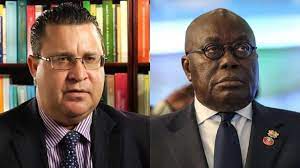
    Hage and Martti


    Namibian President, Hage G. Geingob, eulogize the passing away of Finland President H.E. Martti Ahtisaari.


    He described him as a ‘friend of the Namibian liberation struggle’.


    Marti Ahtisaari passed away on October 16, 2023.


    Below is the full statement published by the Namibian President:


    “I have learned with utmost sadness about the passing of the former President of Finland, H.E. Martti Ahtisaari, a friend of the Namibian liberation struggle and a leading peacemaker who played through the United Nations a pivotal role in midwifing the birth of a new Namibia.


    The history of Martti Athissari is incomplete without Namibia, a country he was associated with in the many roles that he occupied.

    First through his appointment as a senator to the Council of the United Nations Institute for Namibia (UNIN)  in 1975,  a position which later led to his appointment in 1978 by United Nations Secretary General Kurt Waldheim as the Special Representative of the Secretary General for Namibia.


    In 1989, he was appointed by the United Nations Secretary General to assume the difficult task as the leader of the United Nations Transition Assistance Group (UNTAG) in Namibia, which was globally hailed as a model in dealing with complex transitions from conflict to peace.


    Major parts in the history of Namibia would be incomplete without the name of former President Ahtisaari. As a Fin, former President Ahtisaari understood fully our quest for freedom and justice. Therefore, in the roles of diplomat, negotiator, peacekeeper and blue helmet, former President Ahtisaari served the Namibian people who were seeking self-determination and justice with flying colors. As an icon in the imagination of the Namibian people, President Ahtisaari was inscribed as an honorary citizen of the Republic of Namibia, with streets and schools having been named after him in remembrance and in celebration of his exceptional deeds in the birth of a free Namibia.


    Therefore, today, we are not only mourning the loss of former President Ahtisaari, a friend and one of us, but we are also reaffirming the rich legacy of peace and the outstanding international public service of a Nobel peace laureate with an indelible association with Namibia.


    On behalf of the people and the Government of the Republic of Namibia, I wish to extend sincere condolences to the Ahtisaari family and our sister country, Finland.


    May His Soul Rest in Peace.”


    Hage G. Geingob

  • Ghana Muslims demand international sanctions against Israel; to picket in regional capitals

    Ghana Muslims demand international sanctions against Israel; to picket in regional capitals


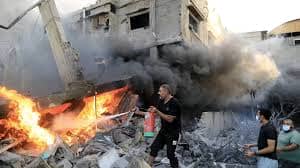
    Gaza destroyed


    Adnan Adams Mohammed 


    Coalition of Muslim Organisations, Ghana(COMOG) has express resentment against the precarious attacks on the people of Palestine by Israeli. 


    The Group says current happening at Gaza must be of grave concern to the international community being represented at the UN. 


    COMOG also expressed its disappointment at Ghana’s abstention from the voting on the proposed Russian resolution on Gaza at the UN Security Council on Monday, October 16, 2023. 


    It says, Ghana’s position as issued by the Foreign Ministry coupled with its abstention at the UN Security Council voting is totally at variance with its Foreign Policy.


    What can be more reasonable in such a crucial act of dehumanizatio than calling for a ceasefire, the release of hostages (on both sides), access to humanitarian aid and safe evacuation of civilians in Gaza.


    “We wish to announce to the general public of an impending picketing in Accra and at various regional capitals on Friday 27th October 2023. We therefore call on all peace loving Ghanaians who share in the plight of the Palestinian people to join us in drumming home our demand for a UN intervention to stop the murders in Palestine”, the Group said in a statement issued on Wednesday, October 18th, 2023.


    Below is the statement:


    FOR IMMEDIATE RELEASE

    19th October, 2023


    COMOG CALLS FOR AN INTERNATIONAL SANCTION ON ISRAEL, CONDEMNS GHANA’S ABSTENTION AT THE UN SECURITY COUNCIL VOTING AND CALLS FOR AN IMMEDIATE CESSATION OF DIPLOMATIC RELATIONS WITH ISRAEL


    We the Coalition of Muslim Organisations, Ghana(COMOG) write to express our resentment against the precarious attacks on the people of Palestine by Israeli. This must be of grave concern to the international community being represented at the UN. 


    COMOG is also calling for an Emergency General Assembly Session to be convened immediately to consider taking the appropriate action. It is sad that, “…the world is watching an unprecedented human catastrophe in Gaza” as Antonio Guterres, the UN Secretary General put it a few days ago.


    As an umbrellah organization which treasures peace and security of humanity across the world, with absolute repulsion against the positions of the USA, UK, Germany, France, etc. of the EU, we wish to add our voices to the many other voices calling on the United Nations to take steps to end the senseless destruction of life and property which is being perpetrated on the innocent and defenseless people of Palestine.


    The carnage in Gaza at this time requires responsible and credible leadership from the USA and her EU allies, and sober invocation of UN mechanisms to resolve this over 75-year Palestine-Israel conflict, instead of the USA and her EU allies one-sided solid-rock and unwavering support for Israel, which is rather the aggressor, occupying and oppressing a sovereign state of Palestine.


    Where is the voice and condemnation of the USA and EU allies when over 250 Palestinians have been killed this year before the current escalations, and the Al-Aqsa Mosque, also desecrated by Israel! Where is the moral integrity of the USA and her EU allies in upholding the UN charter that was entered after the WWII to ensure that the world sees peace and justice, ever after! How can Palestinians who are the OPPRESSED not have the right to defend themselves, but Israel the OPPRESSOR rather has the right to defend itself, and that no country or countries, person or persons have the right to go to the aid of the Palestinians who are being oppressed and killed! 

    In such a volatile sub-region, overwhelmed by the activities of terrorists and extremists, it is certainly not advisable for any one country, like the USA and the EU allies, to show open support for the carnage being perpetrated by Israel and not talk about the rights of Palestinians for self-determination, especially when the terrorists across Africa operate in tandem with the Freedom Fighters of the Middle East and Sahel region, Palestine not an exception.


    COMOG wishes to express its disappointment at Ghana’s abstention from the voting on the proposed Russian resolution on Gaza at the UN Security Council on Monday, October 16, 2023. 


    Ghana’s position as issued by the Foreign Ministry coupled with its abstention at the UN Security Council voting is totally at variance with its Foreign Policy.


    What can be more reasonable in such a crucial act of dehumanizatio than calling for a ceasefire, the release of hostages (on both sides), access to humanitarian aid and safe evacuation of civilians in Gaza.


    In conclusion, we wish to announce to the general public of an impending picketing in Accra and at various regional capitals on Friday 27th October 2023. We therefore call on all peace loving Ghanaians who share in the plight of the Palestinian people to join us in drumming home our demand for a UN intervention to stop the murders in Palestine.


    We finally wish to extend our condolences to the bereaved families, while we offer our solidarity and prayers to the people of Palestine. Long live the State of Palestine! Long live the people of Palestine!


    End .


    ………………………….

    Hajj Abdel-Manan Abdel-Rahman

    (President of COMOG)

    Spokesperson: Bro Shamsudeen Shaibu 0244843696


  • ADB with NIB merger: stakeholders slam idea

    ADB with NIB merger: stakeholders slam idea

    ADB and NIB Merger


    Adnan Adams Mohammed 


    Government’s plan to merger two major state banks National Investment Bank (NIB) and the Agricultural Development Bank (ADB)  have met stiff opposition.


    Various stakeholders of the economy disagree with the idea. 


    Latest to contribute to the raging debacle is the Head of the Business School at the University of Ghana, who believes the proposed merger would be economically senseless. The government over the years has been holding onto plans to merge ADB and NIB due to the struggles of the two banks.


    “You cannot put two big banks together,” he said, adding: “Prudent economic management will not allow merging two state-oriented banks”, Professor Laud Mensah said in an interview last week. 


    “Any outcome from the decision-making level is likely to create imbalances in the bank’s balance sheet.”


    Professor Mensah called out the finance minister, who is supporting this initiative, to provide a paper indicating the economic value they intend to generate by allowing ADB to acquire NIB.


    Additionally, he suggested that external funds would be the best way for an economy to divert.


    Professor Mensah stated that if ADB absorbs NIB, their balance sheets would be weakened.


    NIB, being cash-trapped, needs an external investor to inject funds into the bank.


    Already, the Minority in Parliament has expressed its opposition to the government’s plans to either collapse the National Investment Bank (NIB) or merge it with the Agricultural Development Bank (ADB).


    The Spokesperson on Finance, Isaac Adongo, speaking to journalists in Parliament fortnight ago alleged that this plan is merely a smokescreen to sell off the two banks after their merger to government cronies as part of State capture efforts.


    “It is clear that this is not about the interest of NIB. This is the last step towards passing through the back door to acquire NIB and ABD for themselves in a state capture,” he said on Thursday, September 28.


    The Minority has asked the government to pay the debt owed to the bank and further proscribed measures that will make it viable.


    “Government should just restructure the balance sheet of NIB to swap all the NIB debt that it owes to government and give government equity. Government says it doesn’t have money to capitalize the bank, but it has given 500 million debt to NIB, it has given 800 million debt… The two will give you 1.3 billion. It is your money. You owe the bank. The money is already sitting there. Commit to saying that this is my contributing towards capitalisation so that we issue shares to you and move the money to equity.


    Hon Adongo said the move by the imminent collapse and subsequent acquisition by ADB will lead to the loss of about 800 jobs.


    The MP further indicated that contractors NIB engaged to work on government projects are yet to be paid by the Finance Ministry.


    “As a result of that, NIB has incurred GHC1 billion on its loan books, resulting from Ken Ofori-Atta’s refusal to pay, now you say NIB is weak.”


    Also, a banking consultant, Dr Richmond Atuahene, has condemned the proposed merger idea. 


    “I don’t think merging NIB and ADB is solving any problem, it is not a solution at all,” the Consultant reacted to the government idea. 


    He contends that the government should not rush on the matter but take its time to conduct a diagnostic study of the two banks first.


    According to him, the NIB has suffered from corporate government crises in addition to its current fiscal challenges noting that the buildup to the current point started in 2016.


    He added ADB is also going through the same challenges based on a report published in 2022.


    “…ADB does not have the capacity to acquire NIB. He said even if government refinances ADB, it may not be enough to take over NIB’s debts.”


    For this reason, he suggested that both banks – NIB and ADB be recapitalised, explaining that “you don’t bring a weak institution to buy a bad institution. You have what we call a good bank buying a bad bank, there is a theory there but the two of them are not good for anything.”


  • Ghana’s fiscal deficit-to-GDP to improve by more than half in 2023 


    Adnan Adams Mohammed


    Ghana’s fiscal deficit-to-Gross Domestic Product (GDP) ratio is estimated to record 4.6 percent as against 11.2 percent in 2022, International Monetary Fund has predicted.


    This 2023 estimated ratio is an improvement of about 6.6% of the 2022 figure.


    A further reduction in the ratio is expected in the next five year. This follows a significant cut in government expenditure and expected improvement in revenue as announced in the 2023 budget review. The fiscal deficit-to-GDP recorded in 2020 and 2021, were pegged at 17.4% and 12.0% respectively.


    “It is expected to fall to 4.1% of GDP in 2024 and subsequently to 3.5% of GDP in 2025 and 3.0% of GDP in 2026. It will again decline to 2.6% of GDP in 2027and 2.8% of GDP in 2028”, the October 2023 Fiscal Monitor noted.


    “These figures indicate that the government has adopted a tight budget spending in 2023 as captured by the IMF Programme which stresses more on revenue mobilisation.


    “This is also a reflection of the country’s second quarter growth rate where some sub-sectors such as Construction (-11.7%) that rely heavily on government spending contracted.”


    Similarly, the primary balance will fall to 0.5% of GDP, from a deficit of 3.7% in 2022.


    However, in the next five years, the primary balance will record a surplus.


    This is a result of an anticipated strong revenue growth and reduced expenditure in 2023.


    Meanwhile, the Fund has revealed that, the 1.2% Gross Domestic Product (GDP) growth forecast for Ghana in 2023 captured in the World Economic Outlook (WEO) was based on old data.


    According to the Resident Representative to Ghana, Dr. Leandro Medina, the Fund would revise the growth rate projection when it receives new data.


    The Resident Representative said the Fund did not take into account the recent data released by the Ghana Statistical Service.


    “In particular, it did not take into account the recent data that showed a higher growth rate than expected at the beginning of the programme (averaging 3.2% for the first two quarters).”


    Dr. Madina argued that “ At the current juncture, and based on the findings of the first ECF [Economic Credit Facility] review, the IMF Staff assessment indicated that the growth projection for 2023 will be revised up from the previous 1.5%”.


    The IMF lowered Ghana’s growth rate to 1.2%, from the July 2023 forecast of 1.6%.


    It was the second time the Fund has revised Ghana’s GDP growth for this year.


    In April 2023, the Fund predicted a 2.8% growth rate for Ghana in its World Economic Outlook (WEO) Report.


    The World Bank had also slightly lowered the country’s growth rate forecast for this year to 1.5%, according to its October 2023 Africa Pulse Report.


  • Ghana to receive $600m disbursement nexmonth… as IMF boss okays review 

    Ghana to receive $600m disbursement nexmonth… as IMF boss okays review 

    IMF boss and Ghana President


    Adnan Adams Mohammed 


    The International Monetary Fund (IMF) has expressed satisfactory of Ghana’s programme during the first review and has assured disbursement of second tranche of US$600m disbursement in November. 


    The Fund noted a significant improvement in the country’s economic recovery programme over the past month.


    Ghana, concluded a Balance of Payment Support of a US$3 billion from IMF in May this year. The debt distressed country is currently undergoing its first programme review, expected to be conclude in November. But, the Managing Director of the Fund in an interview last week noted that, Ghana, which has defaulted on its debt, is making progress under their IMF programme. 


    “Ghana is doing actually quite well. You have seen that their position has improved over the last month, the economy is in a much better place”, Kristalina Georgieva has said. “I would very much hope that we can have the disbursement,” she said referring to a $600 million tranche of IMF money that’s due to be disbursed in November. 


    “That is part of the confidence building that we are projecting,” she said regarding Ghana’s economic stability.


    In her broader remarks, Georgieva identified addressing unsustainable debt crises as a “top priority”.


    She defended the G20 Common Framework for debt treatment, despite criticism for its perceived slow pace in providing relief to applicants.


    Georgieva pointed out that as more nations seek assistance, the process is becoming more efficient, with Chad, Zambia, Sri Lanka, and Ghana demonstrating shorter timeframes for progress.


    Chad took 11 months between an initial staff level agreement to financial assurances, Zambia nine months, Sri Lanka six months and Ghana five months, she said. 


    “I hear lots of people saying, oh this doesn’t work,” she said.


    “My question to them is, ok, you forget about it. What do you have instead?”


    Meanwhile, the Fund noted that, Tunisia doesn’t need a restructuring yet but should act soon to shore up its economy.


    Also, the IMF boss said Egypt will “bleed” precious reserves unless it devalues its currency again, as she praised other steps her institution’s second-largest borrower has taken to right its stricken economy.


    Egypt’s devalued the pound three times since early 2022, with the currency losing almost half its value against the dollar.


    Georgieva said it’s delaying the inevitable by holding off from doing so again and the longer it waits, the worse it will get.


    “The sooner we can reach an agreement on the road map for this the better,” she said.


    “The issue here is very simple. Egypt would bleed reserves protecting the pound and neither the country nor overall the environment is such that this is desirable. That’s a problem that has to be solved.” 


    Egypt’s net international reserves last year fell to the lowest level since 2017 before stabilizing in recent months to reach $35 billion in September — still down by more than a fifth since their 2020 high. 

  • Ghana’s healthcare budget to balloon by $1.3 billion more in 2024

    Ghana’s healthcare budget to balloon by $1.3 billion more in 2024


    Healthcare


    Adnan Adams Mohammed


    Government of Ghana’s financing of healthcare from consolidated revenues contributed 67.5 percent  to the Ministry of Health budget in 2022, according to the ministry’s data. 


    The funds for the health system come from non-tax revenues, taxes, donor contributions, and out-of-pocket payments by individuals and households.


    Consequently, external assistance for health as a share of total health spending between 2015 and 2019 has decreased from 25% to 11%. 


    Meanwhile, an international investment firm and rating agency, Fitch Solutions, has projected an increased in government of Ghana spending by about $1.3 billion in 2024. 


    According to the UK firm, Ghana’s health budget is expected to expand to ¢16.5 billion in 2024, from ¢15.2 billion in 2023. However, the country’s poor fiscal space outlook in addition to factors such as fiscal capacity deficits, debt and relatively low prioritization of health does not create a bright picture for sustained financing for primary health care. All these notwithstanding, the Universal Health Coverage (UHC) roadmap aims at mobilizing the equivalent of at least US$7 billion over 10 years in non-wage-resources including GDP allocation for healthcare delivery, especially primary health care. 

    Healthcare system

    This requires significant policy measures to facilitate a transition process from previously supported donor interventions to sustainable domestic public financing of interventions. 


    Fitch further indicates that, from its projected figures, the cost elements to benefit more will be the medical device market due to increasing government spending on health and economic recovery over 2024. 


    “We believe ongoing health infrastructure projects and rollout of the National Health Insurance Scheme will continue to support increased budgetary spending on health over the coming decades as well spending on pharmaceuticals and medical devices”, Fitch Solutions said in its new release. 


    “We further highlight recovery in Ghana’s real Gross Domestic Product in 2024 after sharp declines in 2022 and 2023 will also support private spending on medical devices and medical devices imports in the country over our forecast period.”


    GDP forecast 


    “We forecast real GDP growth to accelerate to 3.7% in 2024 from an estimated 3.0% in 2023. However, GDP will remain below the five-year pre-pandemic average of 5.3% as a result of strong price pressures and fiscal consolidation”, the UK based firm added.


    Medical devices market to record double digit growth


    In terms of the medical devices market, it said all product categories will post high to double digit growth in US dollar terms, led by consumables and dental products.


    Consumables accounted for more than a quarter of the total medical devices market in Ghana, and the category is expected to record the fastest Compound Annual Growth Rate (CAGR) growth of 21.3% in US dollar terms over our five-year forecast period to 2027.


    “We believe growth in consumables over the near-to-medium-term will continue to be supported by improving access to healthcare in Ghana as the country continues to implement its universal health coverage goals”, it pointed out.


    “While accounting for the smallest portion of the medical devices market, dental products will record a 2022-2027 CAGR of 21.1% in US dollar terms. Dental services such as tooth replacement and filling, root canal therapy, dental X-ray and scaling are provided free of charge in the public health sector in Ghana, however access remains limited in rural areas due to a shortage of equipment and trained dentists”, it furthered.


    Fitch Solutions said demand for diagnostic products is also expected to remain strong as the market copes with prevention and treatment with the double burden of chronic and communicable diseases. 


    Strategic Purchasing for Primary Health 

    Care in Ghana


    At the recent held Ghana’s Health Sector Annual Summit 2023 in Accra, in June this year, it was confirmed that, the National Health Insurance Scheme (NHIS) is the main source of financing primary health care services in Ghana. The Scheme purchases health services for its members from over 4000 accredited healthcare providers. 


    In 2020, the Scheme spent GH₵ 2.39 billion (approximately USD 408 million) on healthcare providers’ claims. Outpatient care accounted for the largest share of NHIA spending, with GH₵ 1.37 billion (approximately USD 235 million), representing 57.3%. The NHIA has set provider payment rates for healthcare services, which are negotiated annually with healthcare providers. 


    Available evidence suggests that since the implementation of the NHIS in 2003, the NHIA has employed different payment models, including fee-for-service (FFS) and diagnosis-related grouping (DRG), and piloted the capitation method. However, the scheme continues to face some challenges, including the following: 

     Exclusion of some preventive, health promotion, and specialized services: The NHIS does not cover all health services, and this leads to 

    patients paying out-of-pocket for the excluded services.


    Sustainable Financing for Primary Health Care towards Attainment of Universal Health Coverage In Ghana:


    Over the last three decades, the health sector has implemented interventions to improve services at the Primary Health Care (PHC) level, for example, the Community-based Health and Planning Services (CHPS) concept. 


    Recent interventions to reorganize PHC services for further improvement in health outcomes include:1) development of the Essential Health Services Package; 2) revision of the incentive package for health professionals in rural areas; 3) introduction of the Network of Practice; 4) implementation of framework contract for tracer medicines; and 4) scaling up of the last 

    mile distribution of essential medicines and other commodities. 


    However, efficient allocation of resources to finance these interventions to realize 

    the desired outcomes is a challenge confronting the stakeholders.


    There has not been a dedicated source of funding for PHC services over the years. Funding for PHC services is uncoordinated, leading to wastage, 

    low service coverages, and poor health outcomes. Although the NHIS pools funds for purchasing PHC for the population, some PHC services are 

    not covered by the scheme, for example, health promotion and other preventive services. In addition, the effective use of these resources has 

    been a concern by many health sector actors. Lately, there has been a call by stakeholders to increase resource allocation to finance services at the PHC levels towards the realization of UHC.

  • PRINPAG National Executives visit Algerian Ambassador to Ghana 


    PRINPAG and Algerian Ambassador to Ghana

    The National Executives of the Private Newspapers and Online News Publishers Association of Ghana (PRINPAG) have met with the Algerian Ambassador to Ghana, His Excellency Ali Redjel in his office in Accra.

    The meeting, which was at the invitation of the Ambassador, was to discuss how PRINPAG can support the Algerian Embassy to deepen bilateral relationships between Ghanaian and Algerian journalists.

    Edwin Arthur and Algerian Ambassador to Ghana

    Among others, the Ambassador highlighted the importance of the media in all walks of life, including foreign relations and diplomacy. He said the media is a powerful tool that, when properly resourced, could support the development agenda of every institution through the dissemination of accurate news and information.

    According to him, the Embassy is interested in creating a lasting relationship with the media in Ghana and sees PRINPAG as a strategic partner that can contribute to the dissemination of accurate information, hence the meeting.

    Jorge Wilson and the Algerian Ambassador to Ghana

    He highlighted the historical and cultural ties between Ghana and Algeria, dating back to the independence struggles of both countries.

    In his remarks, President of PRINPAG, Andrew Edwin Arthur, who led the five-member delegation, lauded the initiative and assured that, the Association stands in readiness to project accurate news on Algeria.

    He sought the support and guidance of the Algerian embassy to access credible sources and contacts in Algeria for professional exchange programmes.

    PRINPAG agreed to support the Algerian embassy for good collaboration.

    The Embassy has agreed with the proposal to facilitate the formation of a partnership between PRINPAG and the Algerian Press Service (APS) for the exchange of news and information about Ghana and Algeria for the development of both countries in all sectors and on African issues.

    This would culminate in training and exchange programmes with Algerian journalists so as to learn from their best practices and experiences, among others.

    There would also be a deliberate promotion of accurate and balanced reporting on the bilateral relations between Ghana and Algeria, especially in the areas of economic, trade, investment, agriculture, infrastructural development and cultural exchanges.

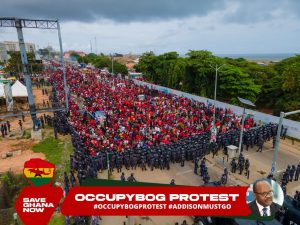
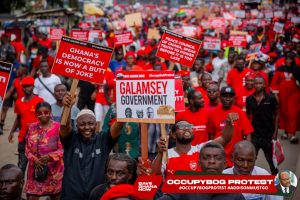
  • OccupyBoGProtest in pictures

    The long awaited event led by the Minority in Parliament took place yesterday, Tuesday October 3, 2023.


  • Reopened DDEP: Gov’t expresses satisfaction for securing GH₵3.9bn


    Reopened DDEP: Gov’t expresses satisfaction for securing GH₵3.9bn


    Adnan Adams Mohammed 


    The government has successfully secured GH₵3.9 billion as at end of the reopened domestic debt exchange programme which ended last week.


    According to a statement issued by the Finance Ministry, no further tenders will be accepted, and neither revocations nor withdrawals will be permitted. The domestic debt exchange initiative is an integral part of the government’s broader strategy to alleviate its debt burden and enhance debt sustainability.


    “The Government deeply expresses its appreciation to bondholders and key stakeholders for their immense support of the Domestic Debt Exchange Programme (DDEP), the results of which constitute a significant achievement for the Government to implement fully the economic strategies in the post-COVID-19 Programme for Economic Growth (PC-PEG) during this current economic crisis”, the statement noted.