President-elect John Dramani Mahama has raised alarm over the deteriorating state of the Electricity Company of Ghana (ECG), citing unsustainable technical and commercial losses exceeding 32%.
Describing ECG’s current governance as deeply flawed, Mahama expressed concern over the impact of these losses on the nation’s energy sector. “ECG’s governance is in a very bad way, and they are making commercial and technical losses of more than 32%,” he stated.
Mahama warned that if the challenges facing the ECG are not addressed promptly, they could undermine key economic recovery initiatives, including the debt exchange programme and the ongoing International Monetary Fund (IMF) agreement.
“The energy sector can derail everything that we have done with regard to the debt exchange and the IMF programme because debt continues to pile up there,” he cautioned.
Highlighting the urgency of the situation, Mahama stressed the need for reforms across the electricity value chain to ensure the sector’s sustainability. He noted that no utility company could remain viable while incurring such significant losses.
“No utility company can survive with 32% of technical and commercial losses and continue to be a viable utility,” Mahama remarked.
The President-elect called for decisive action to stabilize the energy sector, reduce losses, and secure Ghana’s energy future. He emphasized that reforms were essential to safeguard the sector and sustain its contribution to the nation’s development.
With these remarks, Mahama signalled his administration’s commitment to addressing the challenges in Ghana’s energy sector as a priority upon taking office.
Ghana’s energy sector remains under pressure as the International Monetary Fund (IMF) highlights persistent challenges and calls for urgent reforms under the Energy Sector Recovery Programme (ESRP) to restore fiscal stability.
In its latest staff report, the IMF revealed that Ghana’s energy sector deficit for 2024 exceeded expectations, widening by 0.6 percentage points of GDP and further straining public finances.
Persistent inefficiencies, particularly the Electricity Company of Ghana’s (ECG) failure to effectively implement the Cash Waterfall Mechanism, have worsened arrears owed to Independent Power Producers (IPPs) and fuel suppliers.
Despite these challenges, the IMF expressed optimism about forthcoming reforms. A draft energy sector strategy aimed at cutting operational costs and boosting revenue collection is expected to be finalised by June 2025 and approved by Cabinet by September 2025.
To address the sector’s vulnerabilities, the IMF proposed key medium-term measures, including:
Debt Audits: Completion of legacy debt validation audits for 2023 and 2024 by March and August 2025, respectively.
Tariff Reforms: Quarterly tariff adjustments under the Public Utilities Regulatory Commission’s (PURC) 2022-2025 Electricity and Water Major Tariff Review, backed by technical analyses to ensure financial sustainability.
Operational Review: A thorough assessment of inefficiencies across the energy sector to be led by PURC.
As part of immediate steps, a 3% average electricity tariff increase introduced in October 2024 is already in effect to address growing losses.
The IMF report noted that as of December 2023, energy sector arrears, including legacy debts, stood at USD2.1 billion, equivalent to 2.8 per cent of GDP.
The IMF cautioned that the energy sector remains a significant fiscal risk, warning that “timely implementation of these reforms is essential to mitigating vulnerabilities and achieving sector stabilisation.”
From January 7 next year, President Mahama returns to take over the reins of government, having received an overwhelming endorsement and the biggest presidential and parliamentary win in the country in over two decades.
This historic win strengthens the hands of the former president and comfort him to initiate and implement far-reaching reforms and policies to reset the nation in the direction it so much desires.
What the former legislator and vice president does with the next four years will add to or subtract from his oozing legacy and the stature of the National Democratic Congress (NDC) in Ghana’s democratic dispensation when he retires from active politics.
This is why the team he assembles to help him prosecute the agenda is critical. Conscious of the huge expectations from the citizens and the leadership gap the country suffered over the past eight years, President Mahama needs to be surrounded by leaders of merit who are conscious of the NDC’s socialist ideals and the need to quickly improve lives for all, not a few.
These team members must be people who exude confidence, engender trust and are pragmatic in their actions and thoughts.
He needs leaders with adequate foresight, adept in Ghana’s peculiarities and knowledgeable in the global architecture to quickly harness opportunities into results for the people.
These people must not just be technocrats but well blended in specialty and politics to meet the aspirations of the various stakeholders at play.
Economic performance
In Ghana as is the case elsewhere, the success or otherwise of a president and a government in general is dependent on how the economy performs. Needless to say Ghanaians booted the Akufo-Addo-Bawumia government out due to their poor showing on the economy over the last eight years.
Thus, for JM v.2 to succeed, President Mahama must have a finance minister that tick all the boxes. As the national purse keeper, the finance minister must be someone the president trusts.
He/she must have integrity and aura, commanding the respect of the government and the party and attracting confidence from global partners like the IMF, World Bank, investors and diplomats.
The person must not be tainted and the resume and achievements must precede him/her. Importantly, the person must be politically correct, meeting the power balance in the party and gelling well with its hierarchy and the base.
The options
Since the December 8 declaration, various names have popped up as potential fiance ministers.
Among them are former Finance Minister, Seth Terkper, former deputy Finance Minister and current NDC Leader in Parliament, Dr Casiel Ato Forson, MP for Bolgatanga Central and Ranking Member on Parliament’s Finance Committee, Isaac Adongo, and the Chairman of the Public Accounts Committer, James Klutse Avedzi.
Former deputy Finance Minister, Mona Quartey’s name has also come up as a potential finance minister.
While each of these merits the speculation around them, it is only one who will be selected and the appointee must fit the bill as explained above and even more.
Pros and cons
Mr Terkper is a fine technocrat whose tax and IMF backgrounds were evident in the economy in President Mahama’s first term.
His current comments on critical issues like economic growth and the free senior high school policy, however, leave much to be desired. This creates the impression that he falls short of the fine balance needed by a finance minister as far as blending specialty with politics is concerned.
Then come his two deputies, Dr Forson and Madam Quartey. As stock of the Terkper regime, one wonders if they possess the air of confidence and clout a finance minister at this critical juncture must have.
Dr Forson’s case is complicated by his persecution by the outgoing Akufo-Addo-Bawumia government and his origin from the Central Region.
As the region with Ghana’s first woman Vice President-elect, where the NDC’s performance has not been smooth, one wonders if he meets the political balance required at a time appointments must be strategic.
Capacity and competence are also key, conscious of the heap of challenges a finance minister will confront.
The fine blends
How about Messrs Adongo and Avedzi?
As seasoned finance legislators from the NDC’s traditional strongholds, either of fits the bill.
Their experiences in public finance, systems and economic management make them a great pick for the role at a time when pragmatism rather than theory is needed to stabilise and reboot economy.
Each has exhibited high professionalism in their fields, holding the government to account and exciting the base of the party in the lead up to the resounding victory.
They have integrity and are closely associated with JM, which are critical attributes of a finance minister.
Thus, as the lobbying continues, the appointing authorities need to look beyond names into capacity and track record. There is also the need to meet regional balance in the power distribution though that should not lead results being sacrificed.
The JM v2 is critical to Ghana’s survival, President Mahama’s legacy and the NDC’s progress. Who becomes the finance minister will be critical in how President Mahama meets these expectations.
President-elect, John Dramani Mahama’s promise to cut or abolish a number of taxes in his 120days governance faces mixed concerns from the public.
While other stakeholders of society uphold that, it is unrealistic for the next Mahama’s administration to cut or abolish some of the taxes; that is, e-levy, the COVID levy and the 10% levy on sportbets as it will affect the economy while affecting the moral standard of the young population. Some economists believes otherwise.
An Economist, Dr Theo Acheampong has stated that there will be minimal impact on public finances when the e-levy and Covid levy are removed. In his analysis of these two taxes, he explained that together, they raised GHS3.259 billion or USD 296 million in 2023, accounting for 2.4% of total domestic revenue or 0.4% of Ghana’s 2023 Gross Domestic Product (GDP).
“These two taxes can easily be scrapped. In my view, scraping them would have a limited impact on public finances but bring significant relief to many citizens and businesses,” Dr Acheampong shared on his social media handle.
However, the Institute of Community Sustainability has said that sports betting threatens the well-being of Ghana’s youth. According to the Institute, the proliferation of sports betting, particularly among young people, has reached alarming proportions hence their call to the government to consider increasing the betting tax to 50% from the current 10% to curb this menace.
President-elect Mahama, during the campaign towards 2024 elections promised to scrap sports betting tax and others.
“First is resetting the economy for prosperity. In the first 120 days in office, we will hold a national economic dialogue to draw up a four-year fiscal consolidation plan. We would rationalize taxes, abolishing among others the obnoxious e-levy, the COVID levy and the 10% levy on bets winning.”
However, a s statement issued by the Executive Director of Institutes of Community Sustainability, Eric Jerry Aidoo, said that the current state of sports betting in Ghana is worrisome. Many young people are spending an inordinate amount of time and money on betting platforms, with some staking 50% of their winnings only to lose it all again.
According to the Institute, “This vicious cycle of betting and losing is not only draining the financial resources of our youth but also eroding their productivity and potential.
“If left unchecked, this betting epidemic could have severe consequences for our society. Desperate individuals may resort to crime, such as robbery, to fund their betting habits. Companies may also suffer as employees squander their salaries on betting, leading to financial losses and decreased productivity.”
In contrast, advanced countries have recognized the dangers of betting addiction and have established rehabilitation centers to provide support and treatment to affected individuals. Unfortunately, Ghana lacks such facilities, with only five psychiatric hospitals available, which are not even up to standard.
“Increasing the betting tax to 50% would be a bold step towards addressing this issue. The revenue generated from this tax could be channeled towards establishing rehabilitation centers and providing support services for individuals struggling with betting addiction”, the Institute posited.
Moreover, a higher betting tax would also serve as a deterrent to young people who are tempted to indulge in sports betting. By making betting more expensive, we can reduce its appeal and encourage our youth to seek more productive and fulfilling pursuits.
Consequently, another analysts, Chief Executive Officer of Dalex Finance, Joe Jackson, raised concerns about how the incoming Mahama administration will generate revenue for development if it removes all the taxes it has promised to abolish.
Jackson highlighted the significant challenges in managing the economy, particularly with the manifesto pledge to remove certain taxes, including the e-levy.
“Let us not be mistaken, in 2025, we have to look at how we are performing in terms of revenue because some of the items are going to go out. There has been a manifesto commitment to take out the e-levy, betting tax, the COVID levy. So a lot of issues are going to come out and I have no doubt in my mind that the challenge is going to be huge”, Dalex CEO said during a TV conversation.
“So, let’s focus on the E-levy and COVID-19 levy, two consumer taxes that irk many Ghanaians and for which both the NDC and NPP promised to do something about, besides other tax handles.
Deloitte West Africa has raised concerns over the surge in inflationary trend in the last quarter of 2024 in Ghana and Nigeria.
This, the professional accounting firm believes could affect the rate of economic growth in both West African economic giant nations as a further surge is expected in December due to the Christmas and new year festive spending.
“The resultant of rising inflation is that, businesses face higher costs while consumers have to cut spending, worsening the ongoing cost of living crisis”, Deloitte, the globally acclaimed professional services firm, shared in its November 2024 Inflation Update.
Already, inflation in Ghana surged for the third-consecutive month to 23%, driven by rising food prices and election spending.
Headline inflation in Nigeria also rose to 34.60%, reflecting a further increase in the cost of goods and services.
Also, the Economist Intelligence Unit has projected an average inflation rate of 22.4% for Ghana and 33.2% for Nigeria in 2024.
This is expected to decline to 15.2% and 27.7% in 2025 for Ghana and Nigeria respectively, supported by improved foreign exchange stability, trade policy and base effects.
Ghana’s November 2024 inflation was driven by five divisions. They were led by Alcoholic Beverages, Tobacco and Narcotics (30.0%); Housing, Water, Gas and Electricity (29.20%) and Health (22.20%).
A near fatal accident occurred today some minutes after noon today at Tarkwa Astoria junction.
A Rhino truck, heading towards market circle run into on coming traffic from the market circle going towards Kar Kwano.
The truck which lost break control run into an onwards tricycle (aboboyaa) which was first in the traffic pushing it to hit three other salon cars.
The tricycle was damaged beyond repairs, however the operator escaped unhurt.
The truck
Unfortunately, a passenger in one of the affected cars suffered minor injury on her limbs while they tried to rush out of their cars.
Ella, the injured passenger, narrated to the reporter at the scene of accident that, “we were in our taxi going home, but all of a sudden we saw the truck coming towards our lane descending the hills sloping down towards Astoria. The truck hit the aboboyaa then the aboboyaa came back and hit the cars following it.”
This caused a massive traffic on the busy stretch of the road as there were no police officers around to direct and control traffic.
Whiles we at Economy Times congratulate you, President-elect H. E. John Mahama, there is no doubt that your second coming victory is historic, yet, it is not a loud chorus of unwavering love for your person or policies.
It is, rather, a stark indictment of the current administration’s failures. The electorate has handed you the reins, not out of romantic nostalgia for the days of dumsor or a craving for infrastructural debates, but as an act of desperation. The people’s fury at corruption, mismanagement, and unfulfilled promises has channeled their votes your way.
This is not blind faith; it is an act of protest. You, Mr. President, are the beneficiary of their anger and hope for redemption. The stakes could not be higher.
Your previous tenure was not without its missteps. The tag of “incompetence” haunted your administration, a label your political opponents wielded skillfully. Yet, time, as the wise say, is the ultimate arbiter. The very failings that once defined you have been dwarfed by the abyss into which the outgoing administration plunged the nation. From the depths of economic crises to the erosion of public trust, the bar was lowered to an unimaginable level, painting you as a saint by comparison.
But sainthood, however undeserved or thrust upon, comes with expectations. This second chance is not a blank check. It’s a lifeline cast by a disillusioned populace, a mandate to not only right the wrongs of the present but also to prove that you are not the man many once doubted.
This mandate is not yours to squander, Sir. Every step you take, every policy you roll out, will be scrutinised in a harsh light. The people are not looking for excuses or passing blame—they want results. The fight against corruption must be more than lip service; it must be swift and decisive. The economy, battered and bruised, needs urgent intervention. Jobs must be created, systems repaired, and confidence restored.
Your party, too, must recognize its position. This victory is not a ringing endorsement of its ideals. It is a second chance to rebuild a relationship with the electorate. The voter who queued in the blistering sun to make their voice heard did so not out of loyalty to your colors but out of desperation for something better.
Your redemption story is already being written, but the ending remains uncertain. Will you rise to the occasion, using this second chance as a springboard for greatness, or will history repeat itself in a tragic loop? The Ghanaian people have shown remarkable resilience and patience, but that patience is finite.
The National Chairman of the National Democratic Congress described the situation at some constituencies collation centers where parliamentary results are being recollated as illegal.
Indicating that, in most of the recollated results, there were no consensus either among interested parties.
The NDC cautions that, as parties are capable of perpetrating fraud, the Electoral Commission is even more capable of perpetrating frauds and therefore reminded the EC officials to be mindful that illegalities are a crime in the country.
“What is happening at the recollation centres is not based on any law or consensus by both parties and the EC”, Johnson Asiedu Nketiah said at a press conference a while ago in Accra.
“We want to call on the Electoral Commission Boss and the police to take note that there are consequences for their actions in the future.”
Regarding the Police depot, Chairman Asiedu Nketiah stated that there was no prior discussion or invitation to the NDC party, and they are not involved. He advised against appearing at the depot, as the process is not agreed upon in law.
“The police are protecting people to perpetrate illegalities by recollating results that they are not mandated to conduct.”
Chairman Asiedu Nketiah further explained the electoral processes as outlined by the constitution and IPAC, as well as the election declaration processes to the press.
“Once parties have pink sheets of tally votes, there is a big problem. The EC boss has the power to pronounce the outcome of the presidential election but has no powers to pronounce or declare constituency or parliamentary elections. It is the ECs at the constituencies that declare and swear in parliamentary results.”
He warned the staff of the Electoral Commission that if they choose to continue with the illegalities, they should be mindful of the consequences in the future.
The Chairman also advised the traditional authorities (chiefs), who are interfering in some constituency results, to stay away from the illegalities. He reminded them that if they present themselves as competitors or contestants, they will be treated as politicians, as the constitution bans chiefs from partaking in active politics.
Chairman Asiedu Nketiah addressed Afenyo Markin, saying that the NDC needs no lectures on democracy from him. Instead, they will allow him to lecture them on impunity. He warned that anybody using the arms of government to perpetrate illegalities will face the consequences when the NDC takes over on January 7, 2025.
Following the victory of John Dramani Mahama at Ghana’s presidential polls conducted on December 7, and the majority in Parliament won by the political party he leads, the National Democratic Congress, Ghanaians are now gearing up for the socio-economic reset that he promised during his election campaign. The electorate has given them a clear mandate to effect the changes they have promised. This mandate is reflected in voting patterns for both the Presidency and for the legislature.
Based on his election campaign promises and the NDC’s manifesto, Ghanaians are now looking up to a number of key public policy initiatives being introduced over the coming months – or possibly years – as Mahama will have to overcome severe headwinds to implement his ambitious governance agenda.
At the top of the agenda is President elect Mahama’s flagship initiative for revamping and indeed restructuring the country’s economy altogether – the 24 hour economy initiative which plans to support the introduction of three eight hour shifts per day for factories which have real or potential excess demand for their products. This is to enable such factories produce goods all through the day and night, thus tripling their output. Importantly it also has the potential to as much as triple the jobs available at such factories while also dramatically expanding work openings across the spectrum of support services such as public transport, catering and security which would have to be delivered all through the day and night as well.
But while the target is to triple Ghana’s manufacturing capacity in certain industries, by meeting demand for certain goods and services and replacing certain types of imported products with locally produced ones as well, there will be certain constraints to the potentials of this policy in the early stages. This is because some industries do not have any where the installed capacity to operate three shifts a day especially with regards to storage and distribution, and some industries that do have the requisite capacity will find it difficult displacing imported alternatives that are cheaper and have perceived higher product quality. Besides, putting the requisite transportation, distribution, storage and other business support services, will be challenging and thus cannot be done overnight.
Therefore, the electorate will have to exercise patience while the logistical issues are sorted out and the enterprises that sign up to the initiative ramp up their production, distribution and sales infrastructure, which will take several months and indeed, for some, possibly more than a year. Government services that are currently still offered at subsidized rates will be even harder to bring into the 24 hour economy framework because of the State’s financial constraints.
While voters can be expected to understand this and give the incoming new Mahama administration some time to get the implementation up and running, there are several other key initiatives on which they will expect much quicker action. For instance Mahama will be expected to immediately pursue direly needed tax reforms in the form of the removal of the e-levy, COVID levy and the likes. More challenging but equally desired at the beginning of his term in office will be the establishment of initiatives such as the Women’s Bank and the National Apprenticeship Programme. Furthermore, he will be expected to begin defraying academic fees for first year students in government universities as well, from the beginning of the next academic year in September or October 2025, even as the political opposition will most likely demand increased admissions to state universities just to increase the size of the challenge facing the new government.
At the same time the public will expect to start enjoying free medical services at CHIPS compounds nationwide, based on the NDC’s campaign promises.
For reasons of sheer practicality, the incoming Mahama administration will have to choose its early battles carefully. It has become political tradition in Ghana for a newly elected government to trumpet its achievements during the first 100 days, which is made even more challenging by the facts that most of this period will be spent putting the new administration in place with Parliamentary approval and at the same time a national budget will have to drawn up by March, before the three months financial appropriation, approved by Parliament just after the December elections, runs out.
This is made even more challenging by the fact that the incoming administration is inheriting an International Monetary Fund programme which seeks to apply demand management rather supply side economics as its fulcrum, and the IMF remembers how the last attempt at supply side economic policy, implemented too quickly by the outgoing President Nana Akufo-Addo administration, provided the foundation for the now receding acute macroeconomic crisis that afflicted the country in 2022 and 2023.
Nevertheless Mahama and his economic management experts are confident that the hard won fiscal space created by the painful, and therefore controversial,public debt restructuring exercise, will provide the requisite room to get all these initiatives up and running sooner than later. NDC chieftains claim that they had done the math before making the promises; but past experience has shown that outgoing administrations tend to provide a prettier picture of the fiscal situation than what really obtains.
But the Mahama administration has signed up with the electorate to deliver on its promises and this is what it now has to do.
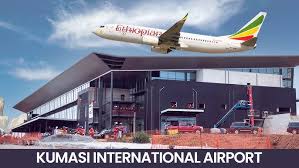
The debut London Gatwick flight to Kumasi direct successfully landed on Friday, December 6, 2024.
Ethiopian Airlines flight ETH8719arrived arrived at the Prempeh I International Airport in Kumasi, having taken off from Gatwick in London marking the very first international flight to land in Kumasi after the domestic airport was remodelled.
In videos on social media, spectators were seen close to the landing site witnessing the historical landing which occured after 10 AM.
Amidst drumming and celebration, traditional rulers were, also, at the airport to receive the travellers.
The flight was initially scheduled for Tuesday, December 3. However, it was postponed due to short notice, according to Ghana Airport Company Limited (GACL).
A return journey is scheduled for Sunday, December 15.