
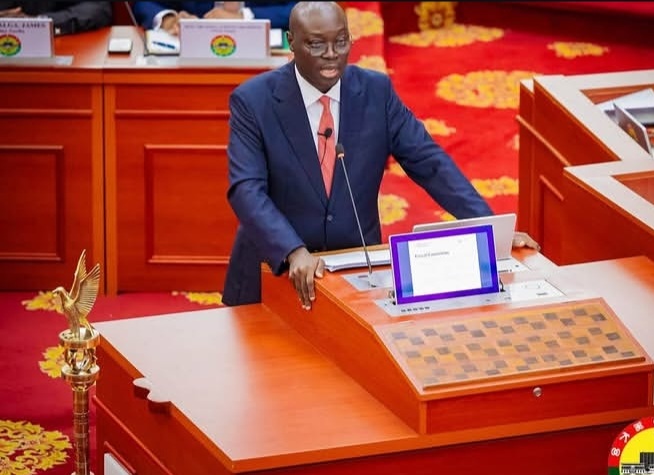
By Adnan Adams Mohammed
Ghana’s economic foundations are now firmly in place, with key performance indicators outperforming full-year targets as the nation prepares to officially wrap up its IMF Extended Credit Facility (ECF) program, Minister for Finance Dr Cassiel Ato Forson has informed Parliament.
Delivering the Mid-Year Fiscal Policy Review on the floor of the House, Dr Forson declared that the macroeconomic stability achieved over the past 18 months proves the foundation of the economy is “solid,” paving the way for sustainable, long-term growth under the leadership of President John Dramani Mahama.
Speaking directly to the nation, the Finance Minister highlighted how fiscal discipline has begun translating into real relief for everyday Ghanaians.
“Mr. Speaker, I now wish to speak directly to every Ghanaian listening to me this afternoon,” Dr Forson stated. “To the market trader whose purchasing power has improved because inflation has fallen. To the entrepreneur who can now borrow at lower interest rates to expand their businesses, and to the worker whose income now stretches further because the cedi has stabilized. These improvements are not abstract statistics; they are the dividend of sound and competent economic management.”
Acknowledging the hardships endured throughout the stabilization process, Dr Forson expressed appreciation for the sacrifices made by citizens while assuring the House of a brighter economic trajectory.
“We recognize that the sacrifices required to restore the economy were significant, and that many households continue to face challenges,” he noted. “But we also know that the foundations of Ghana’s economy are now firmly in place… Under the leadership of His Excellency President John Dramani Mahama, Ghana is not going back; Ghana is moving forward.”
Exit from Bailout Program and Transition to PCI
A major focus of the Minister’s address was the impending conclusion of Ghana’s IMF bailout program and the strategic move toward a non-financing arrangement.
“My Honorable Speaker, next week the Executive Board of the IMF is expected to approve the final review of Ghana’s extended credit facility program, bringing to a successful conclusion the financial bailout program,” Dr Forson announced.
To anchor upcoming structural reforms without relying on fund debt, the government will transition to a 36-month Policy Coordination Instrument (PCI).
“The Executive Board is also expected to approve a 36-month policy coordination instrument, a non-financing arrangement designed for countries that no longer have and are not expected to face balance-of-payment needs,” the Minister explained. “The PCI will anchor our next phase of reforms: strengthening macroeconomic resilience, supporting broad-based growth, and signaling our unwavering commitment to sound and disciplined macroeconomic policy.”
The PCI framework focuses on six key pillars: fiscal consolidation, debt sustainability, governance, monetary and exchange rate frameworks, financial sector stability, and economic diversification. The program includes quantitative goals and 26 reform targets evaluated through semiannual reviews.
H1 2026 Macroeconomic Highlights
Presenting the performance metrics for the first half of 2026, Dr Forson presented figures indicating that major macroeconomic targets had been comfortably surpassed:
Macroeconomic Indicator Target (Full Year 2026) Performance (H1 2026)
Overall GDP Growth 4.8% 6.4% (Q1)
Non-Oil GDP Growth 4.9% 6.3% (Q1)
Headline Inflation 8.0% (±1%) 5.3% (June)
Primary Surplus 1.5% of GDP 0.9% of GDP (On track)
“Mr. Speaker, Ghana has not merely met its first-half year targets; it has exceeded them,” Dr Forson declared. “Overall GDP growth was 6.4% in the first quarter of 2026, well ahead of the 4.8% full-year target… Inflation has more than halved, falling from 13.7% in June 2025 to 5.3% by end of June 2026.”
Concluding his presentation, Dr Forson reiterated that government reforms under the PCI will help restore Ghana’s investment-grade rating and unlock concessional financing for essential public infrastructure.
